A cash transfer plus gender transformative economic empowerment intervention seeking to improve the wellbeing of caregivers of children and adolescents living with HIV in South Africa: a feasibility study protocol for a pilot cluster randomized trial
Darshini Govindasamy, Nwabisa Shai, Nelly Mwandacha, Stanley Carries, Nokwanda Sithole, Kalysha Closson, Arvin Bhana, Lovemore Sigwadhi, Laura Washington, Andrew Gibbs, Angela Kaida

TL;DR
This study tests a program combining cash transfers and gender-focused workshops to improve the wellbeing of caregivers of children and adolescents living with HIV in South Africa.
Contribution
The study introduces a novel gender transformative economic empowerment intervention combined with cash transfers for caregivers of HIV-positive youth.
Findings
The trial will assess feasibility, preliminary effectiveness, and cost-effectiveness of the intervention.
Primary outcomes include psychological wellbeing, depressive symptoms, and gender equality among caregivers.
A qualitative study and economic evaluation will explore participant perceptions and cost data.
Abstract
In sub-Saharan Africa, HIV care is dependent on informal caregiving, typically by female family members. Informal caregiving has been associated with numerous negative effects on caregivers (i.e., depression, intimate partner violence (IPV), financial insecurity). These factors impact caregivers’ ability to provide care and their own wellbeing. South Africa is home to approximately 17% of the world’s children and adolescents living with HIV (CALHIV), making the development of initiatives that mitigate the negative effects of caregiving critical. This protocol details the design of a cluster randomized trial seeking to assess the feasibility, preliminary effectiveness, cost-effectiveness, and acceptability of a cash transfer plus gender transformative economic empowerment intervention for improving psychological wellbeing, depressive symptoms, gender equality, and economic outcomes of…
Genes, proteins, chemicals, diseases, species, mutations and cell lines named across the full text — each resolved to its canonical identifier and authoritative record.
Click any figure to enlarge with its caption.
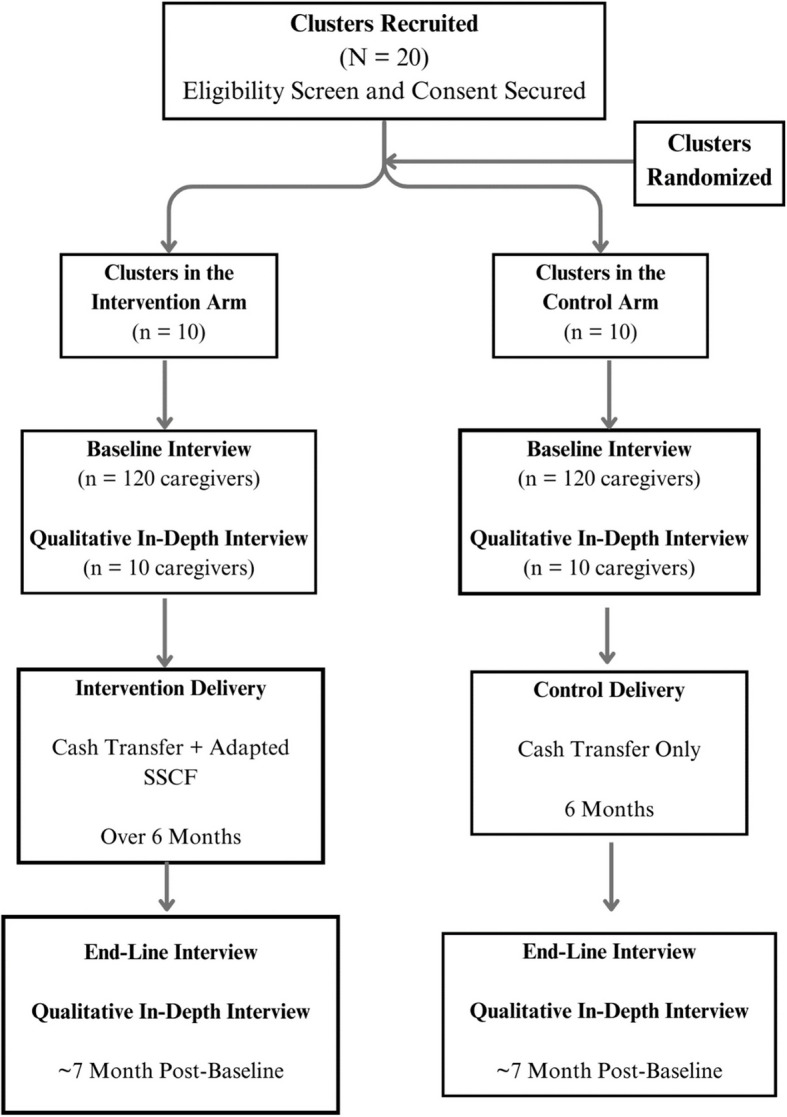 Figure 1
Peer Reviews
No public reviews on file for this paper yet. If you reviewed it on a platform where reviews are public (OpenReview, ICLR, NeurIPS, ICML), you can paste yours below so the community can read it here.
Videos
No videos yet. Explain this paper in a talk, walkthrough, or lecture? Add one.
Taxonomy
TopicsPoverty, Education, and Child Welfare · Adolescent Sexual and Reproductive Health · HIV/AIDS Research and Interventions