Chromosomes of four fishfly species (Megaloptera, Corydalidae, Chauliodinae) from North America
Yoshinori Takeuchi, Koji Iizuka, Tadashi Nakazato, Hiroyuki Koishi, Hidehiro Hoshiba

TL;DR
This study examines the chromosomes of four fishfly species from North America, revealing similarities in their karyotypes and sex chromosome behavior.
Contribution
The study identifies a shared sex-bivalent mechanism in two subfamilies of Corydalidae, suggesting a common evolutionary trait.
Findings
Three western fishfly species have a chromosome number of 2n = 22 with a karyotype of 10 autosomes plus XY in males.
The sex chromosomes of N. serricornis form parachute-type bivalents during meiosis.
The parachute-type Xyp bivalent is found in multiple fishfly and dobsonfly species across East Asia and North America.
Abstract
We analyzed chromosomes of four species of fishflies (Megaloptera: Chauliodinae). Three species were from western North America (Dysmicohermesdisjunctus (Walker, 1866), Dysmicohermesingens Chandler, 1954, and Orohermescrepusculus (Chandler, 1954)), and another one from eastern North America (Nigroniaserricornis (Say, 1824)). The chromosome number of the three western species was 2n = 22, with the karyotype consisting of 10 pairs of autosomes plus XY in males. The X chromosomes of these three species are subtelocentric, while the Y chromosomes are small and dot-like. Of the ten pairs of autosomes, the last pair is substantially smaller than the others. The chromosome number in the first meiotic metaphase in spermatocytes of N.serricornis from Michigan was n = 10 (9 autosomal bivalents + Xyp in the male). The sex chromosomes of N.serricornis formed parachute-type bivalents synchronously…
Genes, proteins, chemicals, diseases, species, mutations and cell lines named across the full text — each resolved to its canonical identifier and authoritative record.
Click any figure to enlarge with its caption.
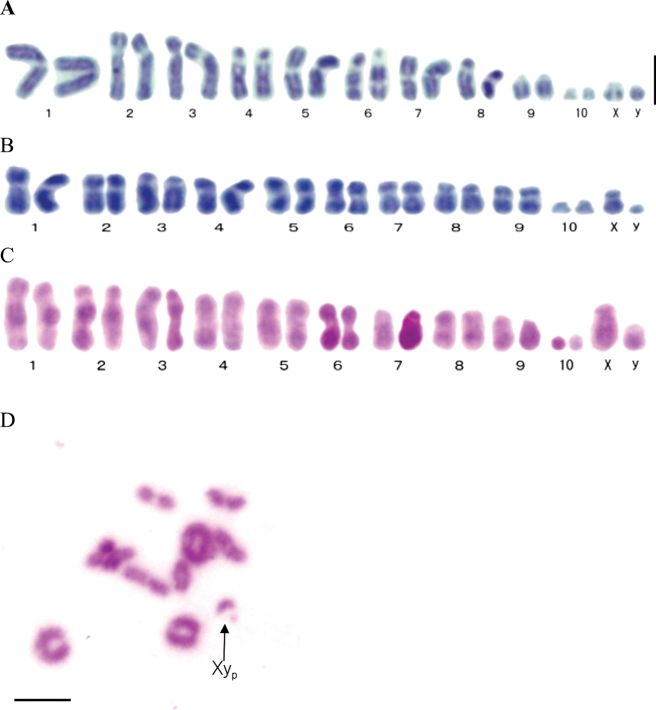 Figure 1
Peer Reviews
No public reviews on file for this paper yet. If you reviewed it on a platform where reviews are public (OpenReview, ICLR, NeurIPS, ICML), you can paste yours below so the community can read it here.
Videos
No videos yet. Explain this paper in a talk, walkthrough, or lecture? Add one.
Taxonomy
TopicsFossil Insects in Amber · Hymenoptera taxonomy and phylogeny · Hemiptera Insect Studies