Modelling the spread of two successive SIR epidemics on a configuration model network
Frank Ball, Abid Ali Lashari, David Sirl, Pieter Trapman

TL;DR
This paper models how two successive epidemics spread through a network, considering that some people might be partially immune after the first outbreak.
Contribution
The paper introduces a novel branching process method to analyze the second epidemic based on the structure of the first.
Findings
A threshold parameter for the second epidemic is calculated using a branching process approximation.
The probability of a large outbreak in the second epidemic is determined based on the first epidemic's structure.
The model accurately approximates outcomes for finite populations, matching known cases from the literature.
Abstract
We present a stochastic model for two successive SIR (Susceptible \documentclass[12pt]{minimal} \usepackage{amsmath} \usepackage{wasysym} \usepackage{amsfonts} \usepackage{amssymb} \usepackage{amsbsy} \usepackage{mathrsfs} \usepackage{upgreek} \setlength{\oddsidemargin}{-69pt} \begin{document}\end{document}→ Infectious \documentclass[12pt]{minimal} \usepackage{amsmath} \usepackage{wasysym} \usepackage{amsfonts} \usepackage{amssymb} \usepackage{amsbsy} \usepackage{mathrsfs} \usepackage{upgreek} \setlength{\oddsidemargin}{-69pt} \begin{document}\end{document}→ Recovered) epidemics in the same network structured population. Individuals infected during the first epidemic might have (partial) immunity for the second one. The first epidemic is analysed through a bond percolation…
Genes, proteins, chemicals, diseases, species, mutations and cell lines named across the full text — each resolved to its canonical identifier and authoritative record.
Click any figure to enlarge with its caption.
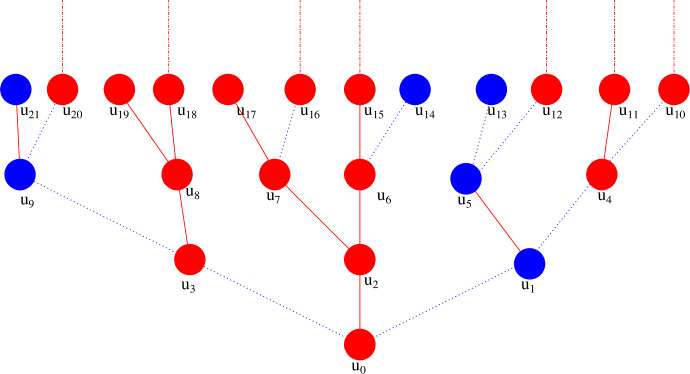 Figure 1
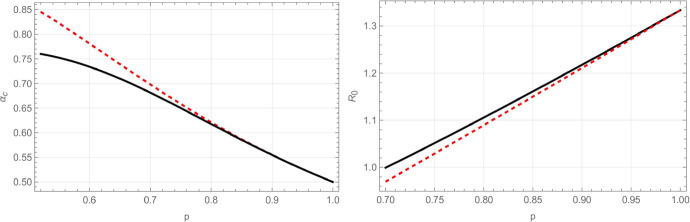 Figure 2
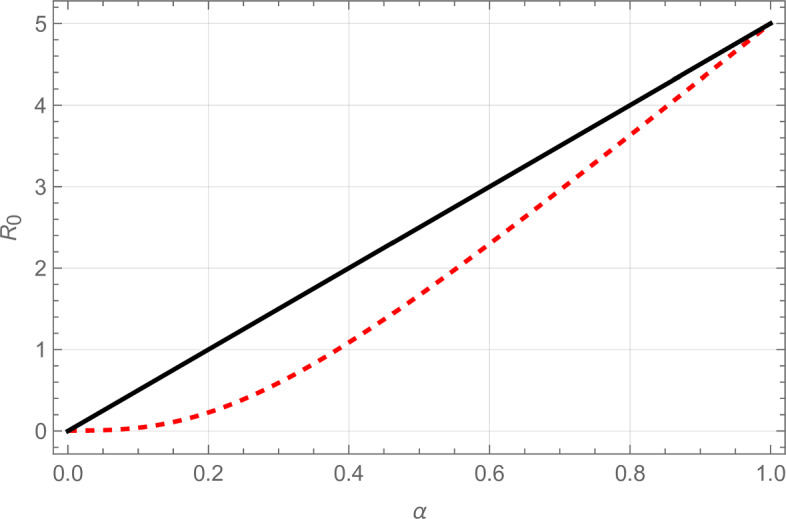 Figure 3
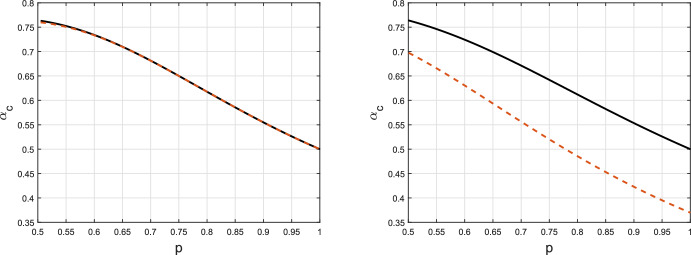 Figure 4
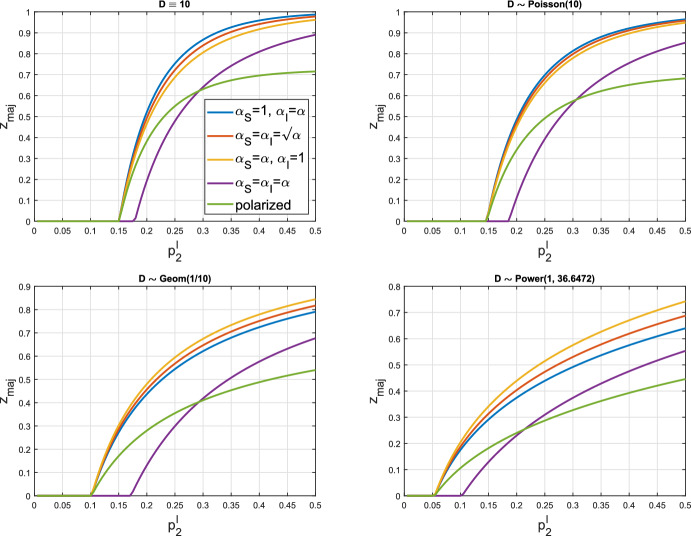 Figure 5
Peer Reviews
No public reviews on file for this paper yet. If you reviewed it on a platform where reviews are public (OpenReview, ICLR, NeurIPS, ICML), you can paste yours below so the community can read it here.
Videos
No videos yet. Explain this paper in a talk, walkthrough, or lecture? Add one.
Taxonomy
TopicsComplex Network Analysis Techniques · Mathematical and Theoretical Epidemiology and Ecology Models · Opinion Dynamics and Social Influence