Key principles to support occupational engagement in mental health inpatient units
Jessica Levick, Kieran Broome, Florin Oprescu, Marion Gray

TL;DR
This paper introduces new principles to support leisure activities for patients in mental health inpatient units to promote recovery and well-being.
Contribution
The paper presents ten evidence-based leisure practice principles for mental health inpatient settings in Australia.
Findings
Ten principles were developed to improve occupational engagement in mental health inpatient units.
The principles integrate salutogenesis and occupational therapy theories to promote recovery.
Abstract
Leisure activity is known to be health promoting and health creating. In mental health inpatient settings, leisure is a common activity that consumers can participate in regardless of their acuity. Leisure can be a powerful therapeutic modality harnessed by the entire multidisciplinary team. The Levick’s Leisure Practice Principles were developed based on the findings of Levick et al., (2022) and piloted with inpatient health staff. This included of seven nurses, one occupational therapist, two psychologists, and two psychiatrists (registrar and consultant). Key evidence informed principles were developed to support occupational engagement in mental health inpatient units in Australia. Ten principles were created to support organisations to improve the quality of their inpatient settings by improving occupational opportunity. Currently no leisure principles exist for consumers to…
Genes, proteins, chemicals, diseases, species, mutations and cell lines named across the full text — each resolved to its canonical identifier and authoritative record.
Click any figure to enlarge with its caption.
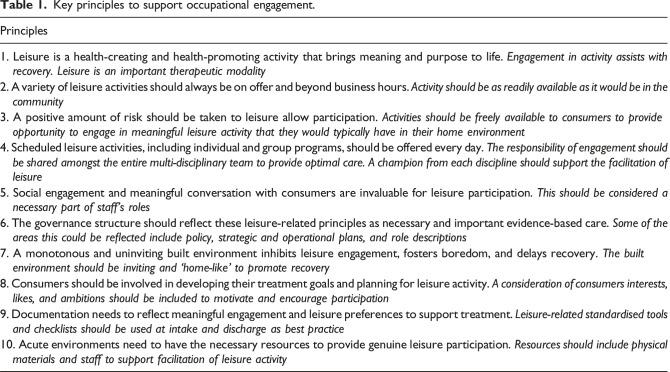 Figure 1
Peer Reviews
No public reviews on file for this paper yet. If you reviewed it on a platform where reviews are public (OpenReview, ICLR, NeurIPS, ICML), you can paste yours below so the community can read it here.
Videos
No videos yet. Explain this paper in a talk, walkthrough, or lecture? Add one.
Taxonomy
TopicsHealth, psychology, and well-being · Childhood Cancer Survivors' Quality of Life · Occupational Therapy Practice and Research