The movement of class: on occupation and everyday mobility patterns in the United States
Karl Vachuska

TL;DR
This paper explores how job types in the U.S. influence people's daily movement patterns using cell phone data.
Contribution
The study introduces a novel link between occupational class and everyday mobility patterns using modern data sources.
Findings
Occupational class strongly predicts mobility patterns in the U.S.
Some occupations are disproportionately exposed to impoverished neighborhoods.
Unexpected mobility patterns are associated with certain occupations.
Abstract
For much of the last century, class analysis has been a major area of sociology and has provided a critical lens through which scholars analyze social stratification. The attributes of certain class positions are of particular sociological interest given their impact on stratification and the possibility of greater inter- and intra-generational mobility. In this work, I explore one perspective of class analysis that has been neglected in the literature: everyday mobility patterns. As a result of the rising availability of rich cell phone data, everyday mobility patterns have become a popular data source for social science research. However, despite the clear theoretical relationship between everyday mobility patterns and class, little sociological research has connected these two concepts. The analysis, set in the United States, indicates that class—specifically, occupational class—is…
Genes, proteins, chemicals, diseases, species, mutations and cell lines named across the full text — each resolved to its canonical identifier and authoritative record.
Click any figure to enlarge with its caption.
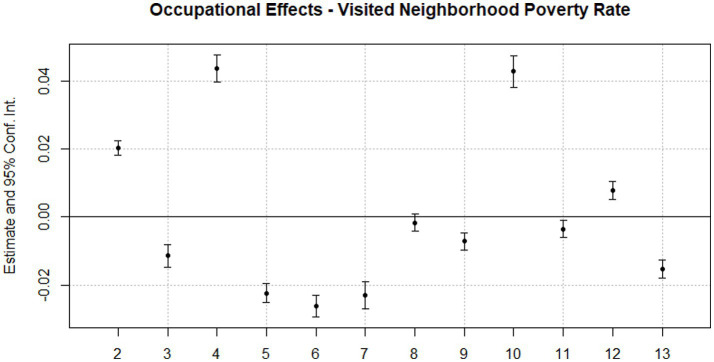 Figure 1
Peer Reviews
No public reviews on file for this paper yet. If you reviewed it on a platform where reviews are public (OpenReview, ICLR, NeurIPS, ICML), you can paste yours below so the community can read it here.
Videos
No videos yet. Explain this paper in a talk, walkthrough, or lecture? Add one.
Taxonomy
TopicsUrban, Neighborhood, and Segregation Studies · Employment and Welfare Studies · Youth Education and Societal Dynamics