Sexual dysfunctions in patients with well-compensated chronic liver disease: role of etiology, Mediterranean diet and quality of life in an observational cross-sectional study
Lorenzo Romano, Mariano Fonticelli, Filomena Morisco, Kateryna Priadko, Alba Rocco, Gerardo Nardone, Luisa Ranieri, Luigi Napolitano, Felice Crocetto, Biagio Barone, Davide Arcaniolo, Lorenzo Spirito, Celeste Manfredi, Antonietta Gerarda Gravina, Carmine Sciorio, Antonio Tufano

TL;DR
This study finds that sexual dysfunction is common in chronic liver disease patients, especially those with MASLD, and is linked to factors like age, diabetes, and quality of life.
Contribution
The study is the first to compare sexual dysfunction prevalence between MASLD and nonMASLD patients and assess the role of Mediterranean diet and quality of life.
Findings
Sexual dysfunction affects 75.8% of chronic liver disease patients, with higher rates in MASLD (89%) compared to nonMASLD (64%).
In males, MASLD and age are risk factors for sexual dysfunction, while physical and mental quality of life are protective.
Mediterranean diet adherence was higher in nonMASLD patients but did not independently protect against sexual dysfunction.
Abstract
Sexual dysfunctions (SD) are highly prevalent in Chronic Liver Diseases (CLD). Whether Metabolic dysfunction-Associated Steatotic Liver Disease (MASLD) carries a higher risk of SD is unknown as is the role of dietary patterns or quality of Life (QoL). to assess (1) prevalence of SD in CLD; (2) whether MASLD is a risk factor for SD; (3) the role of adherence to Mediterranean Diet (MD) or QoL. Observational, cross-sectional study, 207 CLD patients (84 females and 123 males), median age 57 years (IQR:46-63); 96 (46.4%) MASLD; and 111 (53.6%) nonMASLD. SD were assessed through Female Sexual Function Index (FSFI) and International Index of Erectile Function (IIEF) questionnaires. Adherence to MD was evaluated by the MD Score, QoL by SFHS-12 questionnaire evaluating physical [(ie, Physical Component Summary (PCS)] and mental [(ie, Mental Component Summary (MCS)] health. Multivariate…
Genes, proteins, chemicals, diseases, species, mutations and cell lines named across the full text — each resolved to its canonical identifier and authoritative record.
Click any figure to enlarge with its caption.
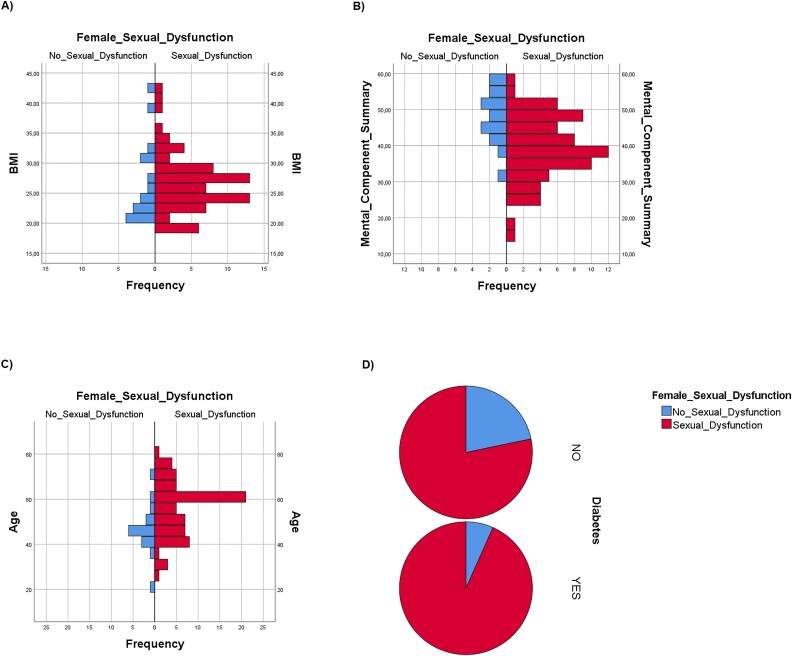 Figure 1
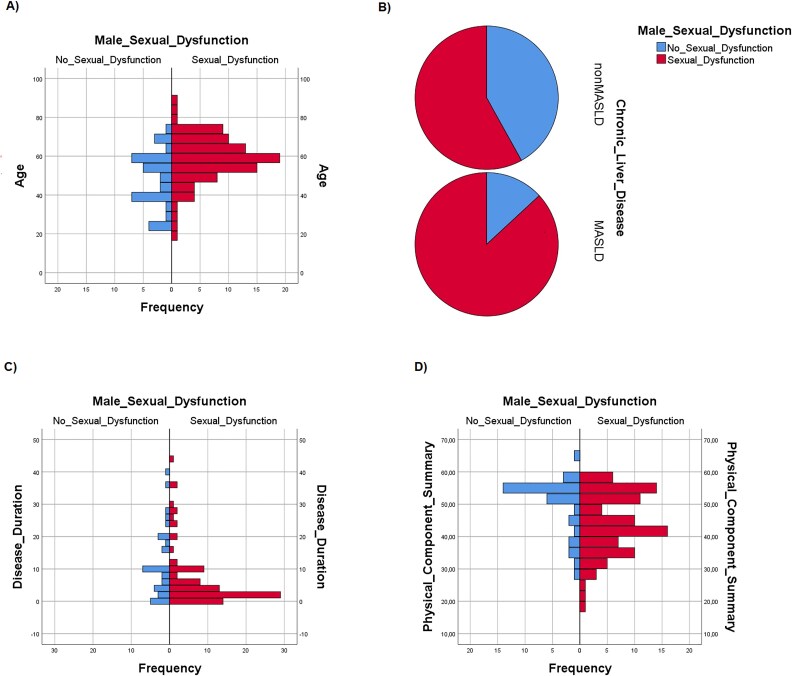 Figure 2
Peer Reviews
No public reviews on file for this paper yet. If you reviewed it on a platform where reviews are public (OpenReview, ICLR, NeurIPS, ICML), you can paste yours below so the community can read it here.
Videos
No videos yet. Explain this paper in a talk, walkthrough, or lecture? Add one.
Taxonomy
TopicsEndometriosis Research and Treatment · Liver Disease Diagnosis and Treatment · Sexual function and dysfunction studies