Common Bacterial Infections in Persons Who Inject Drugs
Michael P. Lorenzo, Kathleen K. Adams, Seth T. Housman

TL;DR
This paper discusses how opioid use has led to increased bacterial infections among drug users and highlights the need for better healthcare approaches.
Contribution
The paper emphasizes the importance of improved pharmacotherapy and management strategies for persons who inject drugs.
Findings
Bacterial infections are common among persons who inject drugs.
There is a disparity in the care received by these individuals, leading to poor outcomes.
Healthcare providers can help by optimizing treatment and management approaches.
Abstract
Opioid use in the United States has increased dramatically. Bacterial infections are common among persons who inject drugs (PWID), and there is a disparity in the care these individuals receive. As such, outcomes associated with these infections can be poor. Healthcare providers can address these disparities through optimal pharmacotherapy recommendations and assistance with changing approaches to the management of PWID.
Genes, proteins, chemicals, diseases, species, mutations and cell lines named across the full text — each resolved to its canonical identifier and authoritative record.
Click any figure to enlarge with its caption.
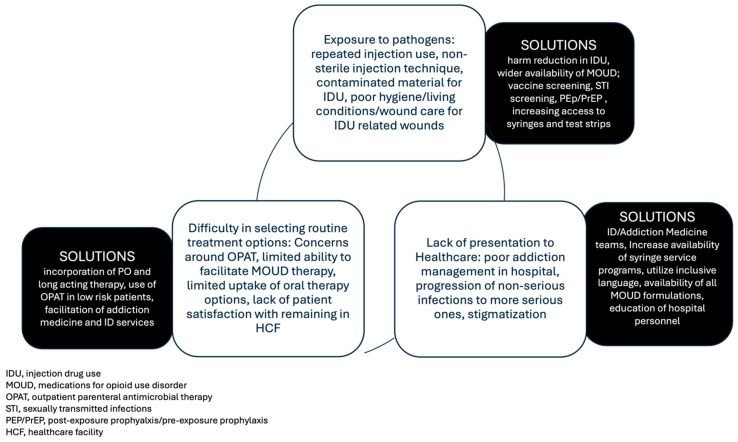 Figure 1
Peer Reviews
No public reviews on file for this paper yet. If you reviewed it on a platform where reviews are public (OpenReview, ICLR, NeurIPS, ICML), you can paste yours below so the community can read it here.
Videos
No videos yet. Explain this paper in a talk, walkthrough, or lecture? Add one.
Taxonomy
TopicsClostridium difficile and Clostridium perfringens research · Antibiotic Use and Resistance · Antibiotics Pharmacokinetics and Efficacy