Exploring Attention in Depth: Event-Related and Steady-State Visual Evoked Potentials During Attentional Shifts Between Depth Planes in a Novel Stimulation Setup
Jonas Jänig, Norman Forschack, Christopher Gundlach, Matthias M. Müller

TL;DR
This study explores how visual attention shifts between different depth planes using brain signals and finds that attentional effects are more evident in later brain responses than in early visual processing.
Contribution
The study introduces a novel experimental setup to investigate attentional shifts in depth using SSVEPs and ERPs.
Findings
Behavioral data showed participants could selectively respond to events at the cued depth.
ERPs like SN and P3b had greater amplitudes for attended events, indicating attentional shifts.
SSVEP amplitudes did not differ between attended and ignored stimuli, suggesting limited depth representation in early visual areas.
Abstract
Visuo-spatial attention acts as a filter for the flood of visual information. Until recently, experimental research in this area focused on neural dynamics of shifting attention in 2D space, leaving attentional shifts in depth less explored. In this study, twenty-three participants were cued to attend to one of two overlapping random-dot kinematograms (RDKs) in different stereoscopic depths in a novel experimental setup. These RDKs flickered at two different frequencies to evoke Steady-State Visual Evoked Potentials (SSVEPs), a neural signature of early visual stimulus processing. Subjects were instructed to detect coherent motion events in the to-be-attended-to plane/RDK. Behavioral data showed that subjects were able to perform the task and selectively respond to events at the cued depth. Event-Related Potentials (ERPs) elicited by these events—namely the Selection Negativity (SN) and…
Genes, proteins, chemicals, diseases, species, mutations and cell lines named across the full text — each resolved to its canonical identifier and authoritative record.
Click any figure to enlarge with its caption.
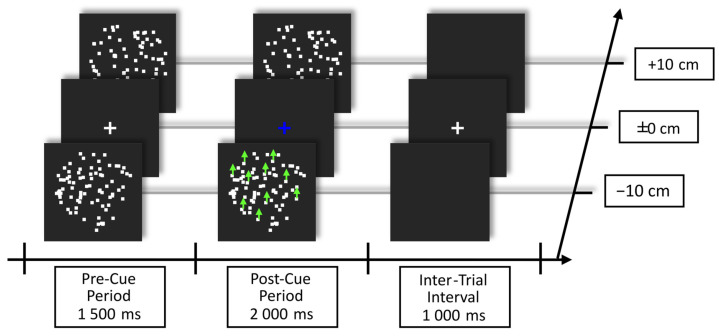 Figure 1
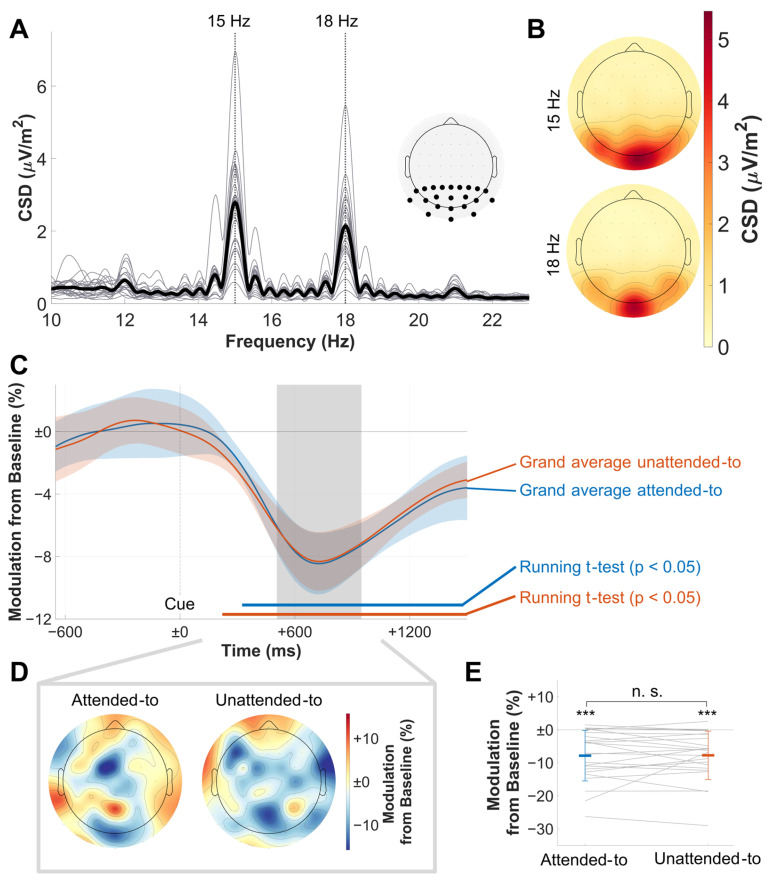 Figure 2
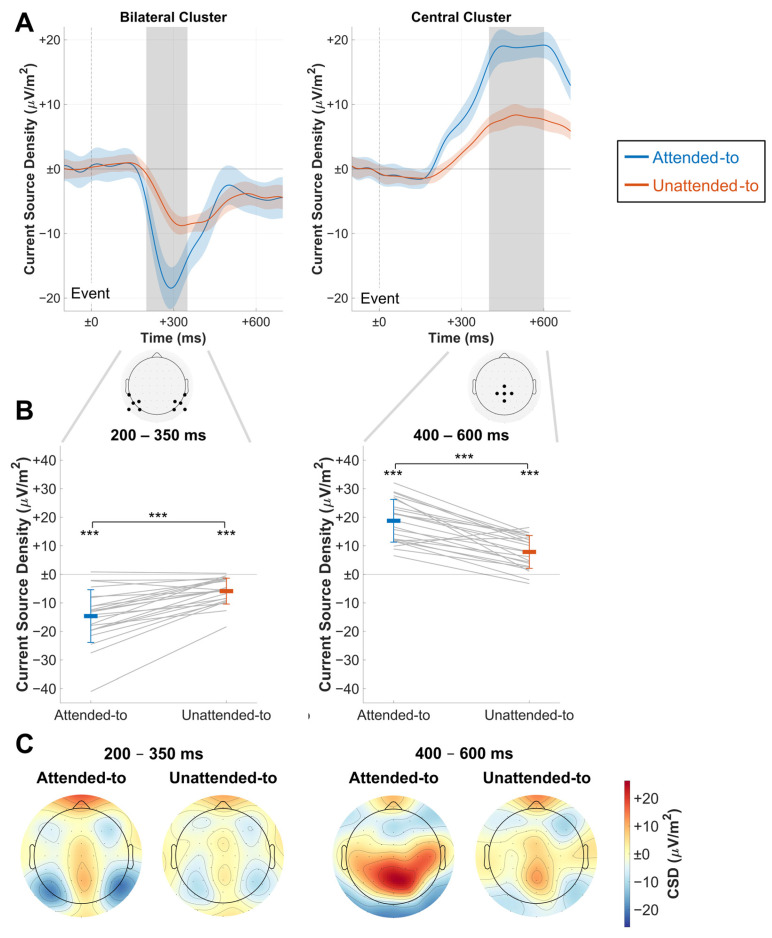 Figure 3
Peer Reviews
No public reviews on file for this paper yet. If you reviewed it on a platform where reviews are public (OpenReview, ICLR, NeurIPS, ICML), you can paste yours below so the community can read it here.
Videos
No videos yet. Explain this paper in a talk, walkthrough, or lecture? Add one.
Taxonomy
TopicsVisual perception and processing mechanisms · Neural dynamics and brain function · Neural and Behavioral Psychology Studies