Polymyalgia Rheumatica (PMR) and Polymyalgia Rheumatica-like (PMR-like) Manifestations in Cancer Patients Following Treatment with Nivolumab and Pembrolizumab: Methodological Blurred Points Identified Through a Systematic Review of Published Case Reports
Ciro Manzo, Marco Isetta, Alberto Castagna, Melek Kechida

TL;DR
This paper reviews case reports of cancer patients developing polymyalgia rheumatica (PMR) after treatment with nivolumab or pembrolizumab, highlighting inconsistencies in how these cases are diagnosed and classified.
Contribution
The study identifies methodological inconsistencies in diagnosing PMR following ICI therapy, particularly in the use of standardized criteria and ADR assessment tools.
Findings
Most case reports did not use validated scales like Naranjo’s for adverse drug reaction assessment.
Nivolumab cases often used validated PMR criteria, while pembrolizumab cases relied on clinical judgment.
PMR symptoms occurred within 1 to 14 cycles of treatment, aligning with drug pharmacokinetics.
Abstract
Background: Among rheumatologic diseases following therapy with immune checkpoint inhibitors (ICIs), the cases of cancer patients diagnosed as having polymyalgia rheumatica (PMR), particularly with nivolumab and pembrolizumab, has been steadily rising in published reports. Objectives: We performed a systematic review of published case reports with the aim of answering these questions: (1) Is PMR following therapy with nivolumab and pembrolizumab an adverse drug reaction (ADR)? (2) Is there a difference between cases of PMR following therapy with nivolumab and those following therapy with pembrolizumab? Methods: Based on Preferred Reporting Items for Systematic Reviews and Meta-Analysis (PRISMA) guidelines, a comprehensive literature search in three main bibliographic databases: MEDLINE (Ovid interface), EMBASE, and COCHRANE Library was carried out on 27 December 2024. This systematic…
Genes, proteins, chemicals, diseases, species, mutations and cell lines named across the full text — each resolved to its canonical identifier and authoritative record.
Click any figure to enlarge with its caption.
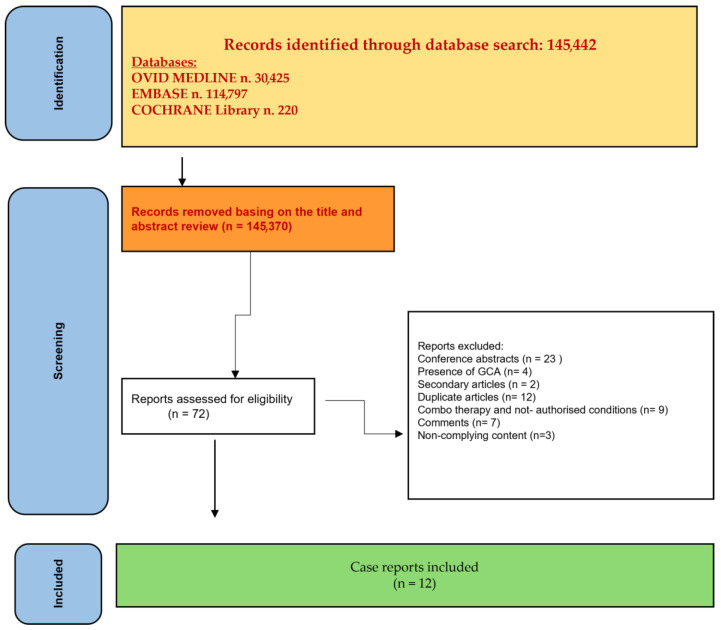 Figure 1
Peer Reviews
No public reviews on file for this paper yet. If you reviewed it on a platform where reviews are public (OpenReview, ICLR, NeurIPS, ICML), you can paste yours below so the community can read it here.
Videos
No videos yet. Explain this paper in a talk, walkthrough, or lecture? Add one.
Taxonomy
TopicsCancer Immunotherapy and Biomarkers · Drug-Induced Adverse Reactions · Heparin-Induced Thrombocytopenia and Thrombosis