Velocity-Based Training in Soccer: A Brief Narrative Review with Practical Recommendations
Andrés Rojas Jaramillo, Richard B. Kreider, Jorge L. Petro, Diego A. Bonilla, Juan José Gonzalez-Badillo, David Rodriguez-Rosell

TL;DR
This paper reviews how velocity-based training can improve soccer performance by optimizing physical skills and reducing injury risks.
Contribution
The paper provides practical recommendations for implementing velocity-based resistance training in soccer.
Findings
Velocity-based resistance training improves linear sprints, vertical jumps, and direction changes in soccer players.
This training method allows real-time adjustment of training loads to optimize outcomes and reduce muscle fatigue.
It serves as an innovative tool for coaches to enhance performance and reduce injury risks.
Abstract
Soccer is an intermittent sport characterized by periods of high intensity interspersed with varying levels of recovery. During the game, soccer players are required to perform numerous determinant actions, such as accelerations, decelerations, pace and directional changes, jumps, and strikes, which demand high levels of strength, speed, endurance, and mobility. This review aims to examine the current scientific evidence on velocity-based training (VBT) in order to assess its role in optimizing key actions in soccer players and to provide practical applications for its implementation. A narrative review of the scientific literature was conducted, focusing on velocity-based resistance training and its application in soccer, identifying relevant studies on its effectiveness in improving specific physical capacities and sports performance. Velocity-based resistance training is an effective…
Genes, proteins, chemicals, diseases, species, mutations and cell lines named across the full text — each resolved to its canonical identifier and authoritative record.
Click any figure to enlarge with its caption.
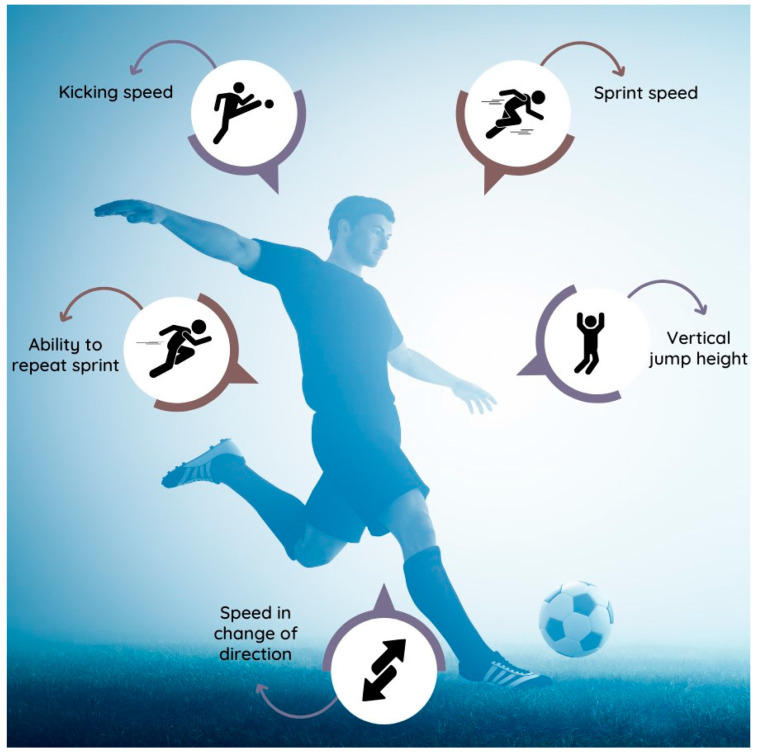 Figure 1
 Figure 2
Peer Reviews
No public reviews on file for this paper yet. If you reviewed it on a platform where reviews are public (OpenReview, ICLR, NeurIPS, ICML), you can paste yours below so the community can read it here.
Videos
No videos yet. Explain this paper in a talk, walkthrough, or lecture? Add one.
Taxonomy
TopicsSports Performance and Training · Sports injuries and prevention · Sports Dynamics and Biomechanics