Efficient electrocatalytic reduction of CO2 on an Ag catalyst in 1-ethyl-3-methylimidazolium ethylsulfate, with its co-catalytic role as a supporting electrolyte during the reduction in an acetonitrile medium
Sayyar Muhammad, Asad Ali

TL;DR
This paper explores using silver catalysts and ionic liquids to efficiently convert CO2 into useful chemicals like CO, which could be used to produce synthetic fuels.
Contribution
The study reveals that [emim][EtSO4] ionic liquid acts as an effective co-catalyst in CO2 reduction, outperforming conventional electrolytes.
Findings
CO2 reduction occurs at lower overpotential on Ag and Cu catalysts compared to Au, Pt, and BDD.
The [emim][EtSO4] ionic liquid improves CO2 reduction performance when used as a supporting electrolyte in acetonitrile.
Imidazolium-based cations significantly enhance CO2 reduction compared to other cations like [TBA]+ and [empyrr]+.
Abstract
CO2 electrochemical reduction reactions (CO2ERR) has shown great promise in reducing greenhouse gas emissions while also producing useful chemicals. In this contribution, we describe the CO2ERR at different catalysts using 1-ethyl-3-methylimidazolium ethyl sulfate [emim][EtSO4] ionic liquid (IL) as a solvent and as a supporting electrolyte. CO2ERR occurs at Ag and Cu catalysts at a lower overpotential than that at Au, Pt, and boron-doped diamond (BDD) catalysts. In addition, we report that ILs play a better co-catalytic role when used as a supporting electrolyte during CO2ERR in an acetonitrile (AcN) medium than the conventional supporting electrolyte, tetrabutylammonium hexafluorophosphate [TBA][PF6] in AcN. Furthermore, it is found that imidazolium-based cations ([emim]+) play a significant co-catalytic role during the reduction compared to [TBA]+ and pyrrolidinium [empyrr]+ cations,…
Genes, proteins, chemicals, diseases, species, mutations and cell lines named across the full text — each resolved to its canonical identifier and authoritative record.
Click any figure to enlarge with its caption.
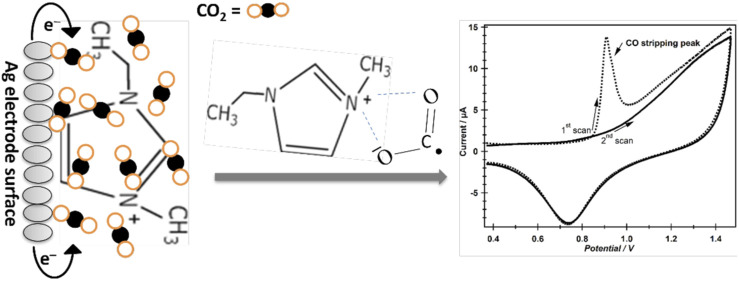 Figure 1
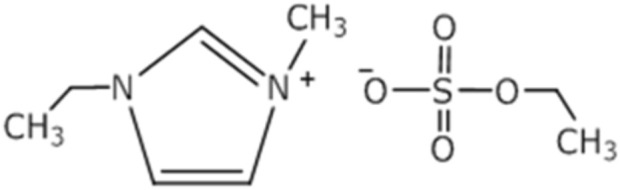 Figure 2
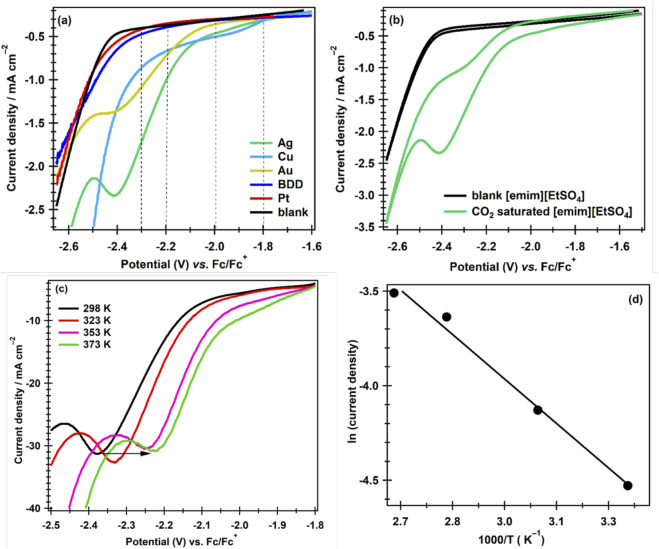 Figure 3
 Figure 4
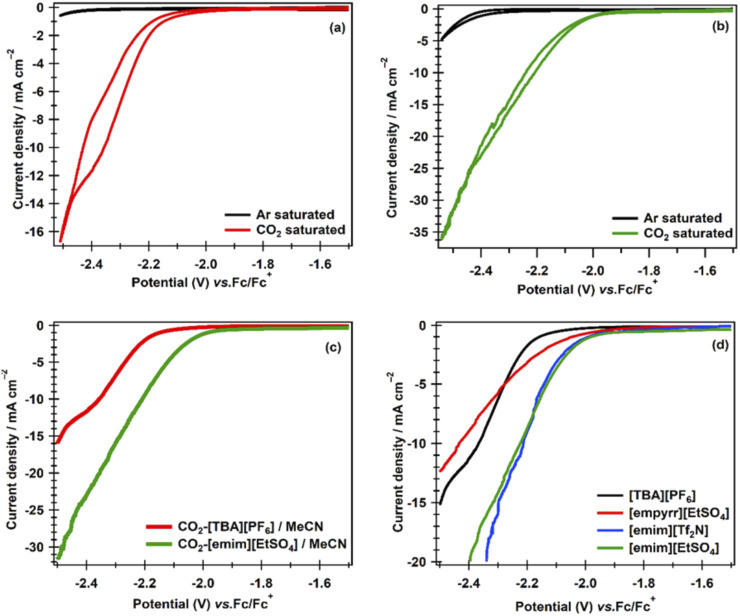 Figure 5
 Figure 6
 Figure 7
Peer Reviews
No public reviews on file for this paper yet. If you reviewed it on a platform where reviews are public (OpenReview, ICLR, NeurIPS, ICML), you can paste yours below so the community can read it here.
Videos
No videos yet. Explain this paper in a talk, walkthrough, or lecture? Add one.
Taxonomy
TopicsCO2 Reduction Techniques and Catalysts · Ionic liquids properties and applications · Carbon dioxide utilization in catalysis