purpleoid 1 , a classic Drosophila eye color mutation, is an allele of the t-SNARE-encoding gene SNAP29
Derek M. Dean, Lillian E. Codd, Ruben Constanza, Xavier M. Segel

TL;DR
A long-known fruit fly eye color mutation called purpleoid is found to be a variant of the SNAP29 gene, which is involved in cell membrane processes.
Contribution
The paper identifies the genetic basis of the purpleoid mutation as a missense variant in the SNAP29 gene.
Findings
The pd1 mutation is a missense mutation in the SNAP29 gene.
SNAP29 is a key component of the SNARE complex involved in vesicle trafficking.
The mutation can be used to study eye pigmentation and SNARE complex assembly.
Abstract
The Drosophila mutant eye color trait purpleoid ( pd ) was first observed by Calvin Bridges over a century ago. Although pd mutant strains have been maintained ever since, the pd locus has not been identified. Using complementation tests, genetic rescue, and DNA sequencing, we show that pd 1 is a missense mutation in SNAP29 ; this gene encodes a key component of the SNARE complex, which facilitates vesicle docking and fusion at cellular membranes. After describing how pd 1 was mapped, we discuss ways that the mutation could be used in future studies of eye pigmentation, SNARE complex assembly, and vesicle trafficking.
Genes, proteins, chemicals, diseases, species, mutations and cell lines named across the full text — each resolved to its canonical identifier and authoritative record.
Click any figure to enlarge with its caption.
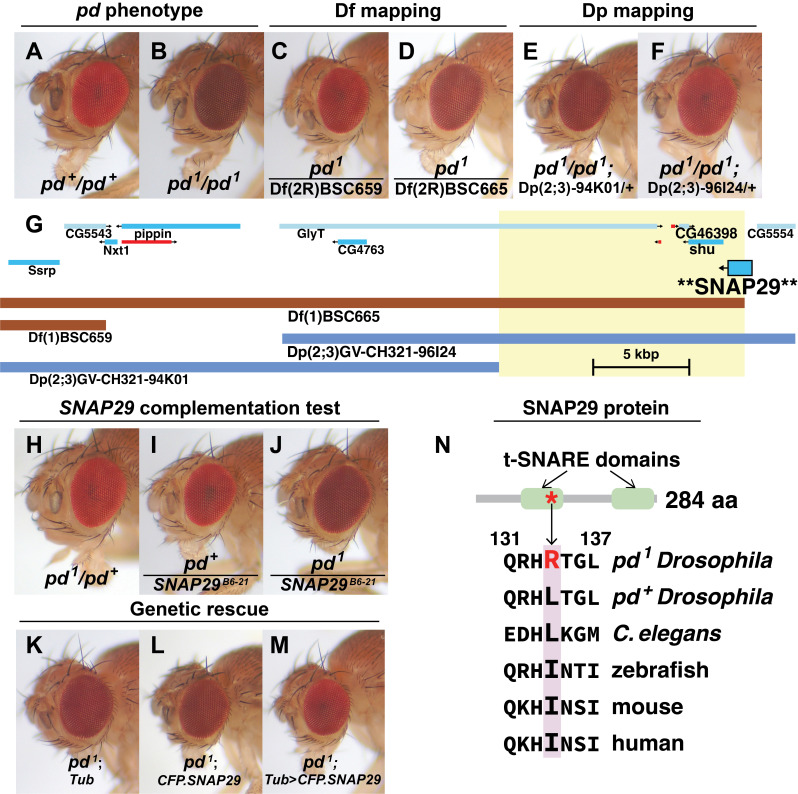 Figure 1
Peer Reviews
No public reviews on file for this paper yet. If you reviewed it on a platform where reviews are public (OpenReview, ICLR, NeurIPS, ICML), you can paste yours below so the community can read it here.
Videos
No videos yet. Explain this paper in a talk, walkthrough, or lecture? Add one.
Taxonomy
Topicsmelanin and skin pigmentation · Retinal Development and Disorders · Genetic and rare skin diseases.