On X-ray Sensitivity in Xenopus Embryogenesis
Hugo Mauricio, Jose G Abreu, Leonid Peshkin

TL;DR
This study explores how X-ray exposure at different stages of Xenopus development affects embryo survival and development.
Contribution
The study identifies critical thresholds and timing for X-ray sensitivity during Xenopus embryogenesis.
Findings
X-ray doses of 10 to 250 Gy caused developmental anomalies in Xenopus embryos.
Post-fertilization irradiation at 50 to 100 Gy resulted in 100% lethality.
Exposure at 250 Gy caused 50% failure in fertilization of Xenopus eggs.
Abstract
We examined the effects of X-ray irradiation on Xenopus laevis , focusing on pre- and post-fertilization exposure. We applied X-ray doses of 10, 50, 100, 250, and 500 Gy. Fifty percent of the 360 eggs irradiated at 250 Gy failed to fertilize, while fertilized eggs developed normally until the gastrula stage. Doses ranging from 10 to 250 Gy caused developmental anomalies. High mortality rates were observed at doses of 100 to 500 Gy. Post-fertilization irradiation at 50 to 100 Gy resulted in 100% lethality, while exposure to 10 Gy led to only 13% lethality, although both exposure levels produced similar types of developmental anomalies compared to pre-fertilization irradiation. This study highlights how the timing and intensity of exposure critically affect embryo viability, especially during the sensitive stages of fertilization and gastrulation. We establish the necessary and sufficient…
Genes, proteins, chemicals, diseases, species, mutations and cell lines named across the full text — each resolved to its canonical identifier and authoritative record.
Click any figure to enlarge with its caption.
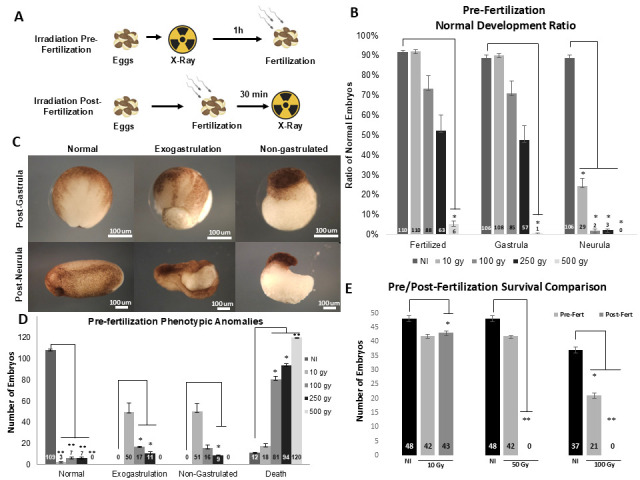 Figure 1
Peer Reviews
No public reviews on file for this paper yet. If you reviewed it on a platform where reviews are public (OpenReview, ICLR, NeurIPS, ICML), you can paste yours below so the community can read it here.
Videos
No videos yet. Explain this paper in a talk, walkthrough, or lecture? Add one.
Taxonomy
TopicsMedical Imaging Techniques and Applications · Numerical methods in inverse problems