Hospital-onset bacteremia in the neonatal intensive care unit: strategies for risk adjustment
Erica C. Prochaska, Shaoming Xiao, Elizabeth Colantuoni, Nora Elhaissouni, Reese H. Clark, Julia Johnson, Sagori Mukhopadhyay, Ibukunoluwa C. Kalu, Danielle M. Zerr, Patrick J. Reich, Jessica Roberts, Dustin D. Flannery, Aaron M. Milstone

TL;DR
This study examines how adjusting for patient and unit-level factors affects rankings of neonatal intensive care units based on hospital-onset bacteremia rates.
Contribution
The study introduces and evaluates four risk adjustment strategies to improve fairness in comparing NICU infection rates.
Findings
Adjusting for birthweight and NICU complexity moved about one-third of NICUs from the worst-performing quartile to better-performing ones.
Units that remained in better-performing quartiles had fewer low birthweight infants and lower mortality rates.
Risk adjustment strategies improve accuracy in comparing NICUs with different patient acuity levels.
Abstract
To quantify the impact of patient- and unit-level risk adjustment on infant hospital-onset bacteremia (HOB) standardized infection ratio (SIR) ranking. A retrospective, multicenter cohort study. Infants admitted to 284 neonatal intensive care units (NICUs) in the United States between 2016 and 2021. Expected HOB rates and SIRs were calculated using four adjustment strategies: birthweight (model 1), birthweight and postnatal age (model 2), birthweight and NICU complexity (model 3), and birthweight, postnatal age, and NICU complexity (model 4). Sites were ranked according to the unadjusted HOB rate, and these rankings were compared to rankings based on the four adjusted SIR models. Compared to unadjusted HOB rate ranking (smallest to largest), the number and proportion of NICUs that left the fourth quartile (worst-performing) following adjustments were as follows: adjusted for…
Genes, proteins, chemicals, diseases, species, mutations and cell lines named across the full text — each resolved to its canonical identifier and authoritative record.
Click any figure to enlarge with its caption.
 Figure 1
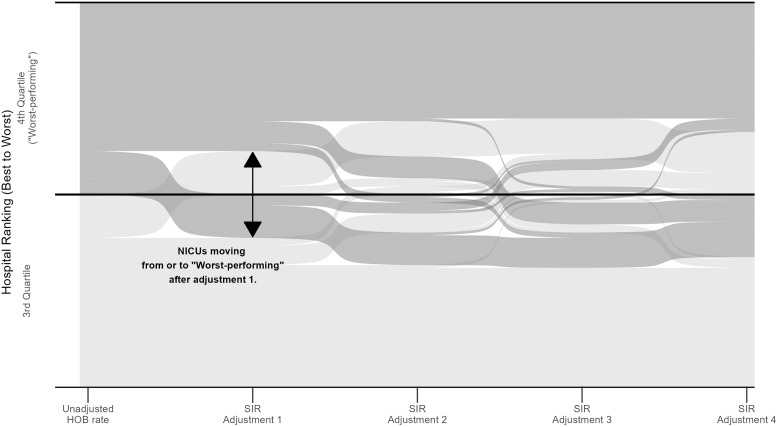 Figure 2
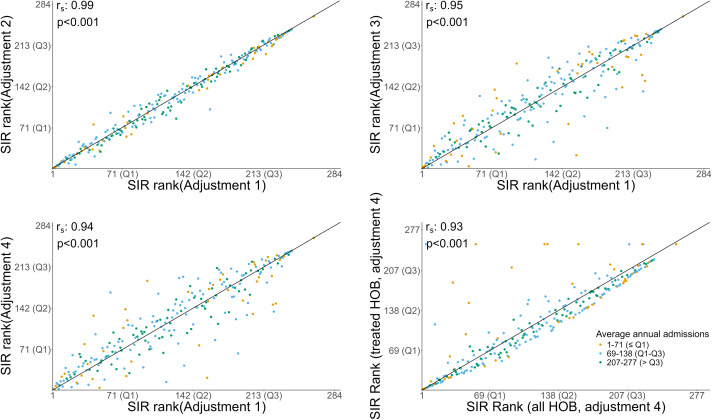 Figure 3
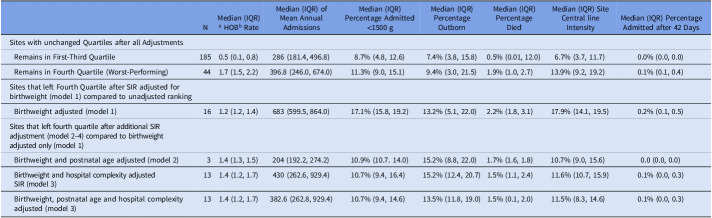 Figure 4
Peer Reviews
No public reviews on file for this paper yet. If you reviewed it on a platform where reviews are public (OpenReview, ICLR, NeurIPS, ICML), you can paste yours below so the community can read it here.
Videos
No videos yet. Explain this paper in a talk, walkthrough, or lecture? Add one.
Taxonomy
TopicsNeonatal and Maternal Infections · Nosocomial Infections in ICU · Central Venous Catheters and Hemodialysis