Elimination of Legionella colonization in a hospital water system: evidence from 23 years of chlorine dioxide use
Natalie G. Exum, Lindsay N. Avolio, Gregory Bova, Clare Rock, Melanie S. Curless, Lisa L. Maragakis, Kellogg J. Schwab

TL;DR
A hospital successfully reduced Legionella bacteria in its water system over 23 years by using chlorine dioxide and replacing pipes.
Contribution
The study demonstrates the long-term effectiveness of chlorine dioxide and pipe replacements in eliminating Legionella colonization.
Findings
Chlorine dioxide application reduced Legionella positivity to less than 1% in hospital water systems.
Iterative treatment of cold and hot water systems followed by pipe replacements was effective.
Over 6,800 samples were analyzed to track Legionella levels over 23 years.
Abstract
A hospital water system colonized with Legionella bacteria (three of four buildings, with > 50% of positive samples) was able to reduce detections to <1% positivity in the long term only after ClO2 was iteratively added first to the cold-water and then hot-water systems followed by pipe replacements (n = 6835 total samples).
Genes, proteins, chemicals, diseases, species, mutations and cell lines named across the full text — each resolved to its canonical identifier and authoritative record.
Click any figure to enlarge with its caption.
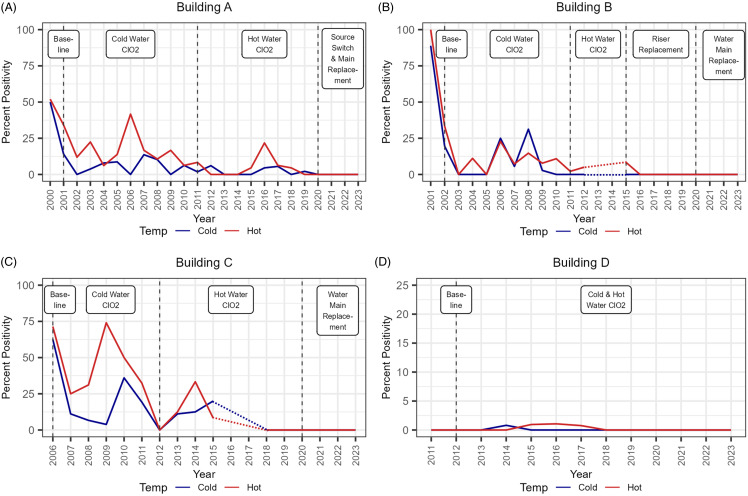 Figure 1
Peer Reviews
No public reviews on file for this paper yet. If you reviewed it on a platform where reviews are public (OpenReview, ICLR, NeurIPS, ICML), you can paste yours below so the community can read it here.
Videos
No videos yet. Explain this paper in a talk, walkthrough, or lecture? Add one.
Taxonomy
TopicsLegionella and Acanthamoeba research · Water Treatment and Disinfection · Vibrio bacteria research studies