Uptake, utility and resource requirements of a genetic counselling telephone helpline within the BRCA-DIRECT digital pathway for mainstreamed BRCA testing in patients with breast cancer
Bethany Torr, Grace Kavanaugh, Monica Hamill, Christopher Jones, Helena Harder, Sophie Allen, Alice Garrett, Subin Choi, Rosalind Way, Rochelle Gold, Amy Taylor, Rhian Gabe, Anneke Lucassen, Ranjit Manchanda, Angela George, Michael Hubank, Stephen Bremner, Ashu Gandhi, Zoe Kemp

TL;DR
This study evaluated a telephone helpline for a digital BRCA testing pathway, finding it used mainly for administrative support with minimal clinical time needed per patient.
Contribution
The study introduces a scalable model for mainstream BRCA testing with minimal clinical resource use via a digital pathway and helpline.
Findings
Only 17.6% of patients used the telephone helpline, with 84.6% of calls for administrative support.
The model required a mean of 0.3 minutes of clinical time per patient, supporting scalability.
Most clinical calls occurred while awaiting results or post-results, with short average call durations.
Abstract
We trialled the first digital pathway (BRCA-DIRECT) aiming to improve capacity for mainstreamed BRCA testing within UK breast oncology services. Patients received standardised digital pretest information, with saliva sampling and consent to testing completed at home. For individualised support, we offered access to a clinical genetics professional via a telephone helpline (TH). To evaluate the utilisation, uptake and resource requirements for provision of the TH, we analysed data from structured call logs recorded in the BRCA-DIRECT Study. Mixed-methods analysis included combining quantitative data from call logs and patient demographics with thematic analysis of free-text notes establishing reasons for calls. Additional data were analysed from structured telephone interviews. Calls were received from 201/1140 (17.6%) patients. We identified that 84.6% of calls (274 calls, 1097 min)…
Genes, proteins, chemicals, diseases, species, mutations and cell lines named across the full text — each resolved to its canonical identifier and authoritative record.
Click any figure to enlarge with its caption.
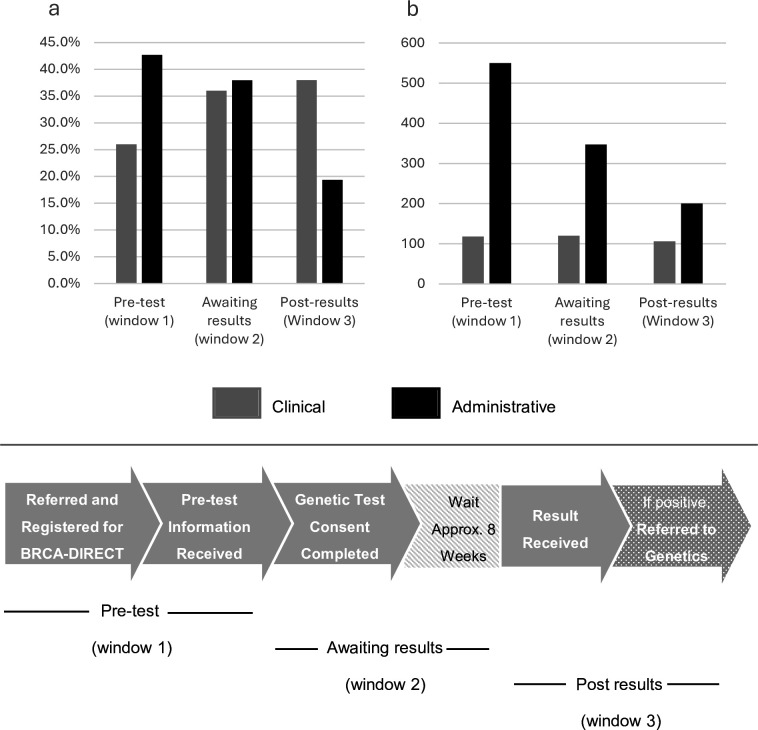 Figure 1
 Figure 2
Peer Reviews
No public reviews on file for this paper yet. If you reviewed it on a platform where reviews are public (OpenReview, ICLR, NeurIPS, ICML), you can paste yours below so the community can read it here.
Videos
No videos yet. Explain this paper in a talk, walkthrough, or lecture? Add one.
Taxonomy
TopicsBRCA gene mutations in cancer · Cancer Genomics and Diagnostics · Genomics and Rare Diseases