Expanding two-way texting for post-operative follow-up: A cost analysis of the implementation and scale-up in routine voluntary medical male circumcision settings in South Africa
Molly Unsworth, Isabella Fabens, Geoffrey Setswe, Khumbulani Moyo, Jacqueline Pienaar, Calsile Makhele, Motshana Phohole, Nelson Igaba, Sizwe Hlongwane, Maria Sardini, Tracy Dong, Monisha Sharma, Hannock Tweya, Felex Ndebele, Marrianne Holec, Caryl Feldacker, Damen Haile Mariam

TL;DR
Using free two-way texting for post-operative care after male circumcision in South Africa reduces costs and improves follow-up quality compared to in-person visits.
Contribution
This study provides a cost analysis of scaling two-way texting for post-operative care in routine male circumcision settings.
Findings
Two-way texting reduced in-person visits and improved adverse event detection and follow-up rates.
At 80% enrollment, texting saved $0.46 per client when scaled to 10,000 circumcisions.
Texting is cost-neutral at 45% enrollment and cost-saving at higher adoption rates.
Abstract
Up to 98% of adult voluntary medical male circumcision (VMMC) clients heal without adverse events (AEs) in South Africa and in the sub-Saharan Africa region. Yet, all clients in South Africa are required to attend in-person reviews, creating added effort for providers and clients. A randomized controlled trial (RCT) using our fee-free, open-source, two-way texting (2wT) approach showed that males could independently monitor their healing with nurse-led telehealth support. 2wT was more cost-effective than routine visits for quality post-operative monitoring. The objectives of this study were:1) assess the additive cost of 2wT vs. standard of care (SoC) during a stepped wedge design (SWD) expansion trial; 2) determine the cost of augmenting 2wT implementation with dedicated personnel during peak VMMC periods; and 3) estimate the cost savings of 2wT from the payer perspective if scaled in…
Genes, proteins, chemicals, diseases, species, mutations and cell lines named across the full text — each resolved to its canonical identifier and authoritative record.
Click any figure to enlarge with its caption.
 Figure 1
 Figure 2
 Figure 3
 Figure 4
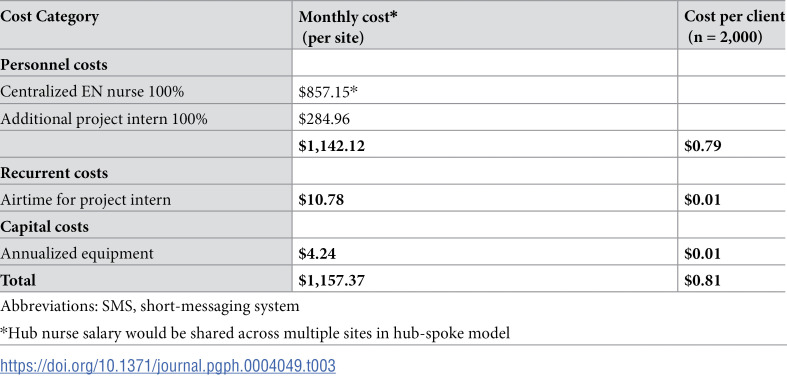 Figure 5
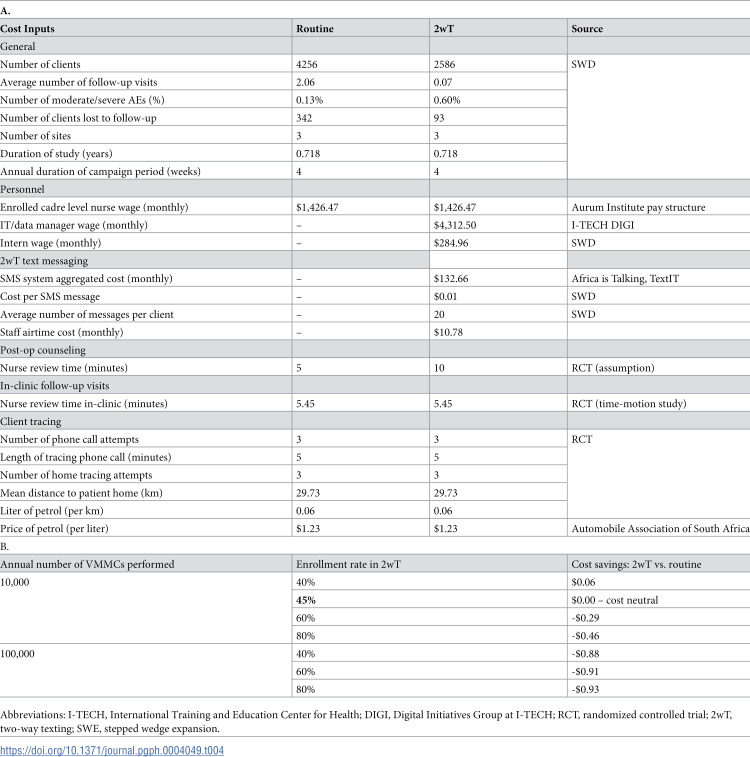 Figure 6
Peer Reviews
No public reviews on file for this paper yet. If you reviewed it on a platform where reviews are public (OpenReview, ICLR, NeurIPS, ICML), you can paste yours below so the community can read it here.
Videos
No videos yet. Explain this paper in a talk, walkthrough, or lecture? Add one.
Taxonomy
TopicsGenital Health and Disease · Female Genital Mutilation/Cutting Issues