Traditional Arabic & Islamic Medicine (TAIM): Principles of Dietary Practices and the TAIM Food Pyramid
Sara N. AlRawi, Suzanna M. Zick

TL;DR
The paper introduces the TAIM food pyramid to represent traditional Arabic and Islamic dietary practices, emphasizing cultural and historical influences on nutrition and health.
Contribution
The novel TAIM food pyramid is introduced to capture the unique dietary practices and cultural nuances of Traditional Arabic and Islamic Medicine.
Findings
The TAIM food pyramid reflects historical and regional dietary influences of Traditional Arabic and Islamic Medicine.
There is a significant research gap regarding the Middle Eastern diet compared to the Mediterranean diet.
Culturally competent healthcare can improve health equity through better patient-centered care.
Abstract
Middle Eastern and Mediterranean culinary tradition and dietary practices are used interchangeably due to geographical proximity and similarities in their cuisine. While these regions share historical impact and cultural exchanges there are differences that delineate each region’s dietary influences. Dietary practices are one of five core elements of an overarching Traditional Arabic and Islamic Medicine (TAIM) conceptual framework, yet current dietary guidelines are lacking. We introduce the TAIM food pyramid as a visual representation of TAIM’s historical and regional nuance, illustrate dietary patterns, and provide a cultural competency strategy. We used Oldways as a model for creating the TAIM food pyramid while illustrating its extension of a wholistic paradigm representing the medical and indigenous traditions, beliefs and practices of a geographic region and cultural community.…
Genes, proteins, chemicals, diseases, species, mutations and cell lines named across the full text — each resolved to its canonical identifier and authoritative record.
Click any figure to enlarge with its caption.
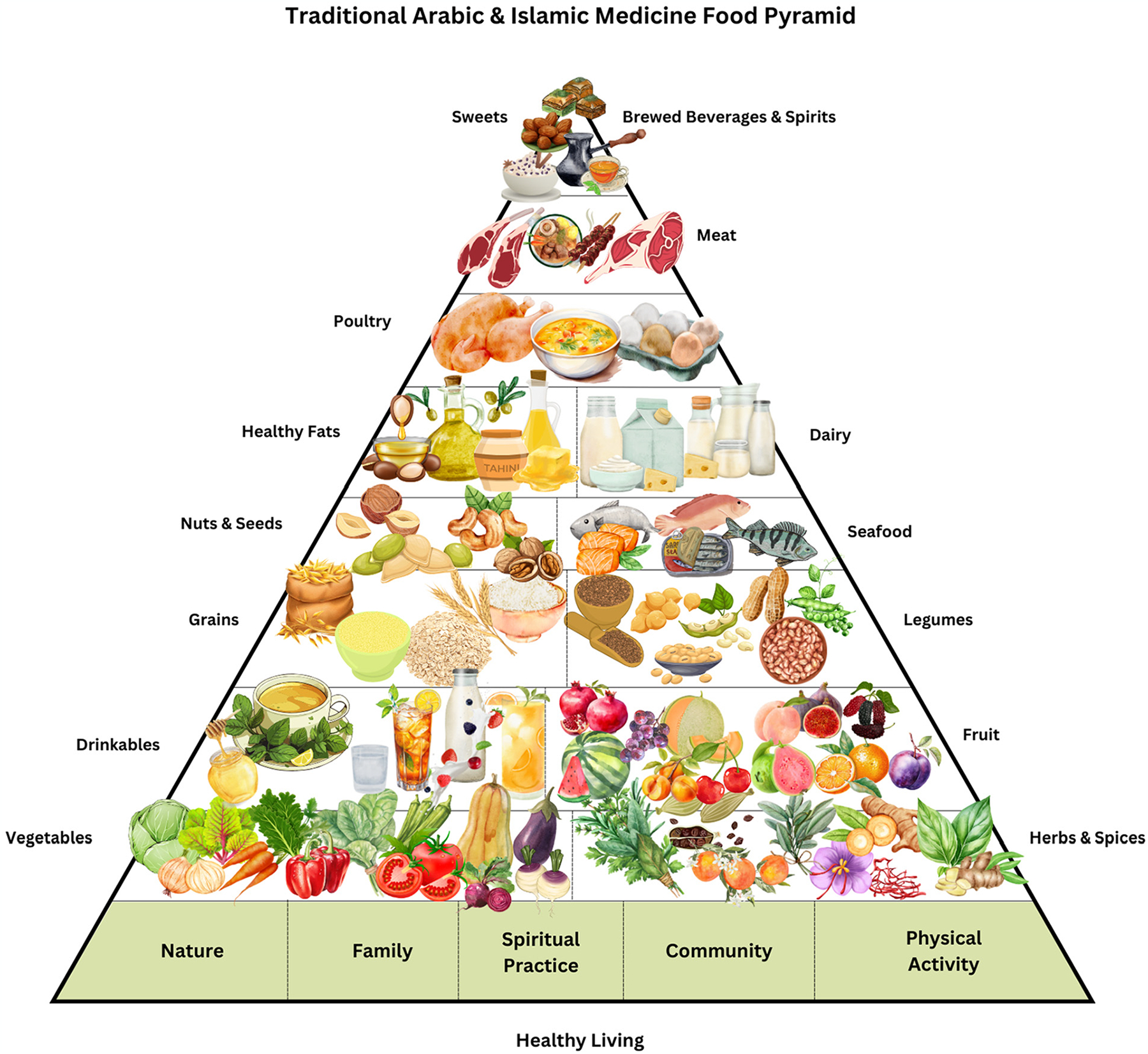 Figure 1
Peer Reviews
No public reviews on file for this paper yet. If you reviewed it on a platform where reviews are public (OpenReview, ICLR, NeurIPS, ICML), you can paste yours below so the community can read it here.
Videos
No videos yet. Explain this paper in a talk, walkthrough, or lecture? Add one.
Taxonomy
TopicsArchaeology and Historical Studies