Light-driven CO2 reduction with substituted imidazole-pyridine Re catalysts favoring formic acid production
Ryan Chafin, Majharul Islam Sujan, Sean Parkin, Jonah W. Jurss, Aron J. Huckaba

TL;DR
Scientists developed new light-driven catalysts that efficiently convert CO2 into formic acid, a useful chemical product, under specific conditions.
Contribution
The study introduces substituted imidazole-pyridine Re catalysts that show high selectivity and turnover for formic acid production.
Findings
The A-π complex RC4 achieved a turnover number of 844 with 86% carbon selectivity for formic acid.
RC4 outperformed other catalyst types in formic acid production under photocatalytic conditions.
The benchmark catalyst Re(bpy)(CO)3Br produced no formic acid under the same conditions.
Abstract
Removing carbon dioxide from the atmosphere is an attractive way to mitigate the greenhouse gas effect that contributes to climate change. A series of donor-pi (D-π), acceptor-pi (A-π), and π Re(i) pyridyl imidazole complexes have been synthesized and examined under photocatalytic conditions for the photocatalytic reduction of CO2. The catalytic activity of the complexes was further supported by cyclic voltammetry through the presence of a catalytic current under CO2 atmosphere. The D-π, π, and A-π complexes were studied to elucidate the effects of incorporating conjugated electron donating vs. withdrawing groups on the catalytic rates and product selectivity. The synthesized complexes were compared with Re(bpy)(CO)3Br (where bpy is 2,2′-bipyridine), the benchmark catalyst for this transformation. Remarkably, the complex with A-π pendant (RC4) outperformed the π (RC2–3) and D-π (RC5)…
Genes, proteins, chemicals, diseases, species, mutations and cell lines named across the full text — each resolved to its canonical identifier and authoritative record.
Click any figure to enlarge with its caption.
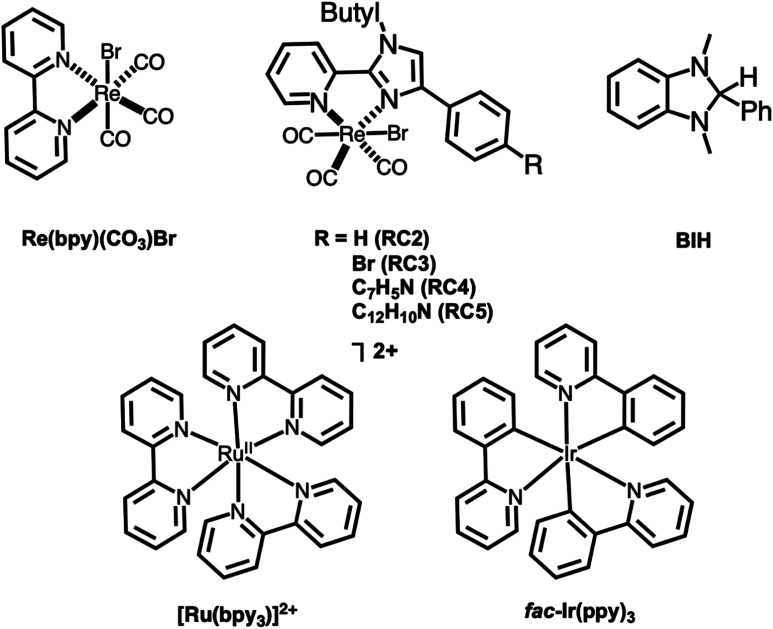 Figure 1
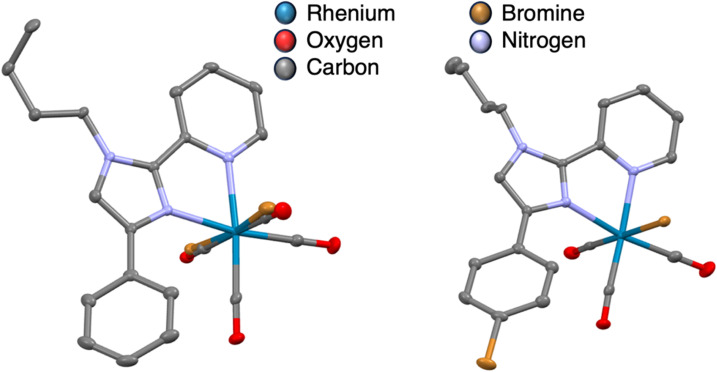 Figure 2
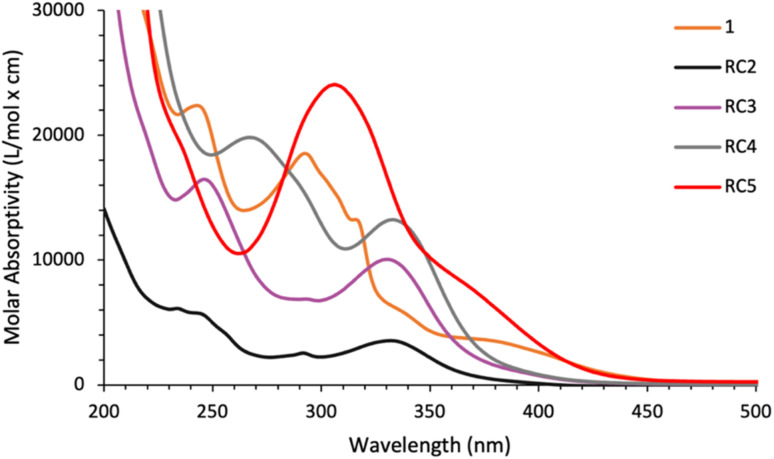 Figure 3
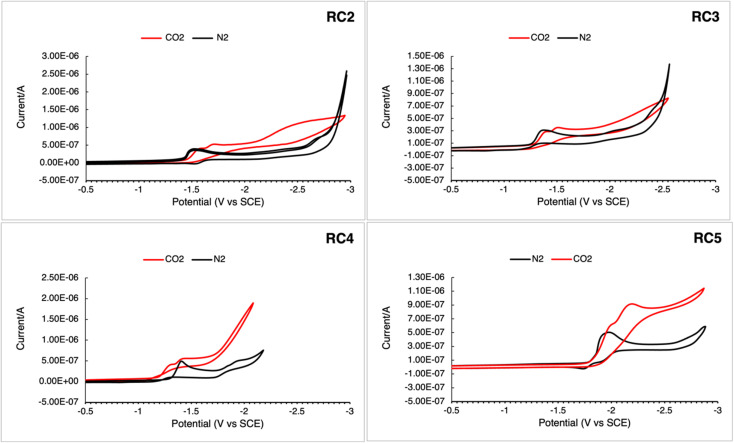 Figure 4
 Figure 5
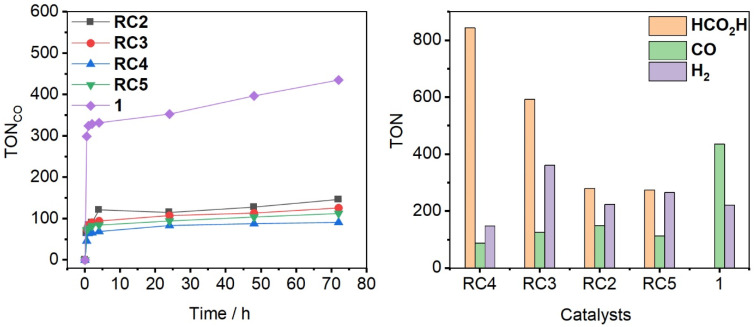 Figure 6
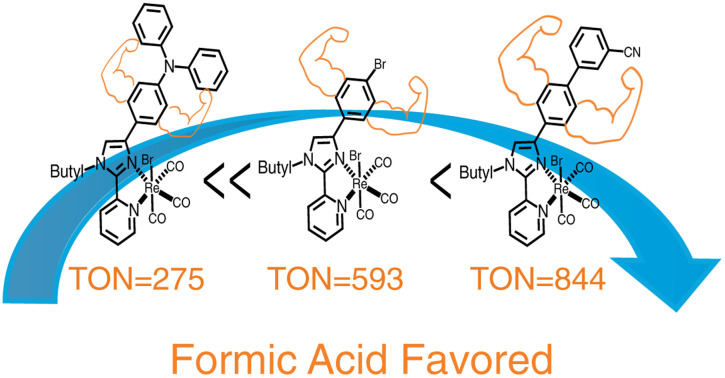 Figure 7
 Figure 8
Peer Reviews
No public reviews on file for this paper yet. If you reviewed it on a platform where reviews are public (OpenReview, ICLR, NeurIPS, ICML), you can paste yours below so the community can read it here.
Videos
No videos yet. Explain this paper in a talk, walkthrough, or lecture? Add one.
Taxonomy
TopicsCO2 Reduction Techniques and Catalysts · Carbon dioxide utilization in catalysis · Asymmetric Hydrogenation and Catalysis