Successful Treatment of Pulmonary Scedosporiosis With Voriconazole and Lobectomy in a Patient With Interstitial Pneumonia
Takahiro Masuda, Ayako Yoshiyama, Sayaka Fujimoto, Yuya Furukawa, Hiroko Jinno, Soichiro Yoshimura, Masatsugu Yamamoto, Kimihide Tada

TL;DR
A rare fungal lung infection was successfully treated with antifungal drugs and surgery in a patient with lung disease.
Contribution
Demonstrates successful treatment of Scedosporium apiospermum infection using voriconazole and lobectomy.
Findings
Prompt diagnosis and treatment led to successful patient outcomes.
Combination of antifungal therapy and surgical intervention was effective.
Abstract
This is a rare case of fungal infection, with Scedosporium apiospermum, which was correctly diagnosed and treated successfully with anti‐fungal therapy and surgical section. The prompt diagnosis and treatment strategy are both important for successful patient outcomes.
Genes, proteins, chemicals, diseases, species, mutations and cell lines named across the full text — each resolved to its canonical identifier and authoritative record.
Click any figure to enlarge with its caption.
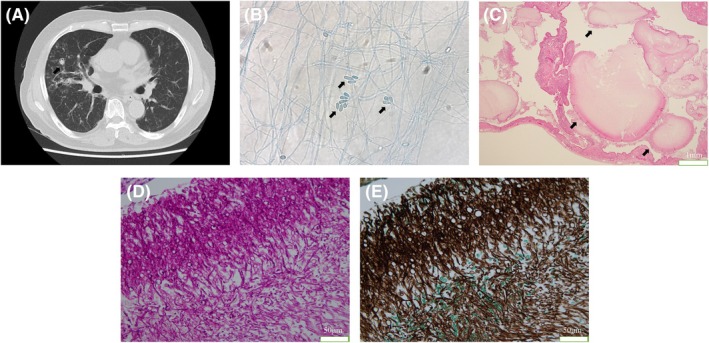 FIGURE 1
Peer Reviews
No public reviews on file for this paper yet. If you reviewed it on a platform where reviews are public (OpenReview, ICLR, NeurIPS, ICML), you can paste yours below so the community can read it here.
Videos
No videos yet. Explain this paper in a talk, walkthrough, or lecture? Add one.
Taxonomy
TopicsParasitic Infections and Diagnostics · Antifungal resistance and susceptibility · Pleural and Pulmonary Diseases
1
The patient was a 78‐year‐old man diagnosed with interstitial pneumonia who had remained stable long‐term with steroid treatment. Routine follow‐up chest CT revealed multiple new nodular lesions in the right middle lobe (Figure 1A). Bronchoscopy was performed, and Scedosporium apiospermum was identified in the bronchoalveolar fluid (Figure 1B). This led to a diagnosis of pulmonary scedosporiosis. Accordingly, treatment with voriconazole was initiated. He received treatment for 2 months; however, there was no noticeable improvement in his condition. Due to the localised nature of the disease, a thoracoscopic right middle lobectomy was performed (Figure 1C–E). Postoperative recovery was smooth, and he received voriconazole for 6 months, with no signs of the infection returning. S. apiospermum is a filamentous saprophytic fungus that causes various infections in humans, especially in individuals with weakened immune systems [1]. Voriconazole is widely recognised as the preferred treatment for S. apiospermum infections. It has been proven to be more effective than other antifungal agents and is typically used as a standalone therapy. In specific cases such as localised infections or abscesses, surgical debridement or resection may be needed along with antifungal therapy [2]. This approach may be particularly beneficial in patients with limited response to antifungal therapy alone.
(A) Computed tomography scan showing multiple nodular lesions (arrow) in the right middle lobe. (B) Saprophytic filamentous fungus in the bronchoalveolar fluid of the right middle lobe (arrow) (lactophenol cotton blue staining; ×400). (C–E) A VATS specimen was obtained from the right middle lobe. (C) Large fungal masses within pulmonary cysts (arrow) (haematoxylin and eosin staining, ×100). (D and E) Saprophytic filamentous fungus (Periodic acid‐Schiff staining, D: ×400) (Grocott staining, E: ×400).
Author Contributions
Takahiro Masuda: Writing – original draft. Ayako Yoshiyama, Sayaka Fujimoto, Yuya Furukawa, Hiroko Jinno, and Soichiro Yoshimura: Resources. Masatsugu Yamamoto and Kimihide Tada: Supervision.
Consent
The authors declare that written informed consent was obtained for the publication of this manuscript and accompanying images using the consent form provided by the Journal.
Conflicts of Interest
The authors declare no conflicts of interest.
The reference list from the paper itself. Each links out to its DOI / PubMed record.
- 1D. Seidel , A. Meißner , M. Lackner , et al., “Prognostic Factors in 264 Adults With Invasive Scedosporium spp. and Lomentospora Prolificans Infection Reported in the Literature and Fungi Scope,” Critical Reviews in Microbiology 45 (2019): 1–21, 10.1080/1040841 X.2018.1514366.30628529 · doi ↗ · pubmed ↗
- 2M. W. Mc Carthy , A. Katragkou , E. Iosifidis , E. Roilides , and T. J. Walsh , “Recent Advances in the Treatment of Scedosporiosis and Fusariosis,” Journal of Fungi (Basel) 4, no. 2 (2018): 73, 10.3390/jof 4020073.PMC 602344129912161 · doi ↗ · pubmed ↗