A pectin lyase-like protein from Verticillium dahliae activates immunity in eggplant through translation regulation
Chi Li, Shuaifei Cui, Yuzhen Li, Xiaoshi Liu, Wei Yan, Chengluo Zhu, Baojuan Sun, Chengwei Yang, Tao Li, Jianbin Lai

Abstract
Genes, proteins, chemicals, diseases, species, mutations and cell lines named across the full text — each resolved to its canonical identifier and authoritative record.
Click any figure to enlarge with its caption.
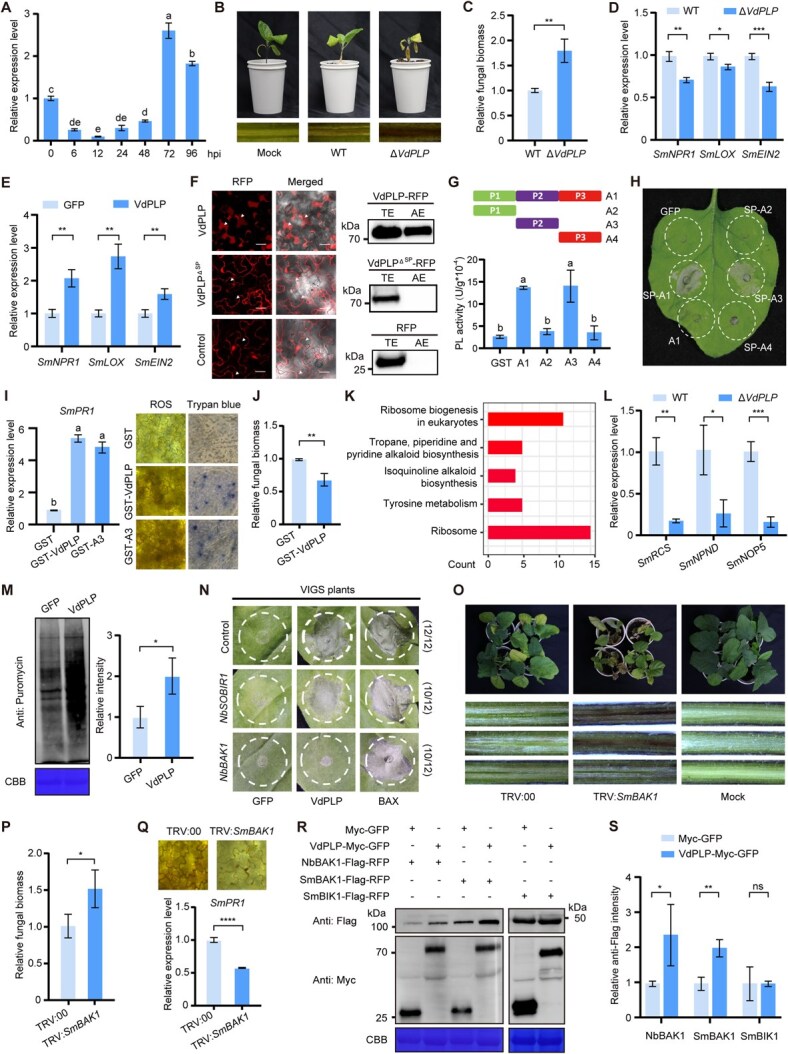 Figure 1
- —Postdoctoral Fellowship Program of CPSF
- —Program for Changjiang Scholars
- —the Natural Science Foundation of Guangdong
- —National Natural Science Foundation of China10.13039/501100001809
Peer Reviews
No public reviews on file for this paper yet. If you reviewed it on a platform where reviews are public (OpenReview, ICLR, NeurIPS, ICML), you can paste yours below so the community can read it here.
Videos
No videos yet. Explain this paper in a talk, walkthrough, or lecture? Add one.
Taxonomy
TopicsPolysaccharides and Plant Cell Walls · Plant-Microbe Interactions and Immunity · Plant tissue culture and regeneration
Dear Editor,
Eggplant (Solanum melongena L.) is a widely cultivated vegetable crop, but it is frequently susceptible to various pathogens, leading to significant yield losses. Verticillium wilt, caused by Verticillium dahliae is an important disease affecting the production of a wide range of host plants. Infection with V. dahliae via the vascular system disrupts uptake of water and nutrients, resulting in symptoms such as wilting, chlorosis, necrosis, vein clearing, and stunting [1]. Given that eggplant is highly susceptible to V. dahliae and that verticillium wilt poses a significant threat to eggplant production, it is essential to elucidate the mechanisms underlying the interaction between V. dahliae and eggplant. During infection, V. dahliae secretes a significant array of carbohydrate-active enzymes, including pectin lyases, which may facilitate the destruction of plant cell walls to enhance invasion by V. dahliae [2]; for instance, the verticillium polysaccharide deacetylase contributes to efficient infection [3]. However, the roles of fungal carbohydrate-active enzymes in the activation of eggplant immunity remain unclear.
Based on bioinformatics analysis, here we identified a pectin lyase-like protein with a potential signal peptide (SP) from V. dahliae, designated VdPLP. The RT–qPCR result indicated a significant increase in the transcript level of VdPLP at 72 hours post-inoculation with V. dahliae on eggplant (Fig. 1A), supporting its potential function during infection. Inoculation with the wild-type V. dahliae induced mild symptoms in eggplant plants, including wilting, etiolation, leaf abscission, and vascular discoloration. Surprisingly, these disease symptoms were significantly enhanced by the mutant strain with depletion of VdPLP (ΔVdPLP) (Fig. 1B). The data on fungal biomass and defense gene expression supported the idea that the mutation of VdPLP attenuated eggplant immunity and facilitated V. dahliae infection (Fig. 1C and D). Consistently, overexpression of VdPLP promoted the expression of defense-related genes in eggplant leaves (Fig. 1E), suggesting that this fungal protein is involved in activation of eggplant immunity.
Therefore, we further investigated the molecular mechanism by which VdPLP functions in plants. Our confocal microscopy and apoplastic fluid immunoblot data confirmed the localization of VdPLP in the apoplastic region of Nicotiana benthamiana leaves (Fig. 1F), implying that it may be secreted from V. dahliae cells. In vitro assay data supported the idea that VdPLP exhibited pectin lyase activity, with the central region (A3) being sufficient to sustain its enzymatic function (Fig. 1G). Removal of the SP abolished the phenotype induced by VdPLP, whereas fusion of the SP with the central region (A3) resulted in cell death similar to full-length VdPLP (Fig. 1H). Furthermore, the purified recombinant GST-tagged VdPLP from E. coli was utilized for treating eggplants. In comparison with the GST control, treatment with either the full-length (without SP) or A3 version of VdPLP resulted in upregulation of the defense gene SmPR1, increased accumulation of reactive oxygen species (ROS), and enhanced cell death (Fig. 1I). Treatment with purified VdPLP also reduced the accumulation of V. dahliae in infected eggplants (Fig. 1J). These findings suggested that VdPLP functions as a pectin lyase, facilitating immunity activation in apoplastic regions.
To elucidate the signaling pathways in eggplant that are regulated by VdPLP during infection, we conducted a transcriptomic analysis using eggplant samples collected 72 hours post-inoculation with either the wild-type or ΔVdPLP variant of V. dahliae (the RNA-seq data were deposited in BioProject under accession number PRJNA1212702). Notably, KEGG analysis of upregulated genes in samples infected with wild-type V. dahliae revealed significant enrichment in ribosome biogenesis pathways (Fig. 1K). Verification through RT–qPCR indicated that the expression levels of genes related to ribosome biosynthesis in eggplant were reduced in response to ΔVdPLP (Fig. 1L). We hypothesized that VdPLP may upregulate host translation during V. dahliae infection, and therefore measured the global levels of protein synthesis in N. benthamiana leaves with and without VdPLP. The result with puromycin labeling [4] revealed that the level of newly synthesized proteins was significantly elevated in the presence of VdPLP (Fig. 1M), suggesting that it enhances host protein synthesis.
Therefore, the synthesis of certain host immune factors may also be upregulated in response to VdPLP, and thus knockdown of these host genes could alleviate the cell death induced by VdPLP. We initiated this detection in N. benthamiana leaves by downregulating critical immune genes, such as NbSOBIR1 and NbBAK1 [5], through virus-induced gene silencing (VIGS). Notably, the knockdown of NbBAK1, rather than NbSOBIR1, suppressed VdPLP-induced cell death (Fig. 1N). Consistently, following inoculation with V. dahliae, more severe symptoms and higher fungal biomass were detected in the SmBAK1-silenced eggplant plants compared with the control (Fig. 1O and P). Consistently, the impact of purified VdPLP on ROS accumulation and SmPR1 expression was attenuated in the SmBAK1-silenced eggplants (Fig. 1Q), supporting the role of SmBAK1 in this process. We further measured the protein levels of BAK1 with or without VdPLP, using samples with similar BAK1 transcript levels. When co-expressed with VdPLP, the protein levels of both SmBAK1 and NbBAK1 were elevated, but the protein level of another immune-related protein, SmBIK1, did not show apparent changes (Fig. 1R and S). This observation supports the notion that VdPLP enhances the translation of the host immune factor BAK1.
As a model, VdPLP is secreted by V. dahliae to facilitate the degradation of host cell walls for infection, but this process leads to the upregulation of ribosome biosynthesis pathways and the consequent increased accumulation of certain immune proteins, such as BAK1, which triggers immunity activation to suppress the infection in eggplant. It remains a possibility that VdPLP may serve as a pathogen-associated molecular pattern, but another plausible mechanism is that it may target the plant cell wall to generate damage-associated molecular patterns for activating downstream immune pathways. Characterization of the residues contributing to the enzymatic activity of VdPLP will enhance our understanding of its working mechanism. Nevertheless, further investigation is required to clarify the mechanism linking cell wall integrity to translation modulation. Based on our current mechanism underlying pathogen–host competition, we propose that novel strategies could be developed to bolster resistance against verticillium wilt in eggplant and other host plants.
The reference list from the paper itself. Each links out to its DOI / PubMed record.
- 1Klosterman SJ, Atallah ZK, Vallad GE. et al. Diversity, pathogenicity, and management of Verticillium species. Annu Rev Phytopathol. 2009;47:39–6219385730 10.1146/annurev-phyto-080508-081748 · doi ↗ · pubmed ↗
- 2Chen JY, Xiao HL, Gui YJ. et al. Characterization of the Verticillium dahliae exoproteome involves in pathogenicity from cotton-containing medium. Front Microbiol. 2016;7:170927840627 10.3389/fmicb.2016.01709 PMC 5083787 · doi ↗ · pubmed ↗
- 3Gao F, Zhang BS, Zhao JH. et al. Deacetylation of chitin oligomers increases virulence in soil-borne fungal pathogens. Nat Plants. 2019;5:1167–7631636399 10.1038/s 41477-019-0527-4 · doi ↗ · pubmed ↗
- 4Van Hoewyk D . Use of the non-radioactive S Un SET method to detect decreased protein synthesis in proteasome-inhibited Arabidopsis roots. Plant Methods. 2016;12:2026989430 10.1186/s 13007-016-0120-z PMC 4794914 · doi ↗ · pubmed ↗
- 5Liebrand TW, van den Burg HA, Joosten MH. Two for all: receptor-associated kinases SOBIR 1 and BAK 1. Trends Plant Sci. 2014;19:123–3224238702 10.1016/j.tplants.2013.10.003 · doi ↗ · pubmed ↗