Description of two new species of the genus Pteromalus Swederus (Hymenoptera, Pteromalidae, Pteromalinae) from Xinjiang, China

Abstract
Genes, proteins, chemicals, diseases, species, mutations and cell lines named across the full text — each resolved to its canonical identifier and authoritative record.
Click any figure to enlarge with its caption.
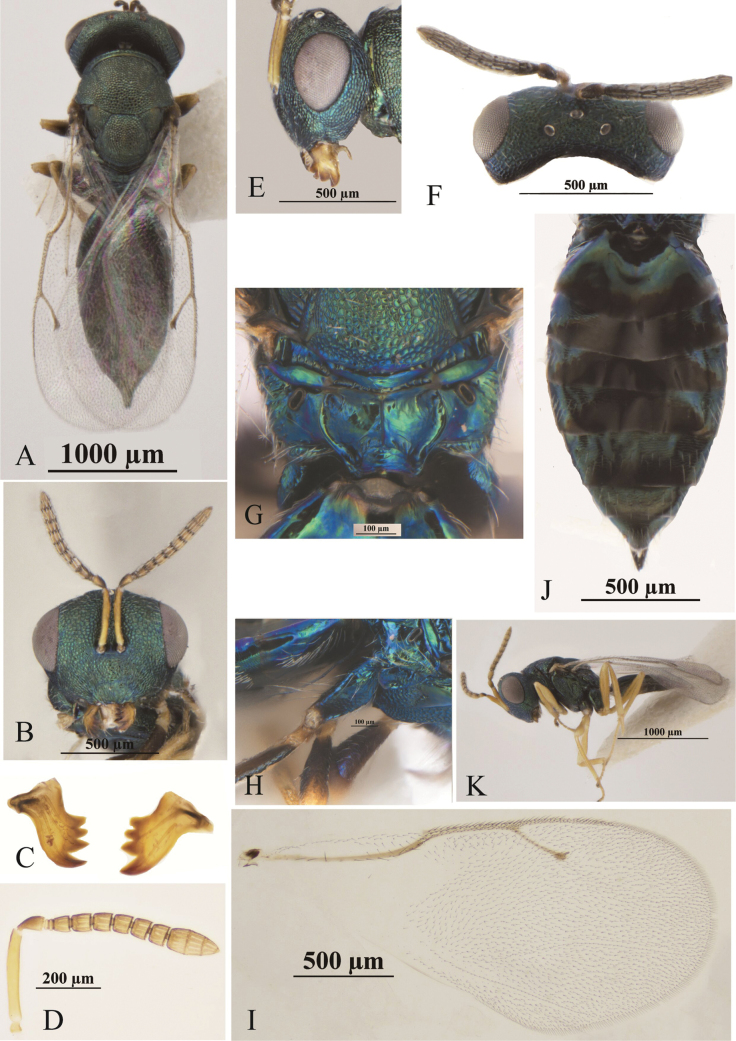 Figure 1
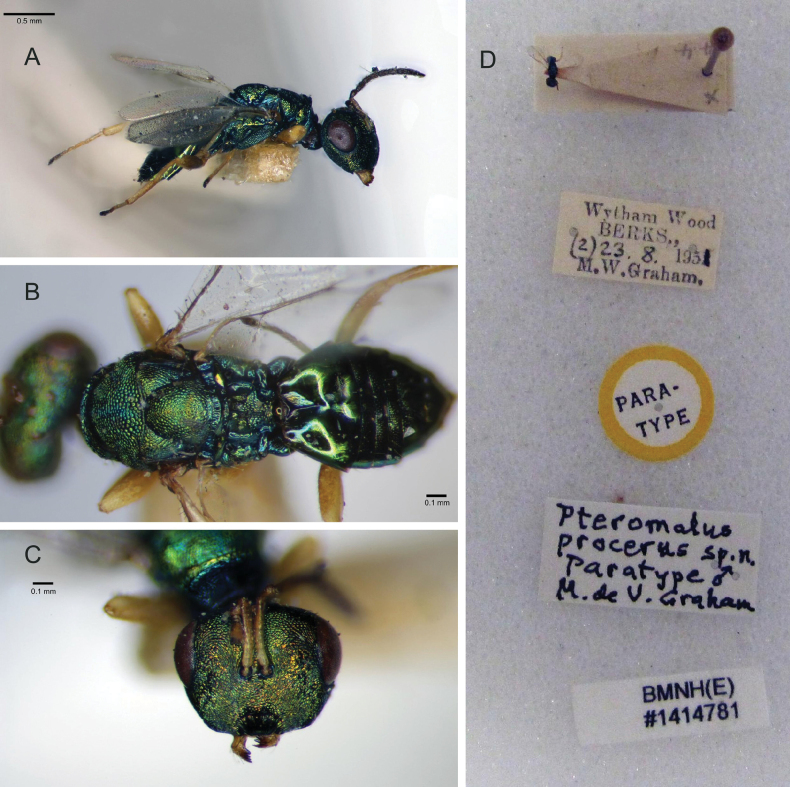 Figure 2
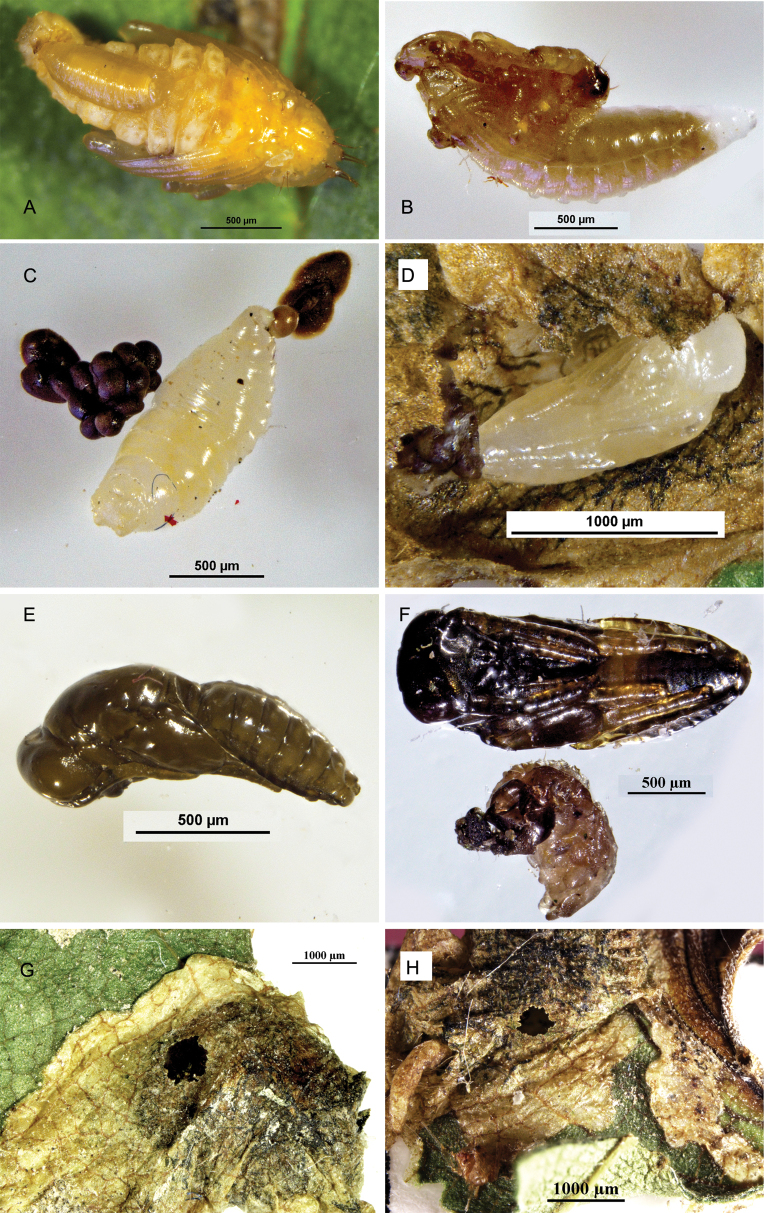 Figure 3
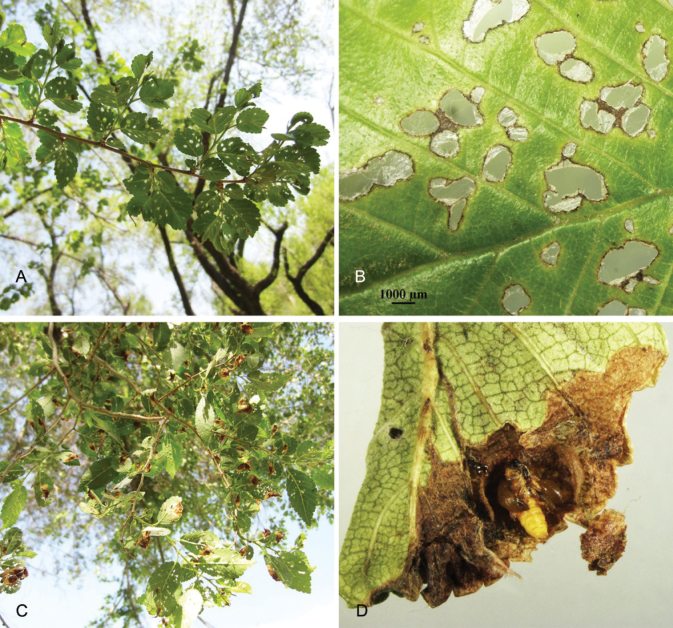 Figure 4
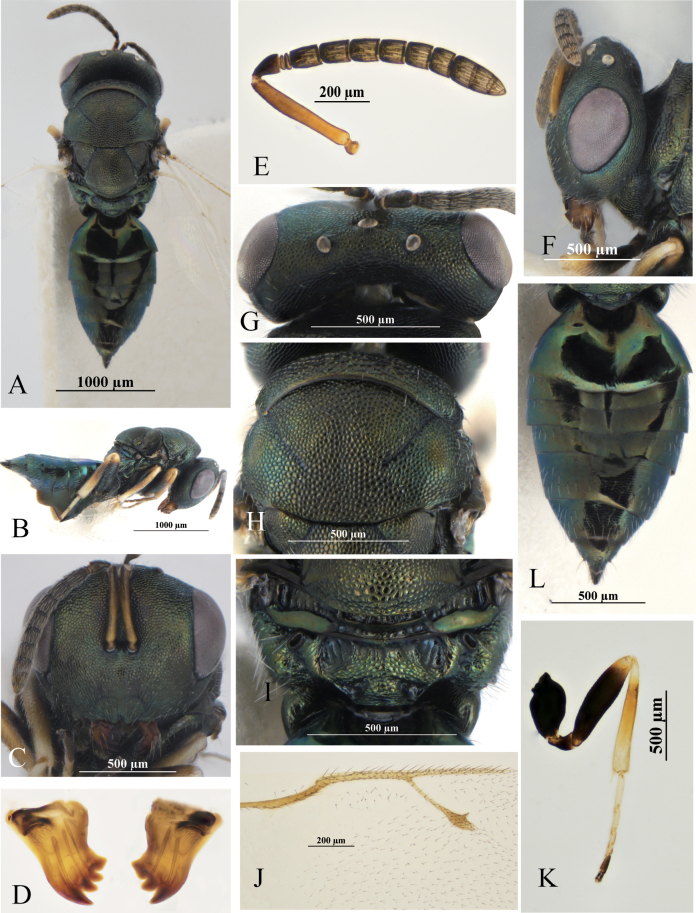 Figure 5
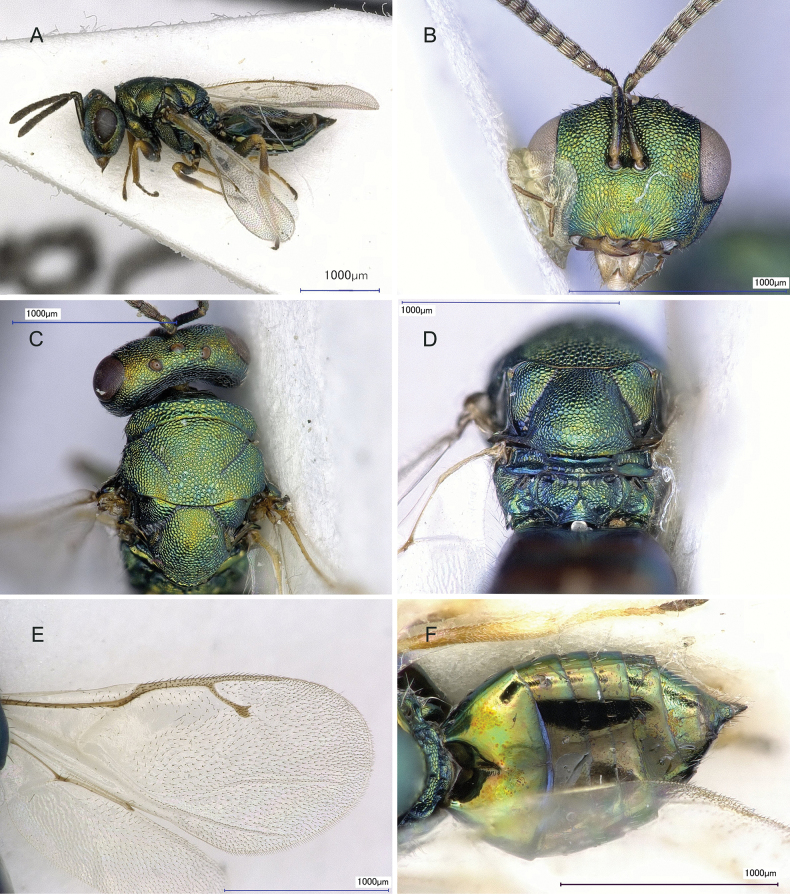 Figure 6
| Num. | Species | Detailed (re)description in Chinese | Distribution in China | Citation | Deposition of type material |
|---|---|---|---|---|---|
| 1 | Yes | Xinjiang |
|
| |
| 2 | Yes | Beijing |
|
| |
| 3 | Yes | Jiangxi, Shandong |
| ||
| 4 | Yes | Fujian |
|
| |
| 5 | Yes | Heilongjiang |
|
| |
| 6 | Yes | Xinjiang |
|
| |
| 7 | Yes | Beijing |
|
| |
| 8 | Yes | Ningxia |
|
| |
| 9 | Yes | Beijing |
|
| |
| 10 | No | Jiangsu, Xinjiang, Xizang, Sichuan, Yunnan, Zhejiang | |||
| 11 | Yes | Qinghai |
|
| |
| 12 | Yes | Qinghai |
|
| |
| 13 | Yes | Beijing, Fujian, Jilin, Xinjiang | |||
| 14 | Yes | Inner Mongolia |
|
| |
| 15 | Yes | Shanxi |
|
| |
| 16 | Yes | Fujian, Xinjiang |
| ||
| 17 | Yes | Xinjiang | This study |
| |
| 18 | Yes | Xinjiang |
|
| |
| 19 | No | Xinjiang |
|
| |
| 20 | Yes | Xinjiang | In this study |
| |
| 21 | Yes | Taiwan, Xizang |
|
|
| 1 | Both mandibles with four 4:4 (Fig. |
|
| – | Left mandible with three teeth and right mandible with four (Fig. |
|
| 2 |
| |
| – |
| |
| 3 | Body length 3.0–3.4 |
|
| – | Body length 2.7–3.1 |
|
Peer Reviews
No public reviews on file for this paper yet. If you reviewed it on a platform where reviews are public (OpenReview, ICLR, NeurIPS, ICML), you can paste yours below so the community can read it here.
Videos
No videos yet. Explain this paper in a talk, walkthrough, or lecture? Add one.
Taxonomy
TopicsPlant and animal studies · Hymenoptera taxonomy and phylogeny · Plant Parasitism and Resistance
Introduction
The genus Pteromalus Swederus, 1795 (type species Ichneumonpuparum (Linnaeus, 1795)) belongs to the family Pteromalidae, subfamily Pteromalinae, and is distributed in the all the zoogeographical regions of the world (UCD 2024). This genus includes about 500 described species, with 375 in Europe alone (Gibson et al. 2024). It is the most speciose genus of the family Pteromalidae and has been taxonomically studied since the 19^th^ century (Maletti et al. 2021). The genus can be recognized by the following combination of characters (Graham 1969; Bouček and Rasplus 1991; Bouček and Heydon 1997; Baur 2015): clypeus striate, its anterior margin truncate or weakly to strongly emarginate, always without a median tooth; flagellum with two anelli and six funicular segments; clava in females symmetrical; prepectus with relatively small upper triangular area; paraspiracular sulci rather deep and usually with some transverse costulae. Most taxonomic or faunistic studies of Pteromalus concern the Palaearctic fauna (Graham 1969, 1984; Bouček and Rasplus 1991; Dzhaokmen 1998, 2001; Gijswijt 1999; Mitroiu 2008; Baur 2015; Klimmek and Baur 2018; Maletti et al. 2021; Haas et al. 2021; Yan et al. 2023).
All species of Pteromalus with known biology are parasitoids of larvae and pupae of various holometabolous insects, such as Lepidoptera, Coleoptera, gall-forming Hymenoptera (Cynipidae, Tenthredinidae), and Diptera (Tephritidae) (Mitroiu 2008; Baur 2015). They play a crucial role in nature as regulating agents of these phytophagous insects (Bouček and Rasplus 1991; Ishizaki and Ishikawa 2010; Mahdavi and Madjdzadeh 2013; Li et al. 2018; Mbata and Warsi 2019; Haas et al. 2021). Despite their ecological and economic importance, Pteromalus species are often difficult to identify because of their diversity and sometimes subtle morphological characters that are used to separate species (Burks et al. 2022). Until now, the genus Pteromalus comprised 494 valid species, with only 19 species being recorded from China, including P.albipennis Walker, 1835; P.astragali (Liao, 1987); P.bifoveolatus Förster, 1861; P.chrysos Walker, 1836; P.coleophorae Yang & Yao, 2015; P.elevatus (Walker, 1834); P.miyunensis Yao & Yang, 2008; P.orgyiae Yang & Yao, 2015; P.procerus Graham, 1969; P.puparum (Linnaeus, 1758); P.qinghaiensis Liao, 1987; P.sanjiangyuanicus Yang, 2020; P.semotus (Walker, 1834); P.sequester Walker, 1835; P.shanxiensis Huang, 1987; P.smaragdus Graham, 1969; P.temporalis (Graham, 1969); P.varians (Spinola, 1808); and P.xizangensis (Liao, 1982) (Liao 1982; Sheng 1985; Liao et al. 1987; Huang et al. 1987; Huang et al. 2003; Yao and Yang 2008; Ye et al. 2012; Yang et al. 2015; Li et al. 2018; Yang et al. 2020; Yan et al. 2023).
The Chinese Pteromalus fauna has been poorly studied until now, and many new species, as well as newly recorded species, may be found in China. During a biodiversity expedition of the pteromalid wasps in northern Xinjiang, China, between 2014 and 2022 (funded by the first author’s projects), most Pteromalus individuals belonged to species not previously known from Xinjiang. The aim of this work is to review the genus Pteromalus from China based on this collected material and data from the literature data (1982–2023), to describe two new species, and to provide the key to the two new species and their similar species.
Materials and methods
Collected material
All specimens of Pteromalusxiaomoheensis Yan & Li, sp. nov. and partial specimens of Pteromalussteppensis Li & Hu, sp. nov. were collected with a sweeping net from Xinjiang, China during 2020–2022. Some specimens of Pteromalussteppensis Li & Hu, sp. nov. were reared from their hosts during 2014–2016, the rearing process of Pteromalussteppensis Li & Hu, sp. nov. and P.varians (Spinola, 1808) follows Li et al. (2018). All specimens were mounted, labeled, and examined under a Nikon SMZ 745T stereomicroscope. Images except for P.tripolii Graham were taken with a Nikon DS-Fi3 connected to a Nikon SMZ 25 stereomicroscope and the images of P.tripolii were downloaded from the interactive key http://pteromalus.identificationkey.fr/mkey.html in Klimmek and Baur (2018). All images were stacked with NIS-Elements software and arranged in figures using Adobe Photoshop. All specimens from Xinjiang, China, including the types of the new species are deposited in the Insect Collection of the College of Life Science and Technology, Urumqi, Xinjiang, China (ICXU), and all specimens from the other provinces in China are deposited in the Institute of Zoology, Chinese Academy of Sciences, Beijing, China (IZCAS).
Morphological description
Morphological terms follow Bouček (1988), Gibson et al. (1997), and Burks et al. (2022). Body length excludes the protruding parts of ovipositor sheaths and was measured in millimeters (mm); other measurements are given as ratios. Abbreviations of morphological terms used are: Fu_n_ = antennal funicular 1, 2…; Gt_n_ = gastral tergite 1, 2…; OOL = shortest distance between eye margin and a posterior ocellus; POL = shortest distance between posterior ocelli.
Results
Taxonomy
Twenty-one species of Pteromalus from China are summarized in Table 1, including 19 species previously reported from China. Among them, there are six species from Xinjiang, including four species reported by Li et al. (2018) (P.varians (Spinola, 1808)) and Yan et al. (2023) (P.elevatus (Walker, 1834), P.albipennis Walker, 1835, P.temporalis (Graham, 1969)) and the two new species, P.steppensis Li & Hu, sp. nov. and P.xiaomoheensis Yan & Li, sp. nov.
The number of teeth on each mandible (both mandibles with four teeth, or left mandible with three teeth and right mandible with four) was not considered a good key character because of the lack of visibility (Gibson et al. 2024), but it is an important differentiating feature for species recognition. Thus, characterize our specimens by reporting the number of mandibular teeth, including the two new species: P.steppensis Li & Hu, sp. nov. (both mandibles with four teeth), and P.xiaomoheensis Yan & Li, sp. nov. (left mandible with three teeth and right mandible with four). According to Gibson et al. (2024), at present there are 22 species of Pteromalus with a 4:4 mandibular formula worldwide, including eight species reported by Graham (1969) (P.apum (Retzius, 1783)) (as P.venustus Statz, 1938), P.bifoveolatus Förster, 1861, P.procerus, P.proprius Walker, 1874, P.puparum (Linnaeus, 1758) (type species of Pteromalus), P.smaragdus Graham, 1969, P.squamifer Thomson, 1878 and P.vopiscus Walker, 1839, six species described from Europe since 1969 (P.bottnicus Vikberg, 1979, P.briani Baur, 2015, P.discors Graham, 1992, P.osmiae Hedqvist, 1979, P.paludicola Bouček, 1972, and P.sylveni Hedqvist, 1979), three species from Kazakhstan (P.melitaeae Dzhanokmen, 1998, P.maculatus Dzhanokmen, 1998, and P.transiliensis Dzhanokmen, 1998), four species from China (P.miyunensis Yao & Yang, 2008, P.orgyiae Yang & Yao, 2015, P.qinghaiensis Liao, 1987, and P.sanjiangyuanicus Yang, 2020), and one species from North America (P.quadridentatus Gibson, 2024). Pteromalussteppensis Li & Hu, sp. nov. is different from the above 22 species and thus is newly described herein. The other new species, P.xiaomoheensis Yan & Li, sp. nov. is identified as belonging to the P.albipennis group of species and is separated from the existing species of that group based on Dzhanokmen (2001), Baur (2015), Klimmek and Baur (2018), and Maletti et al. (2021).
Description two new species of Pteromalus from Xinjiang, China.
Key to the two new species and their similar species (Female)
**: **
Pteromalus
steppensis
Taxon classificationAnimaliaHymenopteraPteromalidae
Li & Hu sp. nov.
051876D1-F96E-542B-A6E4-8A4206AA3ADC
https://zoobank.org/B206A28A-E5AA-4ECB-9B1B-73037259EDC4
Type material.
Holotype. • 1 ♀ (ICXU 20240801), Xinjiang, China, swept by Qin Li research group from Ulmuspumila L. (Ulmaceae) in People’s park of Changji City; 44°01'33.38"N, 87°18'42.67"E; 567 m; 24 May 2022and deposited in ICXU. Paratypes: • 26 ♀ (ICXU 20240802–20240827), and 68 ♂ (ICXU 20240828–20240895), same collection site as holotype; China, Xinjiang, Urumqi, campus of Xinjiang University, Qin Li reared from the larva and pupa of Orchestessteppensis Korotyaev, 2016: • 5 ♀ (ICXU 20240896–20240900) 2 ♂ (ICXU 20240901–20240902), 30 May 2014; • 1 ♂ (ICXU 20240903), 31 May 2015; • 2 ♀ (ICXU 20240904–20240905), 2 Jun 2015; • 1 ♀ (ICXU 20240906), 3 Jun 2015; • 1 ♂ (ICXU 20240907), 4 Jun 2015; • 2 ♀ (ICXU 20240908–20240909), 7 Jun 2015; • 26 ♀ (ICXU 20240910–20240935), 8 Jun 2015; • 9 ♀ (ICXU 20240936–20240944), 9 Jun 2015; • 8 ♀ (ICXU 20240945–20240952), 12 Jun 2015; • 1 ♀ (ICXU 20240953), 15 Jun 2015; • 18 ♀ (ICXU 20240954–20240971) 14 ♂ (ICXU 20240972–20240985), 29.V.2016; • 5 ♀ (ICXU 20240986–20240990)13 ♂ (ICXU 20240991–20241003), 31 May 2016; • 2 ♀ (ICXU 20241004–20241005) 2 ♂ (ICXU 20241006–20241007), 3 Jun 2016; • 2♀ (ICXU 20241008–20241009), 8 Jun 2016; • 3 ♀ (ICXU 20241010–20241012) 1♂ (ICXU 20241013), 13 Jun 2016; • 2 ♀ (ICXU 20241014–20241015) 2 ♂ (ICXU 20241016–20241017), 23 Jun 2016.
Description.
Female. Body (Fig. 1A) length 2.5–3.2 mm (n = 24). Head and mesosoma dark green, propodeum with bluish-green metallic reflections, metasoma dark green with shine, hind margin of Gt_1_, Gt_5_ and Gt_6_, mid-part of Gt_2_, Gt_3_ and Gt_4_ black. Antenna with yellowish-brown scape; dorsal side of pedicel and flagellum dark chocolate-brown; ventral side yellowish brown. Mandibles brown, with dark-brown teeth. Legs with all coxae dark, metallic green; femora dark-chocolate-brown, tibiae and tarsi yellowish brown except last segment black-brown. Wings hyaline, forewing with venation brown.
P.steppensis Li & Hu, sp. nov. A–J female A habitus, dorsal view B head, frontal view C mandible D antenna E head, lateral view F head, dorsal view G propodeum, dorsal view H hind coxa I forewing J metasoma, dorsal view K male, lateral view.
Head in frontal view (Fig. 1B) 1.26–1.35× as broad as high, face with metallic reflections and regular raised-reticulation; clypeus (Fig. 1B) with longitudinal striations; lower margin moderately emarginate, without teeth; both mandibles (Fig. 1C) 4-toothed. Antennae (Fig. 1B, D) inserted at centre of face, higher than the lower margin of eyes; distance between upper margin of antennal toruli and lower margin of median ocellus 1.00–1.42× as long as distance between lower margin of antennal toruli and lower margin of clypeus; antennae with scape reaching lower margin of anterior ocellus, 7.25–7.63× as long as broad; pedicel 1.33–1.67× as long as broad in dorsal view, 1.71–1.98× as long as fu_1_; two anelli annular; funicular segments connected tightly to each other and each with one row of sensilla; fu_1_ and fu_2_ 1.00–1.20× as long as broad each, fu_3_ quadrate, fu_4_ and fu_5_ 0.79–0.87 as long as broad each, fu_6_ 0.64–0.69× as long as broad; clava 2.13–2.67× as long as broad; pedicle and flagellum combined 0.73–0.84× head width. Head in lateral view as in Fig. 1E; eye height 1.24–1.46× eye width; malar sulcus linear and complete; malar space 0.35–0.50× eye height. Head in dorsal view (Fig. 1F) about 2.13–2.45× as broad as long; POL 1.10–1.14× OOL (Fig. 1F).
Mesosoma in dorsal view 0.84–0.87× head width; pronotum collar margined with carina, 0.71–0.85× as wide as mesoscutum, medially 1/9–1/7× as long as mesoscutum; mesoscutum 0.51–0.63× as long as broad; scutellum 0.90–1.00× as long as width, frenal line absent. Propodeum (Fig. 1G) 0.50–0.55× as long as scutellum, with medial area smooth; median carina and plica complete and sharp; nucha with fine transverse striations. Mesosoma in lateral view with prepectus smooth, 0.75–0.86× as long as tegula; entire thoracic pleura regularly reticulate, except upper mesepimeron smooth and shiny-metallic. Forewing (Fig. 1I) with apex exceeding apex of gaster, 2.01–2.24× as long as broad; upper surface of costal cell bare, lower surface of costal cell with 2–3 rows of setae interrupted medially; basal setal line incomplete and basal cell bare; speculum large and open posteriorly. Marginal vein length 0.96–1.00× postmarginal vein length and 1.43–1.68× stigmal vein length; postmarginal vein length 1.50–1.71× stigmal vein length. Metacoxa in dorsal view bare, with several long setaes (Fig. 1H), metafeumur 4.29–4.71× as long as broad.
Gaster (Fig. 1J) long-oval, 1.98–2.38× as long as broad, 1.43–1.88× as long as mesosoma, 1.13–1.21× as long as head plus mesosoma; Gt1 0.20–0.25× as long as gaster and sides of Gt1 with some sparse long setaes; Gt7 0.62–0.73× as long as broad; ovipositor sheaths slightly exserted; hypopygium extending about 0.38–0.45× the length of gaster.
Male (Fig. 1K). Body length: 3.0–3.2 mm. Body color: head, mesosoma, and metasoma the same color as the female; antenna yellowish brown; legs yellow, except all coxae dark green with metallic reflections and apical tarsi black-brown. Wings hyaline, forewing with venation brown.
Head in frontal view 1.25–1.35× as broad as high; distance between upper margin of antennal toruli and lower margin of median ocellus 0.92–1.16× as long as distance between lower margin of antennal toruli and lower margin of clypeus; pedice and flagellum combined 0.89–0.96× head width. Head in dorsal view 2.08–2.29× as broad as long; POL 1.19–1.29× OOL.
Mesosoma in dorsal view 0.79–0.81× as head width; pronotum 0.81–0.85× as wide as mesoscutum; mesoscutum 0.66–0.67× as long as broad. Propodeum 0.49–0.54× as long as scutellum. Forewing with marginal vein length 1.03–1.19× postmarginal vein length and 1.48–1.88× stigmal vein length; postmarginal vein length 1.44–1.60× stigmal vein length.
Gaster long-oval, 1.89–2.18× as long as broad, 0.77–0.84× as long as head plus mesosoma; Gt1 about 0.35–0.39× as long as gaster.
Etymology.
The species is named after its host species Orchestessteppensis Korotyaev, 2016 (Coloptera, Curculionidae) (used as a noun in apposition).
Biology.
This species was reared as a primary, solitary ectoparasitoid of the larval and pupal stage of O.steppensis Korotyaev, 2016. Figures of the development and its damage on the host are provided in Figs 3, 4.
Distribution.
Changji and Urumqi, Xinjiang, China.
Comments.
This species is similar to P.procerus. In females of that species: both mandibles with four teeth; anterior margin of clypeus shallowly emarginate, hardly impressed in the middle; clypeus strigose, the striae hardly extending on to the face and genae; pronotal collar distinctly less wide than the mesoscutum, shorter medially than at the sides, medially from slightly more than 1/8–1/7 as long as the mesoscutum, finely reticulate with a narrow shiny strip along its hind edge, slightly to distinctly margined anteriorly; propodeum somewhat more than half as long as the mesoscutellum (Graham 1969: fig. 389); gaster lanceolate or sublanceolate, usually as long as or slightly longer than the head plus thorax, occasionally slightly shorter, 1.8–2.3 times as long as broad. However, the new species can be distinguished from P.procerus by the following: POL 1.10–1.14× OOL; distance between upper margin of antennal toruli and lower margin of median ocellus 1.00–1.42× as long as distance between lower margin of antennal toruli and lower margin of clypeus; antennae with scape reaching lower margin of anterior ocellus; combined length of pedicellus and flagellum shorter than breadth of head (0.73–0.84×); medial area of propodeum smooth and shiny. In P.procerus: POL 1.20–1.25× OOL; toruli about equidistant from the median ocellus and the lower margin of clypeus; antennae with scape reaching to level of vertex or slightly above it; combined length of pedicellus and flagellum almost equal to breadth of head; propodeum panels almost uniformly reticulate and not shiny.
In males of P.steppensis Li & Hu, sp. nov. (Fig. 1K): antenna yellowish brown; legs yellow, except all coxae dark green with metallic reflections, and apical tarsi black-brown; propodeum smooth and shiny, 0.49–0.54× as long as scutellum. In contrast, in P.procerus (Fig. 2A–D): antenna dark brown to black; pale parts of the legs yellowish, hind femora lightly infuscate at the base only and the fore and mid femora yellowish; propodeum reticulated, about 2/3× as long as scutellum.
P.procerus Graham, 1969 A–C male A body, lateral view B mesosoma and metasoma, dorsal view C head, frontal view D paratype information.
Development stages of P.steppensis Li & Hu, sp. nov. and their emergence holes, A–H. A, B the parasitoid larva feeding on the third larva of the host C prepupa D–F pupa G, H emergence holes.
Damage on Ulmuspumila leaves made by the adults as well as the larvae of O.steppensis Korotyaev, 2016 A–D. A, B holes on U.pumila leaves made by the adults C, DU.pumila leaves.
Pteromalus
xiaomoheensis
Taxon classificationAnimaliaHymenopteraPteromalidae
Yan & Li sp. nov.
698E56FC-4F1B-55CD-B4BA-0240534C41DB
https://zoobank.org/A52C92F0-6305-431B-B59C-AC9BAF665E4C
Type material.
Holotype. • 1 ♀ (ICXU 20246442), Xinjiang, China, Gongliu County of Yili Prefecture; 43°10'52.04"N, 82°44'9.49"E; 1377 m; 10 Jul 2021, coll. Liqin research group. Paratypes. • 8 ♀ (ICXU 20246443–20246450), same collection information as holotype; • 2 ♀ (ICXU 20246451–20246452), Qinghe County of Altay Prefecture; 46°26'5.83"N, 90°2'45.15"E; 600 m; 9 Jul 2020, coll. Liqin research group; • 1 ♀ (ICXU 20246453), Altai City of Altay Prefecture; 47°39'26.97"N, 88°17'20.22"E; 624 m; 24 Jun 2021, coll. Liqin research group; • 1 ♀ (ICXU 20246454), Fuyun County of Altay Prefecture; 47°1'7.69"N, 89°45'24.35"E; 830 m; 11 Jul 2020, coll. Liqin research group; • 6 ♀ (ICXU 20246455–20246460), Zhaosu County of Yili Prefecture; 43°9'10.43"N, 81°26'38.83"E; 1556 m; 9 Jul 2021, coll. Liqin research group; • 1 ♀ (ICXU 20246461), Xinyuan County of Yili Prefecture; 43°22'38"N, 83°36'18"E; 1279 m; 28 Jul 2018, Coll. Hongying Hu research group; • 1 ♀ (ICXU 20246462), Tekes County of Yili Prefecture; 43°13'19.12"N, 81°48'31.80"E; 1200 m; 8 Jul 2021, coll. Liqin research group; • 33 ♀, Tekes County of Yili Prefecture; 43°9'19.98"N, 88°47'23.76"E; 1184 m; 9 Jul 2021, coll. Liqin research group; • 1 ♀ (ICXU 20246463), Gongliu County of Yili Prefecture; 43°20'22.85"N, 82°31'4.19"E; 881 m; 10 Jul 2021, coll. Liqin research group; • 1 ♀ (ICXU 20246464), Urumqi County of Urumqi; 43°27'25.02"N, 87°22'37.20"E; 1757 m; 5 Jul 2022, Coll. Hongying research Hu.
Description.
Female. Body (Fig. 5A, B) length 3.0–3.4 mm (n = 5). Head and mesosoma dark metallic-green, metasoma dark green with reflections. Antenna with yellowish-brown scape; pedicel and flagellum dark-chocolate-brown. Legs (Fig. 5K) with all coxae dark metallic-green, femora dark green, except for apical part brown, tibiae yellowish brown to brown and tarsi pale yellow, except last segment brown. Wings hyaline; forewing with venation brown.
P.xiaomoheensis Yan & Li, sp. nov. holotype A–L female A habitus, dorsal view B body, lateral view C head, frontal view D mandible E antenna F head, lateral view G head, dorsal view H mesoscutem, dorsal view I propodeum, dorsal view J forewing K hind leg L metasoma, dorsal view.
Head in frontal view (Fig. 5C) 1.19–1.28× as broad as high, face with metallic reflections and regular raised-reticulations; clypeus (Fig. 5C) with longitudinal striations, with lower margin deeply incised medially, hence appearing almost bidentate; left mandible 3-toothed and right mandible 4-toothed (Fig. 5D). Antennae (Fig. 5C) inserted at centre of face, higher than the lower margin of eyes; distance between upper margin of antennal toruli and lower margin of median ocellus 0.91–1.11× as long as distance between lower margin of antennal toruli and lower margin of clypeus; antennae with scape reaching lower margin of anterior ocellus; pedicel 1.55–1.59× as long as broad in dorsal view; two anelli annular; funicular segments (Fig. 5E, G) connected tightly to each other and each with two rows of sensilla; fu_1_ to fu_4_ each about 1.10–1.30× as long as broad each; fu_5_ 0.95–1.12× as long as broad; fu_6_ 0.73–0.77× as long as broad; clava 2.52–2.68× as long as broad; pedicle and flagellum combined 0.75–0.90× head width. Head in lateral view (Fig. 5F), eye height 1.42–1.70× as eye width; malar sulcus linear and complete, and malar space 0.46–0.48× eye height. Head in dorsal view (Fig. 5G), 2.19–2.44× as broad as long; POL 1.50–1.86× OOL.
Mesosoma in dorsal view (Fig. 5A) 0.86–0.96× as head width; pronotum collar (Fig. 5H) margined with carina, 0.88–0.91× as wide as mesoscutum, medially one quarter as long as mesoscutum; mesoscutum 0.62–0.72× as long as broad; scutellum 0.95–1.00× as long as width, frenal line absent. Propodeum (Fig. 5I) 0.35–0.47× as long as scutellum, medial area reticulated; median carina and plica complete and sharp; nucha large and reticulate. Mesosoma in lateral view with prepectus smooth, 0.62–0.80× as long as tegula; entire thoracic pleura regularly reticulate, except the upper mesepimeron smooth and shiny metallic. Forewing (Fig. 5J) apex exceeding apex of gaster, 2.05–2.14× as long as broad; lower surface of costal cell with one row of hairs interrupted medially; basal setal line and basal cell bare; speculum large and open posteriorly. Marginal vein length 0.96–1.04× postmarginal vein length and 1.09–1.13× longer than stigmal vein length; postmarginal vein 1.10–1.14× as long as stigmal vein. Metacoxa in dorsal view bare, metafumur (Fig. 5K) 3.87–4.16× as long as broad.
Gaster long-oval (Fig. 5L), 1.57–1.85× as long as broad, 1.06–1.30× as long as mesosoma, 0.81–0.97× as long as head plus mesosoma; Gt_1_ about 0.31–0.35× as long as gaster; Gt_7_ 0.63–1.14× as long as broad; ovipositor sheaths exserted, length of extend part 0.5–1.25× as long as Gt_7_ length; hypopygium extending about 0.51–0.67× the length of gaster.
Male. Unknown.
Etymology.
The species is named after the collection locality of its holotype.
Biology.
Unknown.
Distribution.
Xinjiang, China: Yili Prefecture (Gongliu County; Zhaosu County; Xinyuan County; Tekes County; Gongliu County), Altay Prefecture (Qinghe County; Altai City) and Urumqi.
Comments.
This species is similar to P.tripolii (Fig. 6A–F); both species belong to the albipennis species group, both have with left mandible with three teeth and right mandible with four; head and thorax brightly metallic, green to blue, brassy, or coppery; antenna with sensilla usually numerous and in two irregular rows on at least the proximal segments of the funicle; fu_1_ longer than broad and fu_6_ quadrate or transverse; combined length of pedicellus and flagellum distinctly less than the breadth of the head; propodeum medially a little less than half as long as the scutellum (Graham 1969: fig. 377); gaster ovate, basal tergite occupying 1/3–2/5 of the total length. However the new species is distinguished from P.tripolii by the following characters: body color dark blue; body length 3.0–3.4 mm; gaster long-oval (Fig. 5L), 1.57–1.85× as long as broad, 1.06–1.30× as long as mesosoma. In P.tripolii: body color usually bright green to blue (Fig. 6A); body length 2.7–3.1 mm (Fig. 6A); gaster (Fig. 6F) short-oval, about as long as, or slightly shorter than, the mesosoma, about as broad as the latter, 1.2 to 1.6 times as long as broad, acute but not acuminate apically (Fig. 6A).
P.tripolii (Graham, 1969) A–F female A body, lateral view B head, frontal view C head and mesosoma, dorsal view D propodeum, dorsal view E forewing F gaster, dorsal view.
Discussion
This study adds significant knowledge on the faunal composition and distribution of Pteromalus species in China. With the description of two new species from western China (Eastern Palaearctic Region), the genus now includes 496 valid species worldwide, with 21 of these in China and six species in Xinjiang. As reported by Gibson et al. (2024: p202) “Described species of Pteromalus with a 4:4 mandibular formula appear to be far fewer in number than those with a 3:4 formula. For example, of the 67 species Graham (1969) treated from northwestern Europe, eight named species were reported under Pteromalus and 59 named species under Habrocytus (12%)’’. We had similar results, with only nine Chinese species of Pteromalus having four teeth on both mandibles, and 12 species with three teeth on the left mandible and four teeth on the right mandible.
Pteromalussteppensis Li & Hu, sp. nov. is described from both sexes and was reared as a primary, solitary ectoparasitoid of larval and pupal stages of Orchestes. Steppensis. Detailed information on its life history and phenology of its host in Xinjiang, images of its larval and pupal stages, as well as of its host’s life habits can be found in the publication by Li et al. (2018). Almost 10 years have passed since the first author (Qin Li) reared 558 (340 ♀, 218 ♂) specimens of this new species from its host O.steppensis. Li et al. (2018) reported this new species as Pteromalus sp. 2. Guohua Yan studied the integrated taxonomy of Pteromalus from Xinjiang based on three methods, including morphological taxonomy, comparative morphology, and DNA Barcoding (28S rDNA and ITS2 genes) (Li et al. 2018). She collected 95 specimens (27 ♀, 68 ♂) of this new species by sweep netting on Ulmuspumila L. (Ulmaceae) heavily infested by the pest, O.steppensis in People’s park of Changji City, Urumqi, Xinjiang, China. She compared her specimens with the specimens reared by Qin Li from the elm pest, O.steppensis and based on its morphological characters, and confirmed they are the same species, P.steppensis Li & Hu, sp. nov. These results indicate that many more investigations are necessary to have a complete overview of the Pteromalus fauna from China.
Supplementary Material
XML Treatment for Pteromalus steppensis
XML Treatment for Pteromalus xiaomoheensis
The reference list from the paper itself. Each links out to its DOI / PubMed record.
- 1Baur H (2015) Pushing the limits—two new species of Pteromalus (Hymenoptera, Chalcidoidea, Pteromalidae) from Central Europe with remarkable morphology.Zoo Keys 514: 43–72. 10.3897/zookeys.514.9910 PMC 452502426261432 · doi ↗ · pubmed ↗
- 2Bouček Z Heydon SL (1997) Pteromalidae. In: Gibson GAP Huber JT Woolley JB (Eds) Annotated Keys to the Genera of Nearctic Chalcidoidea (Hymenoptera).NRC Research Press, Ottawa, 541–692. 10.1093/aesa/91.3.359 · doi ↗
- 3Bouček Z Rasplus J-Y (1991) Illustrated key to West-Palearctic genera of Pteromalidae (Hymenoptera: Chalcidoidea). Institut National de la Recherche Agronomique Paris, 140 pp.
- 4Burks R Mitroiu MD Fusu L Heraty JM Janšta P Heydon S Papilloud NDS Peters RS Tselikh EV Woolley J Bvan Noort S Baur H Cruaud A Darling C Haas M Hanson P Krogmann L Rasplus JY (2022) From hell’s heart, I stab at thee! A determined approach towards a monophyletic Pteromalidae and reclassification of Chalcidoidea (Hymenoptera).Journal of Hymenoptera Research 94: 13–88. 10.3897/jhr.94.94263 · doi ↗
- 5Dzhanokmen KA (1998) Review of pteromalids of the genus Pteromalus Swederus (Hymenoptera, Pteromalidae) from Kazakhstan: I.Entomological Review 78: 706–717. [Translated from Entomologicheskoe Obozrenie 77: 483–496.]
- 6Dzhanokmen KA (2001) Review of pteromalids of the genus Pteromalus Swederus (Hymenoptera, Pteromalidae) from Kazakhstan: II.Entomological Review 81: 75–97. [Translated from Entomologicheskoe Obozrenie 80: 472–496.]
- 7Gibson GAP Yonathan U Jade S Paul KA Tara DG Zhang YM Baur H Gates M Franklin MT (2024) The species of Pteromalus Swederus in America north of Mexico with a 4:4 mandibular formula, and description of a potential biocontrol agent of the introduced pest Anthonomusrubi (Herbst) (Coleoptera: Curculionidae).Zootaxa 5501(2): 201–236. 10.11646/zootaxa.5501.2.139647117 · doi ↗ · pubmed ↗
- 8Gijswijt MJ (1999) Four new species of Pteromalus Swederus (Hymenoptera: Chalcidoidea: Peteromalidae) and redescriptions of three other species.Zoologische Mededelingen Leiden 72(7): 167–170.