The Estimation of the Number of Aborted Girls in South Korea
Hyunkuk Cho

TL;DR
This study estimates that around 340,000 girls were likely aborted in South Korea from 1981 to 2010 due to a cultural preference for sons.
Contribution
The paper provides a novel method to estimate the number of female abortions based on the sex ratio at birth and male birth data.
Findings
In 1981, approximately 4,505 girls were likely aborted based on the discrepancy between expected and actual female births.
From 1981 to 2010, an estimated 340,000 girls were likely aborted due to son preference.
The actual number of abortions may be higher as some boys were also likely aborted.
Abstract
Countries such as China and India are well known for their preference for sons. South Korea is another country with a long‐standing preference for sons, with the sex ratio at birth (SRB) reaching as high as 116.5 in some years. Given that the normal SRB ranges from 105 to 107, a higher SRB suggests that some girls were likely aborted. This study estimates the number of girls aborted in the country. Using an SRB of 106 as normal, we first calculate the expected number of girls born (NEG) based on the actual number of newborn boys (NAB). That is, NEG = (100/106) × NAB. We then compare NEG with the actual number of newborn girls. In 1981, 448 655 boys were born, which would imply that 423 259 girls were expected. However, since 418 754 girls were actually born that year, 4505 girls were likely aborted. In total, approximately 340 000 girls were aborted from 1981 to 2010, accounting for…
Genes, proteins, chemicals, diseases, species, mutations and cell lines named across the full text — each resolved to its canonical identifier and authoritative record.
Click any figure to enlarge with its caption.
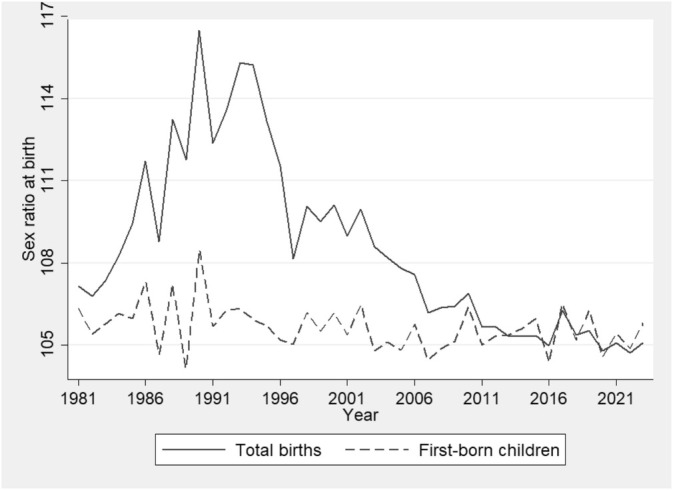 FIGURE 1
| Year (1) | Number of boys born (2) | Number of girls born (3) | Number of girls expected born (4) | Estimated number of aborted girls (5) |
|---|---|---|---|---|
| 1981 | 448 655 | 418 754 | 423 259 | 4505 |
| 1982 | 438 077 | 410 235 | 413 280 | 3045 |
| 1983 | 398 194 | 370 961 | 375 655 | 4694 |
| 1984 | 350 775 | 324 018 | 330 920 | 6902 |
| 1985 | 342 506 | 312 983 | 323 119 | 10 136 |
| 1986 | 335 588 | 300 431 | 316 592 | 16 161 |
| 1987 | 325 038 | 298 793 | 306 640 | 7847 |
| 1988 | 336 203 | 296 889 | 317 173 | 20 284 |
| 1989 | 337 475 | 301 956 | 318 373 | 16 417 |
| 1990 | 349 617 | 300 121 | 329 827 | 29 706 |
| 1991 | 375 276 | 333 999 | 354 034 | 20 035 |
| 1992 | 388 573 | 342 105 | 366 578 | 24 473 |
| 1993 | 383 365 | 332 461 | 361 665 | 29 204 |
| 1994 | 386 080 | 335 105 | 364 226 | 29 121 |
| 1995 | 379 604 | 335 416 | 358 117 | 22 701 |
| 1996 | 364 433 | 326 793 | 343 805 | 17 012 |
| 1997 | 350 929 | 324 465 | 331 065 | 6600 |
| 1998 | 336 147 | 305 447 | 317 120 | 11 673 |
| 1999 | 324 409 | 296 259 | 306 046 | 9787 |
| 2000 | 335 433 | 304 656 | 316 446 | 11 790 |
| 2001 | 291 989 | 267 945 | 275 461 | 7516 |
| 2002 | 260 228 | 236 683 | 245 498 | 8815 |
| 2003 | 257 727 | 237 309 | 243 139 | 5830 |
| 2004 | 247 835 | 229 123 | 233 807 | 4684 |
| 2005 | 227 592 | 211 115 | 214 709 | 3594 |
| 2006 | 234 110 | 217 649 | 220 858 | 3209 |
| 2007 | 255 872 | 240 950 | 241 389 | 439 |
| 2008 | 240 119 | 225 773 | 226 527 | 754 |
| 2009 | 229 351 | 215 498 | 216 369 | 871 |
| 2010 | 242 901 | 227 270 | 229 152 | 1882 |
- —Yeungnam University 10.13039/501100002649
Peer Reviews
No public reviews on file for this paper yet. If you reviewed it on a platform where reviews are public (OpenReview, ICLR, NeurIPS, ICML), you can paste yours below so the community can read it here.
Videos
No videos yet. Explain this paper in a talk, walkthrough, or lecture? Add one.
Taxonomy
TopicsDemographic Trends and Gender Preferences · Global Maternal and Child Health
Introduction
1
Countries such as China and India are well‐known for their preference for sons. South Korea also has a long‐standing preference for sons, with the sex ratio at birth (SRB) reaching as high as 116.5 in some years. Figure 1 shows that the SRB increased until the mid‐1990s, then decreased to 105 in 2020. Given that the normal SRB ranges from 105 to 107, a higher SRB suggests that some girls were likely aborted during this period.
Sex ratio at birth from 1981 to 2023. The numbers in this figure were calculated by the author based on the data source provided in endnote 4.
To achieve a desired number of boys, women could continue having children until they reached that number, which likely kept the SRB within a normal range.1 However, if fetal gender detection had been available and abortion allowed, women could have aborted unwanted female fetuses, leading to an increase in the SRB, as seen in South Korea. Although abortion was illegal in the country, it was effectively tolerated, contributing to the elevated SRB.
This study estimates the number of girls who were likely aborted due to son preference. Using an SRB of 106 as normal, we first calculate the expected number of girls born (NEG) based on the actual number of newborn boys (NAB). That is, NEG = (100/106) × NAB. For example, if 106 boys were born in a year, the normal SRB of 106 indicates that 100 girls should be born. If fewer than 100 girls were born, some girls were likely aborted. In this way, we estimate the annual number of girls aborted from 1981 to 2010, the final year with an SRB greater than 106.
Son preference is not the only factor influencing SRB; other factors could also contribute to it. According to the Trivers–Willard hypothesis, women experiencing poor conditions may be more likely to terminate male fetuses or those perceived as weaker (Trivers and Willard 1973). Studies have shown that factors like malnutrition (Anderson and Bergström 1998; Almond et al. 2010) and natural disasters such as earthquakes (Fukuda et al. 1998) can increase the number of girls being born. If a year had a lower SRB for these reasons compared to the value that would have been achieved without any girl‐increasing events, we would be underestimating the number of aborted girls. However, malnutrition and earthquakes are not serious problems in South Korea, and therefore, the bias is unlikely to be large.
Additionally, studies, such as Oster (2005), reported that women infected with the hepatitis B virus (HBV) are more likely to give birth to boys, thereby raising the SRB. However, other studies (e.g., Das Gupta 2005; Lin and Luoh 2008; Lin et al. 2012) oppose this finding. For instance, Lin and Luoh (2008) found no significant effect based on Taiwanese data, reporting that the marginal increase in the probability of having a male birth for HBV mothers relative to non‐HBV mothers is only 0.0025. In addition, Das Gupta (2005) reported that the SRB for first‐born children in China was within the normal range, and the higher sex ratio at birth was driven by higher birth orders. It is worth noting that, as shown in Figure 1, the SRB among first‐born children in South Korea does not vary significantly over time, mostly remaining in the normal range. Given that the aforementioned factors should affect all birth orders, this suggests that the SRB is primarily influenced by son preference, rather than other factors. Finally, the fact that 1990 recorded the highest SRB in Figure 1, significantly higher than the two adjacent years, is likely due to the influence of the Chinese zodiac, as 1990 was the Year of the White Horse, which was considered unfavorable for the birth of girls.
This study contributes to the literature as follows. While previous studies on the number of girls aborted focused on other Asians including Chinese and Indian groups (Sen 1990; Abrevaya 2009), few have examined South Korea.2 Second, this study adds to the broader literature on son preference. Most previous studies have focused on the effects of son preference or high SRBs, including on sex selection (Chen et al. 2013), girls' health (Cho 2023; Ye et al. 2024), and subjective well‐being (Li 2021). Other studies from different strands include Ibupoto et al. (2025), who examined the effect of the sex composition of children on the desire for more children, presumably sons.
Literature Review and Background Information on Son Preference in South Korea
2
We review studies by Sen (1990) and Abrevaya (2009). Sen (1990) reported that, due to son preference, 50 million girls were missing in China, along with another 50 million girls missing in South and West Asia, as well as North Africa. The study considered an SRB of 105 as normal for the calculation. Abrevaya (2009) reported that the number of aborted girls in the United States among Chinese third and fourth births from 1991 to 2004 is approximately 900, and the estimate for Indian third and fourth births from 1992 to 2004 is nearly 1270. The study obtained these numbers by estimating the abortion rate for girls, which is given by the formula g=p~−pp1−p, where p is the boy‐birth probability, and p is the natural probability of a boy birth. It considered boys at birth to account for 52% as normal, which is equivalent to an SRB of 108.3 (= (0.52n/0.48n) × 100, where n represents the total number of births).
As table 9 of the paper indicates, when p~ = 0.53 for Chinese third‐born children, the abortion rate for girls (g) is equal to 3.8%. Since the total number of births for this birth order is 36018, the number of girls among them is equal to 16 928 (= 36 018 × 0.47), which represents 96.2% of 17 597 girls who would have been born without any selective abortion. This implies that 669 girls (= 17 597—16 928) were aborted for this birth order. Similarly, when p~ = 0.54 for Chinese forth‐born children, g is equal to 7.4%. Given that the total number of births for this birth order is 6802, the number of girls who would have been born is 3204. This means that 250 girls were aborted for this birth order. It is worth noting that the method is essentially the same as ours, and therefore, using this method yields the same result.3
South Korea has traditionally exhibited a strong preference for sons. This preference stems from the patriarchal family system established during the Choson dynasty (1392–1910), where the eldest son became the head of the family and inheritance passed through the male line, fostering a son‐centric culture (Larsen et al. 1998; Chung and Gupta 2007). However, son preference has notably declined and nearly disappeared in recent years. As described, 2010 marked the last year an SRB higher than 106 was recorded. Additionally, the percentage of married women who expressed a desire to have a son at all decreased from 18.0% in 2000 to just 5.7% in 2015 (Oh et al. 2016). Furthermore, data from the Korean General Social Survey (KGSS) shows a shift in preferences: in 2004, 36.2% of people with only one child preferred a son, while 31.9% preferred a daughter. By 2015, this had reversed, with 43.1% preferring a daughter and 35.6% preferring a son.4
Data and Results
3
The data used in this study come from the National Statistical Office, which provides information on the number of boys and girls born each year, as well as their birth orders.5 As shown in Table 1, in 1981, 448 655 boys and 418 754 girls were born, resulting in an SRB of 107.1. The number of newborn babies decreased thereafter. When the SRB peaked at 116.5 in 1990, 349 617 boys and 300 121 girls were born. Since the SRB remained at 106 or higher until 2010, we calculated the number of aborted girls up until that year.
Table 1 shows that 448 655 boys were born in 1981, which would imply that 423 259 girls (calculated as (100/106) × 448 655) were expected. However, since 418 754 girls were actually born that year, we estimate that 4505 girls (= 423 259 − 418 754) were likely aborted. Similarly, based on the 1982 data, an estimated 3045 girls were likely aborted. The year 1990 recorded the highest number of abortions, with 29 706 girls.
In total, approximately 340 000 girls were aborted from 1981 to 2010. Since 8.9 million girls were born during this period, the aborted girls account for 3.8% of all female births.
Conclusion
4
We estimated the number of aborted girls based on the number of boys born. Since some boys were likely aborted, the number of aborted girls is likely higher than 340 000. Therefore, this figure should be considered as an estimate of abortions due to son preference. Additionally, using a value other than 106 for the normal SRB will yield a different estimate. For instance, if we use 105 as the normal SRB, we estimate that approximately 430 000 girls were likely aborted. Using 107 as the normal SRB yields an estimate of approximately 250 000 abortions.
The reference list from the paper itself. Each links out to its DOI / PubMed record.
- 1Abrevaya, J. 2009. “Are There Missing Girls in the United States? Evidence From Birth Data.” American Economic Journal: Applied Economics 1, no. 2: 1–34.
- 2Almond, D. , L. Edlund , H. Li , and J. Zhang . 2010. “Long‐Term Effects of Early‐Life Development: Evidence From the 1959 to 1961 China Famine.” In The Economic Consequences of Demographic Change in East Asia, 321–345. University of Chicago Press.
- 3Anderson, R. , and S. Bergström . 1998. “Is Maternal Malnutrition Associated With a Low Sex Ratio at Birth?” Human Biology 70, no. 6: 1101–1106.9825599 · pubmed ↗
- 4Chao, F. , P. Gerland , A. R. Cook , and L. Alkema . 2019. “Systematic Assessment of the Sex Ratio at Birth for all Countries and Estimation of National Imbalances and Regional Reference Levels.” Proceedings of the National Academy of Sciences of the United States of America 116, no. 19: 9303–9311.30988199 10.1073/pnas.1812593116 PMC 6511063 · doi ↗ · pubmed ↗
- 5Chen, Y. , H. Li , and L. Meng . 2013. “Prenatal Sex Selection and Missing Girls in China: Evidence From the Diffusion of Diagnostic Ultrasound.” Journal of Human Resources 48, no. 1: 36–70.
- 6Cho, H. 2023. “Son Preference and Low Birth Weight for Girls.” Journal of Demographic Economics 89, no. 4: 553–568.
- 7Chung, W. , and M. D. Gupta . 2007. “The Decline of Son Preference in South Korea: The Roles of Development and Public Policy.” Population and Development Review 33, no. 4: 757–783.
- 8Das Gupta, M. 2005. “Explaining Asia's “Missing Women”: A New Look at the Data.” Population and Development Review 31, no. 3: 529–535. 10.1111/j.1728-4457.2005.00082.x. · doi ↗