Persistent free radicals in leaves as a stable standard for quantifying free radicals
Eric P. Vejerano, Khushboo Khushboo, Juan Vejerano

TL;DR
This study shows that free radicals in crape myrtle leaves are more stable than DPPH, making them a better standard for measuring free radicals in experiments.
Contribution
The study introduces plant-derived persistent free radicals as a more stable alternative to DPPH for free radical quantification.
Findings
BPFRs in crape myrtle leaves remained stable under high temperature and humidity for seven days, unlike DPPH.
BPFRs showed a linear response with increasing sample mass, similar to DPPH, making them suitable for quantification.
Using leaf-derived radicals as standards could improve reproducibility and reduce artifacts from DPPH degradation.
Abstract
This study explored plant‐derived biogenic persistent free radicals (BPFRs) in crape myrtle leaves as an alternative standard to 2,2‐diphenyl‐1‐picrylhydrazyl (DPPH) for quantifying organic radicals. Conventional methods rely on DPPH as a standard but are prone to degradation due to light, temperature, and humidity fluctuations. We performed electron spin resonance (ESR) measurements on both DPPH and leaf samples at various masses, temperatures (22 °C and 35 °C), and relative humidity (∼100 % RH) to evaluate radical stability. We observed consistent linear responses with increasing sample mass for crape myrtle leaves, similar to the behavior of DPPH. However, the BPFRs remained more stable under high temperature and humidity over seven days, retaining most of their radical signals compared to DPPH. The g‐factor of crape myrtle leaves remained nearly constant, indicating no significant…
Genes, proteins, chemicals, diseases, species, mutations and cell lines named across the full text — each resolved to its canonical identifier and authoritative record.
Click any figure to enlarge with its caption.
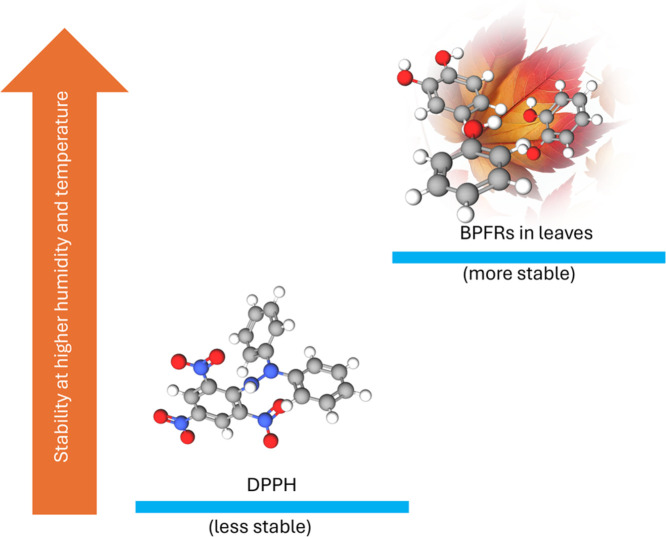 Figure 1
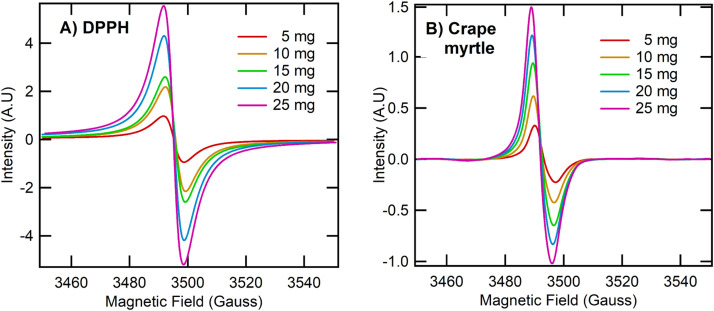 Figure 2
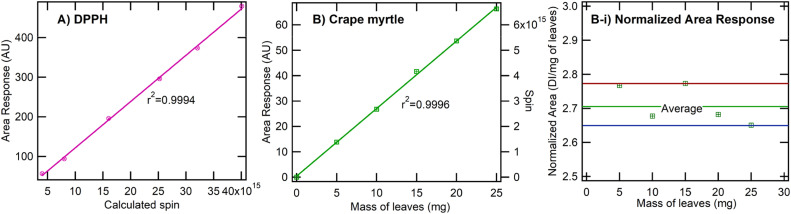 Figure 3
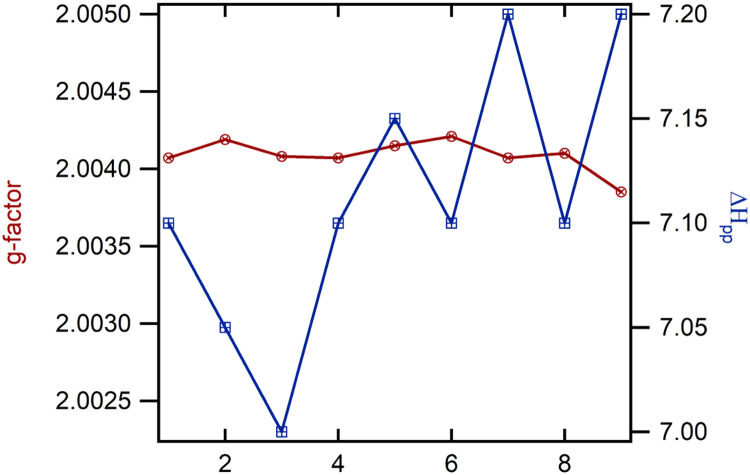 Figure 4
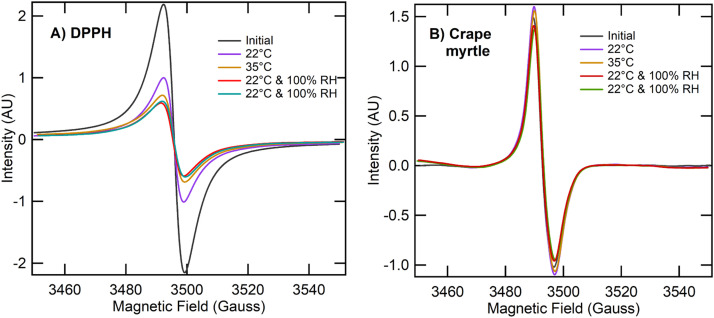 Figure 5
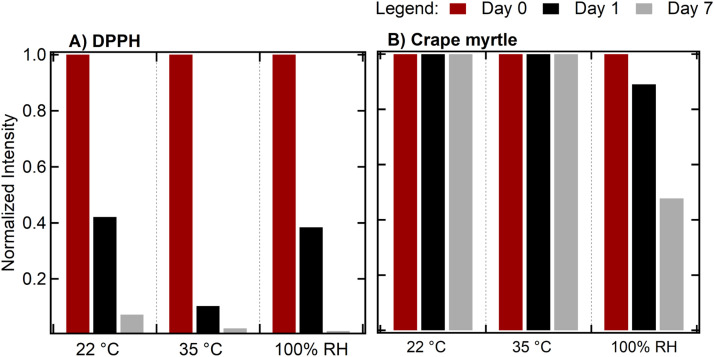 Figure 6
Peer Reviews
No public reviews on file for this paper yet. If you reviewed it on a platform where reviews are public (OpenReview, ICLR, NeurIPS, ICML), you can paste yours below so the community can read it here.
Videos
No videos yet. Explain this paper in a talk, walkthrough, or lecture? Add one.
Taxonomy
TopicsFree Radicals and Antioxidants · Antioxidant Activity and Oxidative Stress · Phytochemicals and Antioxidant Activities