Sugar coating autophagy: exploring the links between the inhibition of NGLY1 (N-glycanase 1) and autophagy induction
Holger B. R. Kramer, Sarah Ann Allman

TL;DR
This paper explores how inhibiting the enzyme NGLY1 leads to the activation of autophagy, a cellular process that breaks down damaged components.
Contribution
The paper presents new evidence establishing a direct causal link between NGLY1 inhibition and autophagy induction.
Findings
Inhibiting NGLY1 leads to increased autophagy induction.
NGLY1 plays a key role in glycoprotein catabolism and ERAD pathway function.
Loss of NGLY1 function is linked to a rare congenital disorder with diverse symptoms.
Abstract
The cytosolic enzyme NGLY1 (N-glycanase 1) is a central mediator of glycoprotein catabolism. The enzyme acts to cleave N-linked glycans from modified substrate asparagine residues prior to degradation of misfolded proteins by the proteasome, playing a key and well-conserved role in the ER-associated degradation/ERAD pathway. In a clinical context, NGLY1 disorder represents a rare congenital disorder of deglycosylation where mutations in the NGLY1 gene result in the loss of enzyme function. Patients with NGLY1 disorder present with a broad and varied array of symptoms, which can include moderate to profound levels of developmental delay, seizures, and complex movement disorders, as well as alacrima. Our recent results highlight a causal link between NGLY1 inhibition and macroautophagy/autophagy induction.
Genes, proteins, chemicals, diseases, species, mutations and cell lines named across the full text — each resolved to its canonical identifier and authoritative record.
Click any figure to enlarge with its caption.
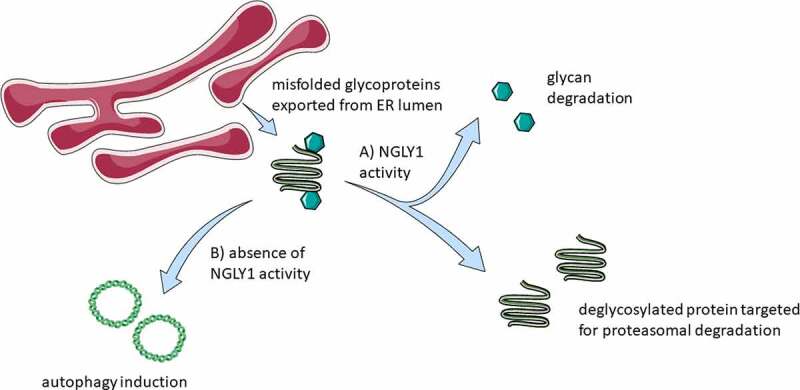 Figure 1
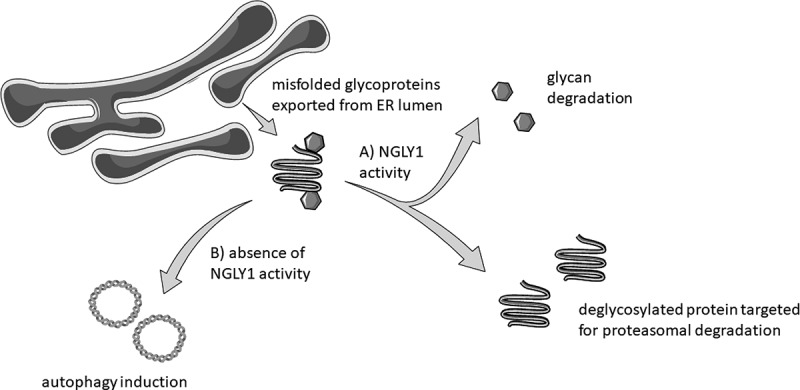 Figure 2
Peer Reviews
No public reviews on file for this paper yet. If you reviewed it on a platform where reviews are public (OpenReview, ICLR, NeurIPS, ICML), you can paste yours below so the community can read it here.
Videos
No videos yet. Explain this paper in a talk, walkthrough, or lecture? Add one.
Taxonomy
TopicsEndoplasmic Reticulum Stress and Disease · Autophagy in Disease and Therapy · Genetics and Neurodevelopmental Disorders