A different perspective on studying stroke predictors: joint models for longitudinal and time-to-event data in a type 2 diabetes mellitus cohort
F. J. San Andrés-Rebollo, J. Cárdenas-Valladolid, J. C. Abanades-Herranz, P. Vich-Pérez, J. M. de Miguel-Yanes, M. Guillán, M. A. Salinero-Fort, A. M. Sobrado-de Vicente-Tutor, A. M. Sobrado-de Vicente-Tutor, M. Sanz-Pascual, M. Arnalte-Barrera, S. Pulido-Fernández

TL;DR
This study uses joint models to predict stroke or TIA in type 2 diabetes patients by combining longitudinal data and survival analysis.
Contribution
The novelty lies in using joint models to dynamically adjust stroke/TIA predictions based on changing patient data over time.
Findings
Age, atrial fibrillation, and systolic blood pressure were significant predictors in both sexes.
Renal function was a significant predictor only in women.
An increase in diastolic blood pressure may act as a protective factor in the cohort.
Abstract
Most predictive models rely on risk factors and clinical outcomes assessed simultaneously. This approach does not adequately reflect the progression of health conditions. By employing joint models of longitudinal and survival data, we can dynamically adjust prognosis predictions for individual patients. Our objective was to optimize the prediction of stroke or transient ischemic attack (TIA) via joint models that incorporate all available changes in the predictive variables. A total of 3442 patients with type 2 diabetes mellitus (T2DM) and no history of stroke, TIA or myocardial infarction were followed for 12 years. Models were constructed independently for men and women. We used proportional hazards regression models to assess the effects of baseline characteristics (excluding longitudinal data) on the risk of stroke/TIA and linear mixed effects models to assess the effects of…
Genes, proteins, chemicals, diseases, species, mutations and cell lines named across the full text — each resolved to its canonical identifier and authoritative record.
Click any figure to enlarge with its caption.
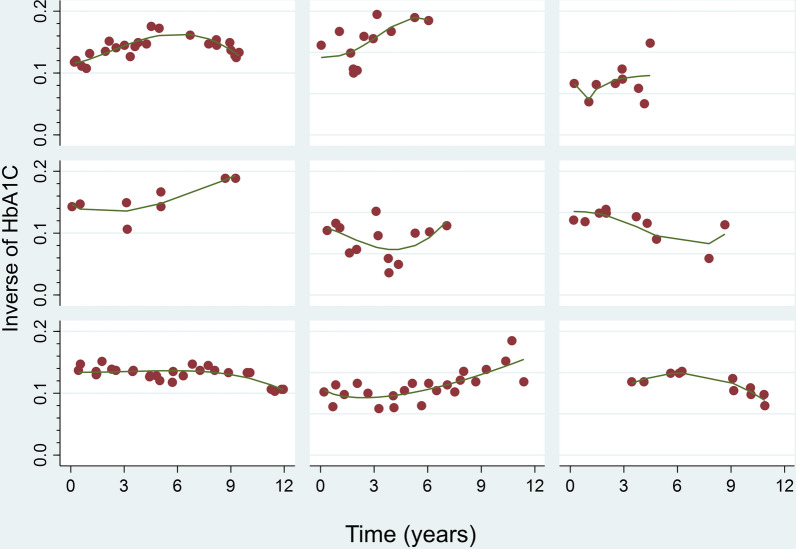 Figure 1
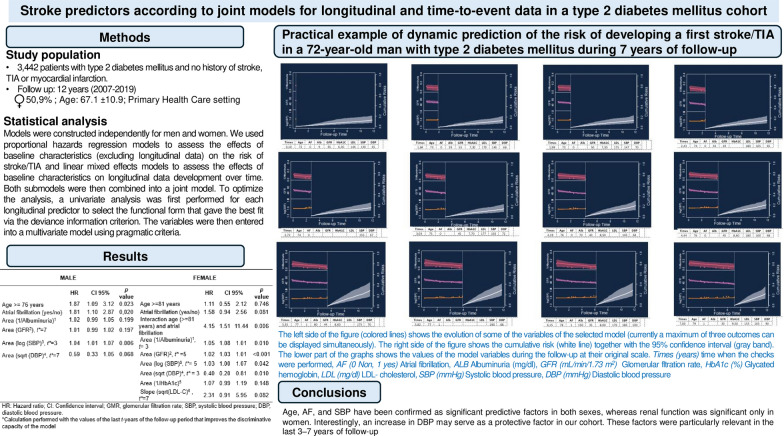 Figure 2
Peer Reviews
No public reviews on file for this paper yet. If you reviewed it on a platform where reviews are public (OpenReview, ICLR, NeurIPS, ICML), you can paste yours below so the community can read it here.
Videos
No videos yet. Explain this paper in a talk, walkthrough, or lecture? Add one.
Taxonomy
TopicsAcute Ischemic Stroke Management · Blood Pressure and Hypertension Studies · Cardiovascular Health and Disease Prevention