Coarse-Grained Molecular Dynamics Simulations Reveal Potential Role of Cardiolipin in Lateral Organization of Proteorhodopsin
Alexander Wroe, Eric Sefah, Blake Mertz

TL;DR
This study uses simulations to explore how cardiolipin interacts with proteorhodopsin, a light-harvesting protein in marine microbes, and suggests it may influence its function.
Contribution
The study reveals new residue-specific interactions between cardiolipin and proteorhodopsin using coarse-grained molecular dynamics simulations.
Findings
Electrostatic and nonpolar forces drive specific interactions between cardiolipin and proteorhodopsin.
Several cardiolipin binding sites were identified near key functional areas of proteorhodopsin.
Lipid–protein interactions occur on the microsecond time scale and may modulate proton pumping.
Abstract
Proteorhodopsin (PR) is a microbial light-harvesting proton pump protein that is ubiquitous in marine ecosystems and is critical for biological solar energy conversion. A unique characteristic of PR is that its function can be directly affected by changes in the surrounding cellular membrane environment. Cardiolipin (CL) is a commonly found lipid in mitochondria and bacterial cell membranes and plays a prominent role in the function of numerous integral membrane proteins, due to its bulky conical shape and ionizable nature of its headgroup. CL can directly interact with other microbial rhodopsins and modulate their function; however, the potential role of CL in the function of PR is unclear. In this study, we used the MARTINI coarse-grained force field to characterize the interactions of CL with PR in a model bilayer via coarse-grained molecular dynamics (MD) simulations. Our…
Genes, proteins, chemicals, diseases, species, mutations and cell lines named across the full text — each resolved to its canonical identifier and authoritative record.
Click any figure to enlarge with its caption.
 Figure 1
 Figure 2
 Figure 3
 Figure 4
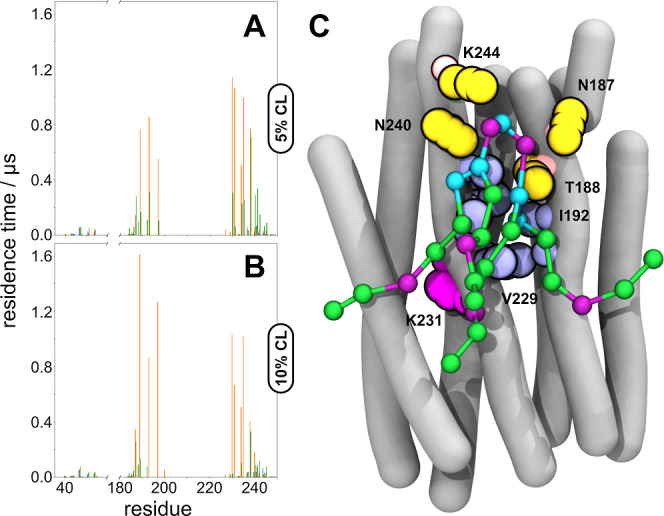 Figure 5
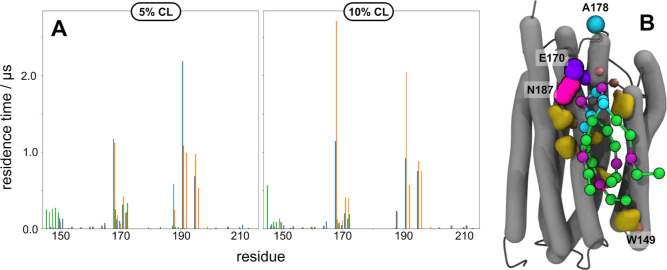 Figure 6
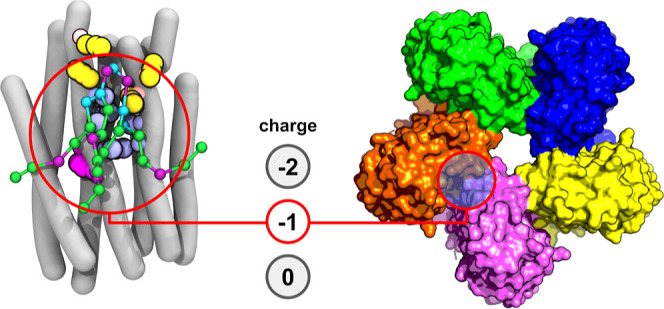 Figure 7
 Figure 8
 Figure 9
Peer Reviews
No public reviews on file for this paper yet. If you reviewed it on a platform where reviews are public (OpenReview, ICLR, NeurIPS, ICML), you can paste yours below so the community can read it here.
Videos
No videos yet. Explain this paper in a talk, walkthrough, or lecture? Add one.
Taxonomy
TopicsPhotoreceptor and optogenetics research · Photosynthetic Processes and Mechanisms · Spectroscopy and Quantum Chemical Studies