Benefits and Limitations of Real‐World Patient‐Reported Toxicity Symptom Monitoring for Guidelines and Care, as Perceived by Patients, Clinicians, and Guideline Developers
Y. Smit, L. Verweij, A. Currie, J. J. W. M. Janssen, E. F. M. Posthuma, A. Dekker, R. P. M. G. Hermens, N. M. A. Blijlevens

TL;DR
This study explores how patients, clinicians, and guideline developers view the use of real-world patient-reported toxicity data in healthcare guidelines and daily care.
Contribution
The study identifies 31 novel benefits and limitations of using real-world patient-reported toxicity data for chronic myeloid leukemia care.
Findings
Participants saw value in using aggregated data to include patient symptoms in guidelines and personalize care.
Expert panel identified 14 knowledge gaps in CML care that could be addressed through real-world data.
Limitations include the lack of causal evidence and perceived low added value over open conversations.
Abstract
Toxicity monitoring should be modernized to include real‐world patient‐reported data. However, little is known about how stakeholders view the incorporation of real‐world patient‐reported toxicity symptoms into guidelines. This gap hinders the development of a sustained learning healthcare environment and limits the incorporation of this data into daily care. This qualitative study, reported according to COREQ, involved interviews with 29 plus 10 chronic myeloid leukemia (CML) patients and 18 CML clinicians, including eight hematologists/guideline developers. The interviews were audio‐recorded, transcribed, and independently coded in Atlas.ti. A framework, adapted from systematically sourced literature, was used for coding. Codes were assessed as either beneficial or limiting. An expert panel of all CML guideline developers completed and prioritized the identified knowledge gaps…
Genes, proteins, chemicals, diseases, species, mutations and cell lines named across the full text — each resolved to its canonical identifier and authoritative record.
Click any figure to enlarge with its caption.
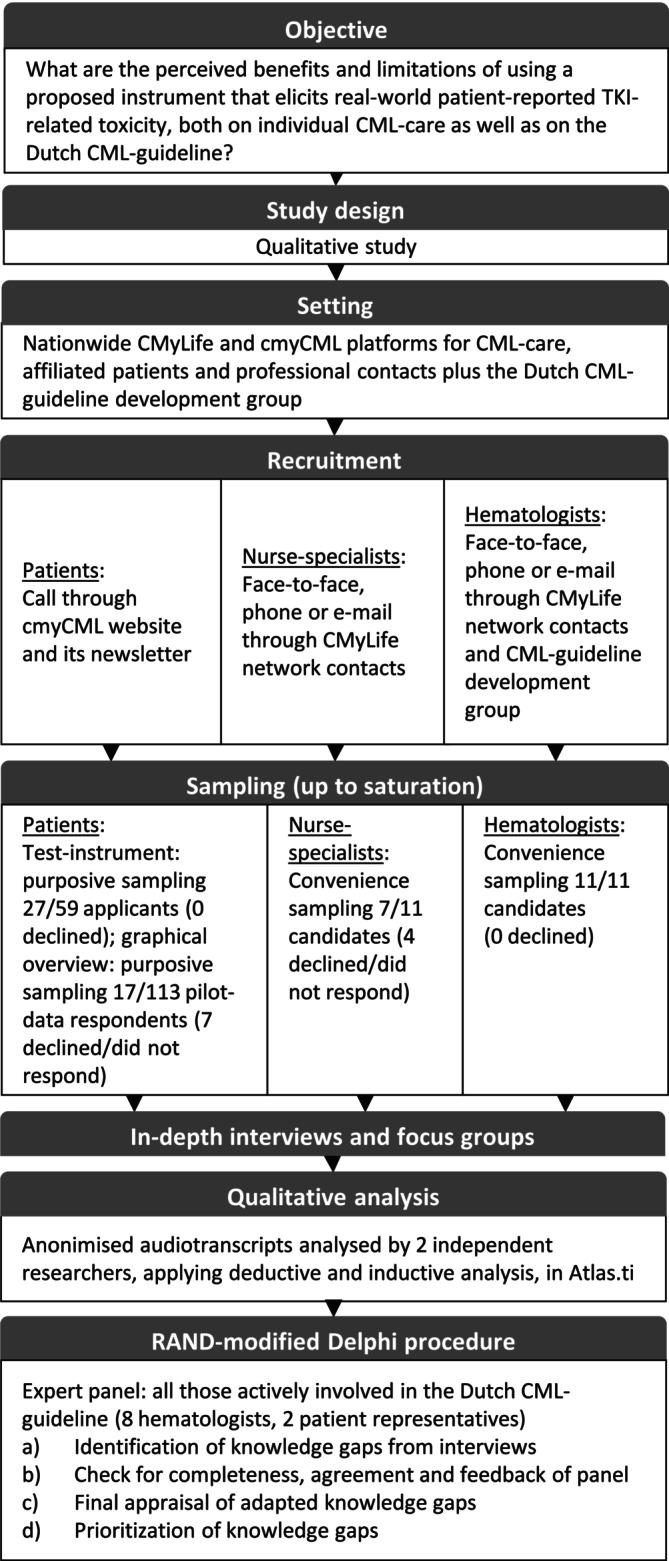 Figure 1
 Figure 2
Peer Reviews
No public reviews on file for this paper yet. If you reviewed it on a platform where reviews are public (OpenReview, ICLR, NeurIPS, ICML), you can paste yours below so the community can read it here.
Videos
No videos yet. Explain this paper in a talk, walkthrough, or lecture? Add one.
Taxonomy
TopicsChronic Myeloid Leukemia Treatments · Cancer survivorship and care · Acute Lymphoblastic Leukemia research