Author Correction: Population structure and identification of genomic regions associated with productive traits in five Italian beef cattle breeds
Daniele Colombi, Giacomo Rovelli, Maria Gracia Luigi-Sierra, Simone Ceccobelli, Dailu Guan, Francesco Perini, Fiorella Sbarra, Andrea Quaglia, Francesca Maria Sarti, Marina Pasquini, Marcel Amills, Emiliano Lasagna

Abstract
Genes, proteins, chemicals, diseases, species, mutations and cell lines named across the full text — each resolved to its canonical identifier and authoritative record.
Click any figure to enlarge with its caption.
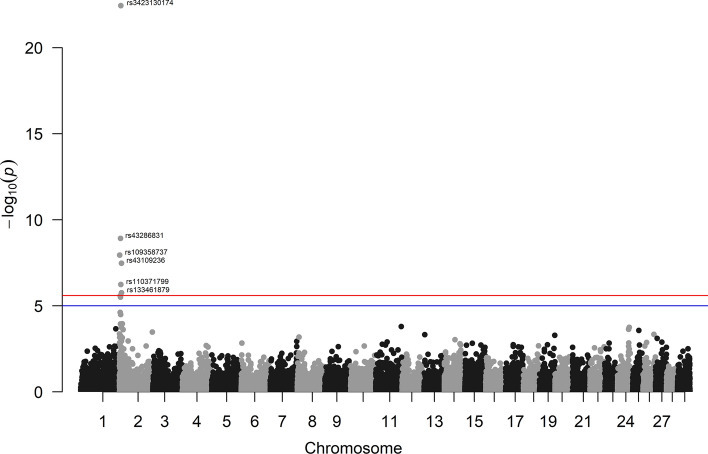 Figure 3
Peer Reviews
No public reviews on file for this paper yet. If you reviewed it on a platform where reviews are public (OpenReview, ICLR, NeurIPS, ICML), you can paste yours below so the community can read it here.
Videos
No videos yet. Explain this paper in a talk, walkthrough, or lecture? Add one.
Taxonomy
TopicsGenetic and phenotypic traits in livestock
Correction to: Scientific Reports 10.1038/s41598-024-59269-z, published online 12 April 2024
The original version of this Article contained errors. In the Results and discussion section, under the subheading ‘Genome-wide association study for productive traits’,
“The muscular hypertrophy phenotype segregates in the MAR breed due to a mutation at nucleotide 874 in exon 3 (g.874G > T) in the MSTN gene^27^. This point mutation has a remarkable effect on the myostatin protein changing, a codon for glutamic acid into a stop codon (E291X variant), that blocks the translation of 254 bases of the third exon. The variant rs3423130174 (P-value 3.640819e−23) is indeed such causative mutation and confirms the implication of the third exon in the proper functioning of myostatin because it encodes the C-terminal region that is fundamental for the protein tridimensional folding^27^.”
now reads:
“The muscular hypertrophy phenotype segregates in the MAR breed due to a mutation at nucleotide 871 in exon 3 (ENSBTAT00000015674.6:c.871G>T, represented by Ensembl sequence ENSBTAT00000015674.6) in the MSTN gene^27^. This point mutation has a remarkable effect on the myostatin protein, changing a codon for glutamic acid into a stop codon (E291X variant) that blocks the translation of 257 bases of the third exon. The variant MSTN_SNP (P-value 3.640819e−23) is indeed such causative mutation and confirms the implication of the third exon in the proper functioning of myostatin because it encodes the C-terminal region that is fundamental for the protein tridimensional folding^27^.”
Additionally, in Table 3, the position for Marchigiana breed in the top row was incorrect,
“rs3423130174 / 2 / 6283726 / T / 0.132 / 0.9037 / 0.0887 / 3.64E−23 / MSTN”
now reads:
“MSTN_SNP / 2 / 6283727 / T / 0.132 / 0.9037 / 0.0887 / 3.64E−23 / MSTN”.
As a result of this error, Figure 3 was incorrect. The original Figure 3 and accompanying legend appear below.
This correction does not affect the results and conclusions of this article.
The original Article has been corrected.Fig. 3. Genome wide significant associations between SNPs and muscularity in Marchigiana breed. Negative log_10_ P-values (Y-axis) of the association between SNPs and the muscularity are plotted against the genomic location of each SNP marker (X-axis). The red line represents the Bonferroni-corrected threshold of significance, while the blue line represents the suggestive threshold of significance (P-value of 0.05).