Correction: Extinction of contextual fear memory is facilitated in TRPM2 knockout mice
Seung Yeon Ko, Do Gyeong Kim, Huiju Lee, Sung Jun Jung, Hyeon Son

Abstract
Genes, proteins, chemicals, diseases, species, mutations and cell lines named across the full text — each resolved to its canonical identifier and authoritative record.
Click any figure to enlarge with its caption.
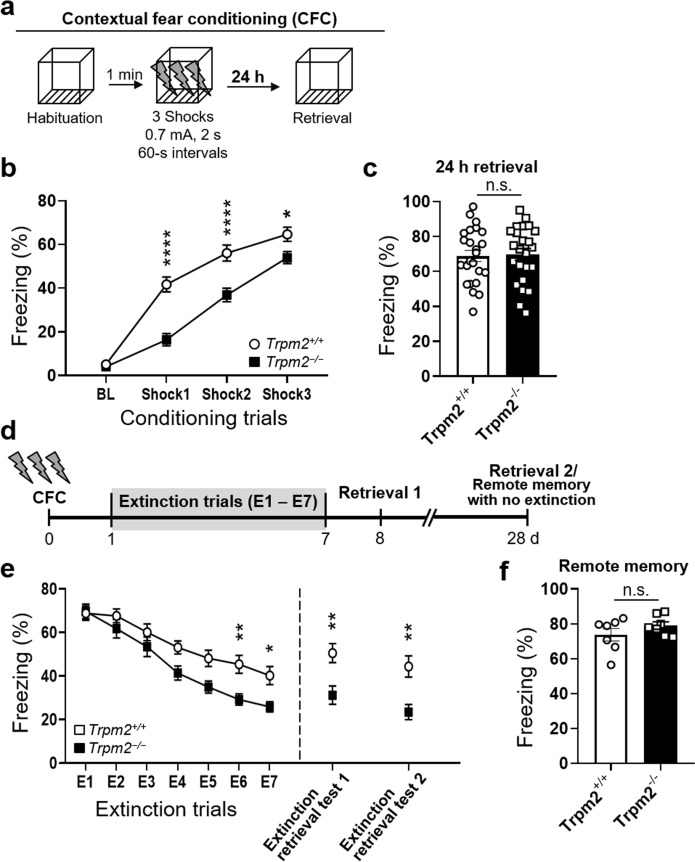 Figure 1
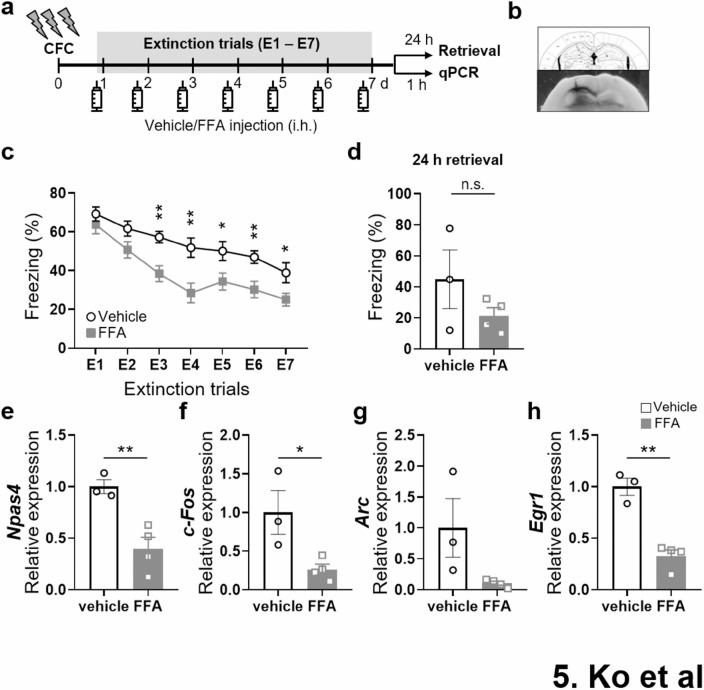 Figure 2
Peer Reviews
No public reviews on file for this paper yet. If you reviewed it on a platform where reviews are public (OpenReview, ICLR, NeurIPS, ICML), you can paste yours below so the community can read it here.
Videos
No videos yet. Explain this paper in a talk, walkthrough, or lecture? Add one.
Taxonomy
TopicsIon Channels and Receptors · Biochemical Analysis and Sensing Techniques
Correction: Molecular Brain (2025) 18:16 10.1186/s13041-025-01181-2
Following publication of the original article [1], the authors identified an error in Fig. 1. Due to an error Fig. 5 was indicated also as Fig. 1. The correct figure and caption is given below.
The incorrect Fig. 1:Fig. 1. Facilitated extinction of contextual fear memory in Trpm2^−/−^mice. (a) Time line of the contextual fear conditioning procedure. The freezing re-sponse during habituation (BL) and acquisition was analyzed for 1 min per trial. A foot shock (2-s, 0.7 mA) was given at the end of habituation and the first three conditioning trials. (b) Trpm2^−/−^ mice displayed reduced contextual fear acquisition (two-way repeated measures ANOVA, genotype: F(1,44) = 23.53, p < 0.0001; shock: F(3,132) = 248.3, p < 0.0001; genotype × shock interaction: Interaction, F(3,132) = 12.26, p < 0.0001; Bonferroni post hoc, 1st, p < 0.0001; 2nd, p < 0.0001; 3rd, p = 0.0276; WT, n = 23; Trpm2^−/−^, n = 23). (c) Similar levels of freezing during fear retrieval 24 h after CFC and the first 5 min of extinction training session E1 (unpaired two-tailed t test, genotype: t(46*)* = 0.1876, p = 0.852; WT, n = 24; Trpm2^−/−^, n = 24). (d) Time line of the contextual fear extinction procedure. During the extinction phase, the mice were placed in the chamber for 5 min without reinforcing shock. 24 h later, consolidated extinction memory was recalled by monitoring freezing behavior for 2 min in the original chamber. (e) Trpm2^−/−^ mice showed a faster rate of contextual fear extinction over the 7-day course of extinction training (two-way repeated measures ANOVA, genotype: F(1,46) = 6.369, p = 0.0151; day: F(6,276) = 65.95, p < 0.0001; genotype × day interaction: Interaction F(6,276) = 3.067, p = 0.0064; Bonferroni post hoc, E2, p > 0.999; E3, p > 0.999; E4, p = 0.1266; E5, p = 0.0556; E6, p = 0.0085; E7, p = 0.0278; WT, n = 24; Trpm2^−/−^, n = 24). Extinction retrieval tests 24 h (at 8 d: retrieval 1) and 21 d (at 28 d: retrieval 2) after extinction training showed that Trpm2^−/−^ mice had less context-dependent freezing behavior to the conditioning context 24 h and 21 d after extinction training than WT mice (unpaired two-tailed t test, 24 h, p = 0.0065, WT, n = 8; Trpm2^−/−^, n = 8; 28 d, genotype: t(23) = 3.535, p = 0.0018, WT, n = 12; Trpm2^−/−^, n = 13). (f) Remote memory. Conditioned mice without extinction training were returned to the context 28 d later for the remote memory test. There were no significant differences in the percentage durations of freezing between WT and Trpm2^−/−^ mice at day 28 (p = 0.2405). Animal freezing is measured as percent time spent freezing over a given test period. *p < 0.05, **p < 0.01, ***p < 0.001, ****p < 0.0001 compared with WT littermates. Numbers in parentheses denote the number of mice in each group used for the experiment. All data are mean ± SEM. Detailed statistics in Supplementary Information
The correct Fig. 1:
Fig. 1. Facilitated extinction of contextual fear memory in Trpm2^−/−^mice. (a) Time line of the contextual fear conditioning procedure. The freezing re-sponse during habituation (BL) and acquisition was analyzed for 1 min per trial. A foot shock (2-s, 0.7 mA) was given at the end of habituation and the first three conditioning trials. (b) Trpm2^−/−^ mice displayed reduced contextual fear acquisition (two-way repeated measures ANOVA, genotype: F(1,44) = 23.53, p < 0.0001; shock: F(3,132) = 248.3, p < 0.0001; genotype × shock interaction: Interaction, F(3,132) = 12.26, p < 0.0001; Bonferroni post hoc, 1st, p < 0.0001; 2nd, p < 0.0001; 3rd, p = 0.0276; WT, n = 23; Trpm2^−/−^, n = 23). (c) Similar levels of freezing during fear retrieval 24 h after CFC and the first 5 min of extinction training session E1 (unpaired two-tailed t test, genotype: t(46*)* = 0.1876, p = 0.852; WT, n = 24; Trpm2^−/−^, n = 24). (d) Time line of the contextual fear extinction procedure. During the extinction phase, the mice were placed in the chamber for 5 min without reinforcing shock. 24 h later, consolidated extinction memory was recalled by monitoring freezing behavior for 2 min in the original chamber. (e) Trpm2^−/−^ mice showed a faster rate of contextual fear extinction over the 7-day course of extinction training (two-way repeated measures ANOVA, genotype: F(1,46) = 6.369, p = 0.0151; day: F(6,276) = 65.95, p < 0.0001; genotype × day interaction: Interaction F(6,276) = 3.067, p = 0.0064; Bonferroni post hoc, E2, p > 0.999; E3, p > 0.999; E4, p = 0.1266; E5, p = 0.0556; E6, p = 0.0085; E7, p = 0.0278; WT, n = 24; Trpm2^−/−^, n = 24). Extinction retrieval tests 24 h (at 8 d: retrieval 1) and 21 d (at 28 d: retrieval 2) after extinction training showed that Trpm2^−/−^ mice had less context-dependent freezing behavior to the conditioning context 24 h and 21 d after extinction training than WT mice (unpaired two-tailed t test, 24 h, p = 0.0065, WT, n = 8; Trpm2^−/−^, n = 8; 28 d, genotype: t(23) = 3.535, p = 0.0018, WT, n = 12; Trpm2^−/−^, n = 13). (f) Remote memory. Conditioned mice without extinction training were returned to the context 28 d later for the remote memory test. There were no significant differences in the percentage durations of freezing between WT and Trpm2^−/−^ mice at day 28 (p = 0.2405). Animal freezing is measured as percent time spent freezing over a given test period. *p < 0.05, **p < 0.01, ***p < 0.001, ****p < 0.0001 compared with WT littermates. Numbers in parentheses denote the number of mice in each group used for the experiment. All data are mean ± SEM. Detailed statistics in Supplementary Information
Figure 1 has been updated above and the original article [1] has been corrected.