Lagerstroemiayangchunensis (Lythraceae), a new species from Guangdong, China

Abstract
Genes, proteins, chemicals, diseases, species, mutations and cell lines named across the full text — each resolved to its canonical identifier and authoritative record.
Click any figure to enlarge with its caption.
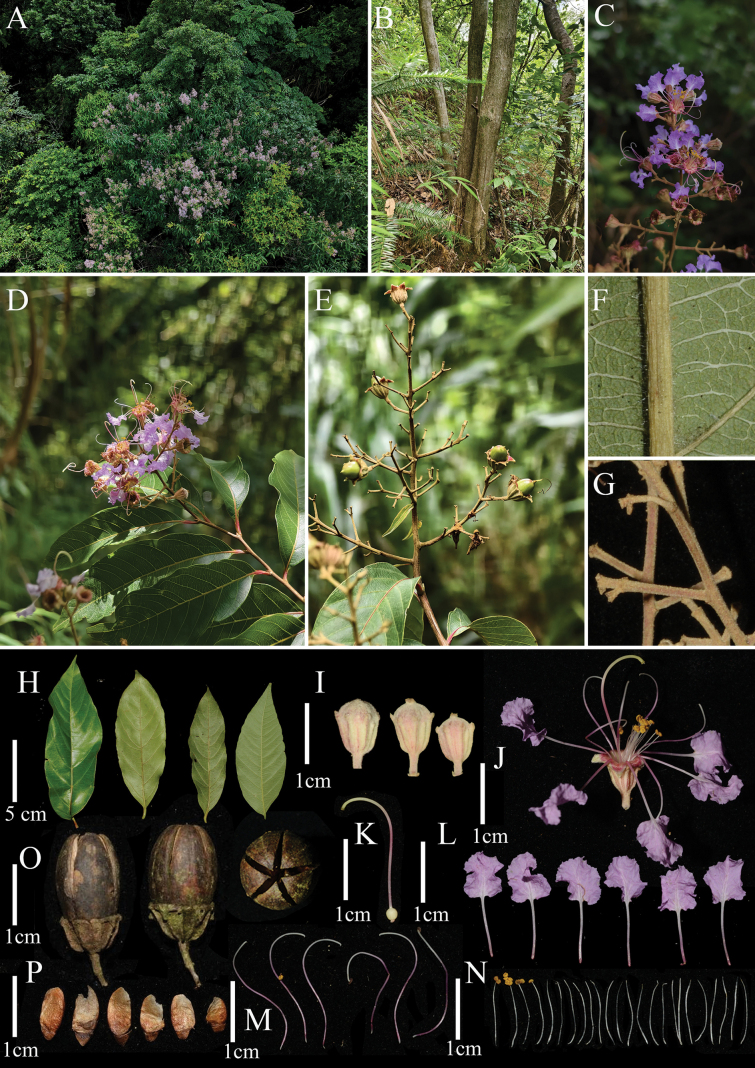 Figure 1
| Characters |
|
|
|
|---|---|---|---|
| Bark | greyish brown, thick, coarse, vertically fissured | light brown grey, thin, mottled and dimpled | light brown, black when old, coarsely vertically cracked and slightly flaking |
| Leaf shape | elliptic-oblong, oblong, rarely obovate | oblong, elliptic-oblong, sometimes obovate | elliptic, elliptic-oblong, or elliptic-ovate |
| Leaf size | 10–14 cm long, 3.5–5 cm wide | 8–12(–15) cm long, 3–5 (–10) cm wide | 10–25 cm long, 6–12 cm wide |
| Leaf surface | adaxial surface glabrous, abaxial surface slightly pubescent along midvein | glabrous | glabrous |
| Number of lateral veins | 10–15 on each side | 8–10 on each side | (6–)8–14 on each side |
| Petiole length | 4–8 mm | 3–5 mm | 6–15 mm |
| Panicle length | densely whitish tomentose | glabrous | glabrous |
| Flower buds | densely whitish tomentose, obovoid, 7–9 mm long, pseudopedicel 2–3 mm long | short densely whitish hairy, obovoid, ca. 6 mm long, pseudopedicel 6–12 mm long | short-farinose, subglobose, ca. 0.5 mm long, pseudopedicel 3–8 mm long |
| Calyx tube | 6–8 mm long, distinctly 12-ridged | 5–6 mm long, (indistinctly) 12-ridged | calyx tube 6–8 mm long, distinctly 12-ridged |
| Calyx lobe | 2.5–4.3 mm long, glabrous within | ca. 3 mm long, densely whitish hairy in the upper part within | up to 8 mm long, glabrous within |
| Petal length | 15–20 mm long, including 9–10 mm long claw | 10–15 mm long, including ca. 5 mm long claw | ca. 20 mm long, including ca. 5 mm long claw |
Peer Reviews
No public reviews on file for this paper yet. If you reviewed it on a platform where reviews are public (OpenReview, ICLR, NeurIPS, ICML), you can paste yours below so the community can read it here.
Videos
No videos yet. Explain this paper in a talk, walkthrough, or lecture? Add one.
Taxonomy
TopicsPlant and Fungal Species Descriptions · Plant Diversity and Evolution · Phytochemistry and Biological Activities
Introduction
Lagerstroemia L. (Lythraceae) is a significant genus known for its ornamental value, notably for its vibrant summer blooms. Taxonomic revisions of Lagerstroemia have been extensive, commencing with Koehne’s monograph (Koehne 1883, 1903) and followed by subsequent revisions by Furtado and Srisuko (1969), which recognized 53 species. Subsequently, regional taxonomic updates (Lee and Lau 1983; Hewson 1990; Qin and Graham 2007; De Wilde and Duyfjes 2013, 2014, 2016; De Wilde et al. 2014) and additional species descriptions (Zhou et al. 2004; Gu et al. 2012, 2015; Deepu and Pandurangan 2017; Pham et al. 2017; De Wilde and Duyfjes 2019; Wu et al. 2023) have refined our understanding of the genus. Currently, the genus comprises ca. 52 species (Wu et al. 2023).
In recent years, we carried out several field surveys to gather germplasm resources of Lagerstroemia in China. In 2024, we found an unknown Lagerstroemia species with coarse and vertically fissured bark, a character uncommon in Lagerstroemia species of Guangdong. After extensive morphological comparisons and taxonomic analyses, we confirmed a new species which we formally describe herein.
Materials and methods
Morphological characteristics were analyzed based on observations of the living plants in the field and dried specimens in herbaria. Measurements were conducted manually with rulers or using Digimizer version 4.6.0 (MedCalc Software, Mariakerke, Belgium). The voucher specimens were deposited in the herbarium of South China Botanical Garden (IBSC), South China Agricultural University (CANT), Sun Yat-Sen University (SYS) and China National Botanical Garden (CNBG).
Taxonomic treatment
Lagerstroemia
yangchunensis
Taxon classificationPlantaeMyrtalesLythraceae
B.H.Wu & G.D.Chen sp. nov.
A9319AC3-DAE0-53DF-A4C8-6A8A2DE9B553
urn:lsid:ipni.org:names:77359970-1
Type.
China • Guangdong: Yangchun City, Chunwan Town, Xinglong Country, in forest, on sunny slope. 22.3327°N, 112.0097°E, 205 m a.s.l., 28 Jun 2024 (fl), B.H. Wu Lg2024142 (holotype: IBSC!; isotypes: CANT!, CNBG!, SYS!).
Diagnosis.
Lagerstroemiayangchunensis is morphologically similar to L.duperreana, but distinguished by its coarse bark with vertical fissures, calyx lobes glabrous inside, and flowers with shorter pseudopedicels and petals with longer claws.
Description.
Trees to 15 m tall. Bark greyish brown, thick and coarse, vertically fissured; branchlets glabrous, terete. Leaves alternate, rarely subopposite; petiole 4–8 mm long, glabrous; leaf blade papery, margin entire, elliptic-oblong, oblong, rarely obovate, 10–14 × 3.5–5 cm, base cuneate to acute, apex acute, acuminate, rarely obtuse, adaxial surface green, glabrous, abaxial surface pale green, slightly pubescent along midvein, lateral veins brochidodromous, 10–15 on each side of midvein. Inflorescences paniculate, terminal or axillary; panicles 9–22 cm long, puberulous with whitish brown hairs. Pedicels 2–5 mm long, densely whitish tomentose; flower buds densely whitish tomentose, obovoid (excluding pseudopedicels), 7–9 mm long, pseudopedicel 2–3 mm long; flowering calyx tubes (excluding pseudopedicels) cup-shaped, 6–8 mm long, outside densely whitish tomentose, distinctly 12-ridged, inside glabrous, lobes 6, triangular to slightly acuminate, 2.5–4.3 × 2–3.5 mm, reflexed, epicalyx minute, pseudopedicel 2.5–5 mm long; petals 6, crumpled, ovate to broadly ovate, 15–20 mm long including 9–10 mm long claw; stamens 30–40, dimorphic, with 6 stamens longer (21–24 mm long), thicker and the lower half reddish purple in color, the remaining stamens shorter (10–13 mm long), thinner and white in color, filaments glabrous; ovary glabrous, styles 22–30 mm long, glabrous, stigmas small. Capsules oblong, smooth, 16–19 mm long, ca. 10 mm in diameter, loculicidally dehiscent, 5-valved. Seeds 7–10 mm long including wing.
LagerstroemiayangchunensisA canopy view during flowering period B stems C flowering branchlet of the inflorescence D flowering branch E fruiting branch F part of the abaxial leaf surface G floral axes H leaves I flower buds J flower K gynoecium L petals M longer stamens N shorter stamens O capsules P seeds. Photographed by Guo-Di Chen and Bao-Huan Wu.
Phenology.
Flowering from June to July, fruiting after July.
Distribution and habitat.
Lagerstroemiayangchunensis is hitherto known from its type locality, Chunwan Town, Yangchun City of Guangdong; only 4 individuals were found in the population. It grows in forest on sunny slopes at ca. 200 m elevation.
Etymology.
The species epithet “yangchunensis” refers to Yangchun County, the locality where this species was discovered.
Vernacular name.
The proposed Chinese name for Lagerstroemiayangchunensis is 阳春紫薇 (yáng chūn zǐ wēi).
Discussion.
Lagerstroemiayangchunensis is morphologically similar to L.duperreana; however, it can be easily distinguished from the latter species by several characteristics, such as bark coarse and vertically fissured, calyx lobes glabrous inside and flowers with shorter pseudopedicels and petals with longer claws. A detailed comparison is summarized in Table 1.
Having large inflorescences with flowers boasting vibrant purple colors, Lagerstroemiayangchunensis is a potential ornamental species for urban landscaping or Lagerstroemia breeding. However, its restricted distribution to the edge of a managed woodland in Chunwan Town poses significant threats to its survival. The small and isolated population, coupled with interference from human activities in its habitat, makes this species highly vulnerable to extinction. To ensure the species’ long-term viability and promote its sustainable development, urgent conservation measures, such as habitat protection, seed banking, ex situ cultivation, and public awareness campaigns, are necessary.
Additional specimen examined.
China • Guangdong Province: Yangchun City, Chunwan Town, 22.3327°N, 112.0097°E, 205 m a.s.l., 28 Jun 2024 (fl), B.H. Wu Lg2024141; ibid., 28 June 2023, B.H. Wu Lg2024143, Lg2024144.
Supplementary Material
XML Treatment for Lagerstroemia yangchunensis
The reference list from the paper itself. Each links out to its DOI / PubMed record.
- 1De Wilde WJJO Duyfjes BEE (2013) Miscellaneous information on Lagerstroemia L. (Lythraceae). Thai Forest Bulletin (Botany) (41): 90–101.
- 2De Wilde WJJO Duyfjes BEE (2014) Lagerstroemia (Lythraceae) in Malesia.Blumea 59(2): 113–122. 10.3767/000651914 X 685357 · doi ↗
- 3De Wilde WJJO Duyfjes BEE (2016) Survey of Lagerstroemia L. (Lythraceae) in Indochina (excl. Thailand) with the description of Lagerstroemiadensiflora, sp. nov., a new species from Vietnam.Adansonia 38: 241–255. 10.5252/a 2016 n 2a 8 · doi ↗
- 4De Wilde WJJO Duyfjes BEE (2019) Three new species of Lythraceae and one new species of Stemonaceae described from Indochina.Blumea 64(2): 177–182. 10.3767/blumea.2019.64.02.08 · doi ↗
- 5De Wilde WJJO Duyfjes BEE Phonsena P (2014) Lythraceae. In: Santisuk T Newman M (Eds) Flora of Thailand, vol.11. The Forest Herbarium Department of National Parks, Wildlife and Plant Conservation, Bangkok, 547–597.
- 6Deepu S Pandurangan AG (2017) Lectotypification and note on the status of Lagerstroemiaintermedia (Lythraceae).Phytotaxa 296: 297–300. 10.11646/phytotaxa.296.3.11 · doi ↗
- 7Furtado CX Srisuko M (1969) A revision of Lagerstroemia L. (Lythraceae).Gardens’ Bulletin (Singapore)24: 185–334.
- 8Gu C-H Ji M-C Ma D-D (2012) Lagerstroemiamenglaensis sp. nov. (Lythraceae) from Xishuangbanna, Yunnan Province, China.Nordic Journal of Botany 30: 299–301. 10.1111/j.1756-1051.2011.01276.x · doi ↗