Cost-effectiveness of de-escalated molecular subtype dependent use of neoadjuvant chemotherapy in patients with muscle-invasive bladder cancer in a Swedish setting
Sanjib Saha, Ulf-Göran Gerdtham, Gottfrid Sjödahl, Christel Häggström, James W. F. Catto, John D. Kelly, Anders Ullén, Lars Holmberg, Fredrik Liedberg

TL;DR
This study shows that avoiding chemotherapy for a specific bladder cancer subtype saves costs while maintaining effectiveness in Sweden.
Contribution
The study introduces a cost-effective treatment strategy for bladder cancer based on molecular subtypes in a Swedish healthcare context.
Findings
Molecular subtype-based treatment has an ICER of 4,964 Euro/QALY in Sweden.
The treatment has a 65% probability of being cost-effective at a 100,000 SEK threshold.
Results remain robust under uncertainty analyses.
Abstract
Guidelines recommend neoadjuvant chemotherapy (NAC) and radical cystectomy (RC) for muscle-invasive bladder cancer (MIBC). Current recommendations do not consider genomic profiles, although the Basal/Squamous (Ba/Sq) subtype is less likely to respond to NAC compared to Urothelial-like (Uro) and Genomically Unstable (GU) subtypes. The aim of this study is to perform cost-effectiveness analyses of a de-escalated use of NAC in patients with Ba/Sq tumors and MIBC. A cost-effectiveness analysis was performed using a decision analytic Markov model using a healthcare provider perspective. Treatment and prognosis probabilities originated from the Bladder Cancer Data Base, Sweden (BladderBaSe) 2.0. Information on molecular subtype and outcomes was retrieved from published studies, and quality-adjusted life year (QALY) data were obtained from the iROC trial. Costs were collected from the…
Genes, proteins, chemicals, diseases, species, mutations and cell lines named across the full text — each resolved to its canonical identifier and authoritative record.
Click any figure to enlarge with its caption.
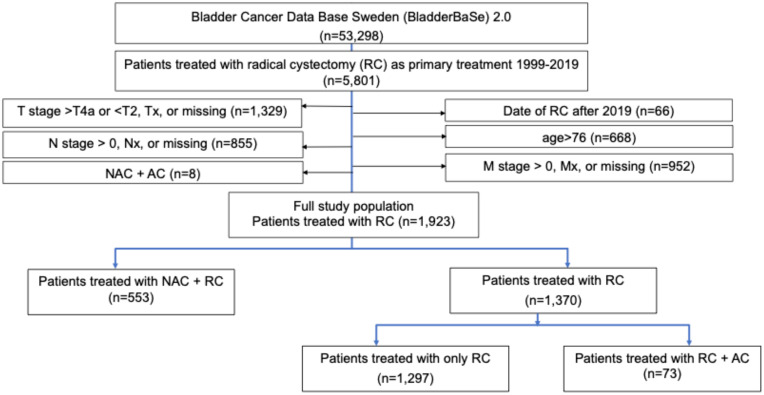 Figure 1
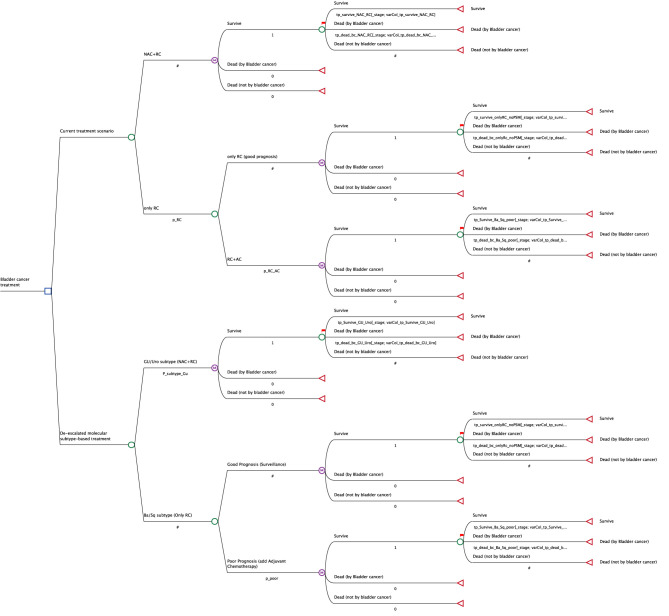 Figure 2
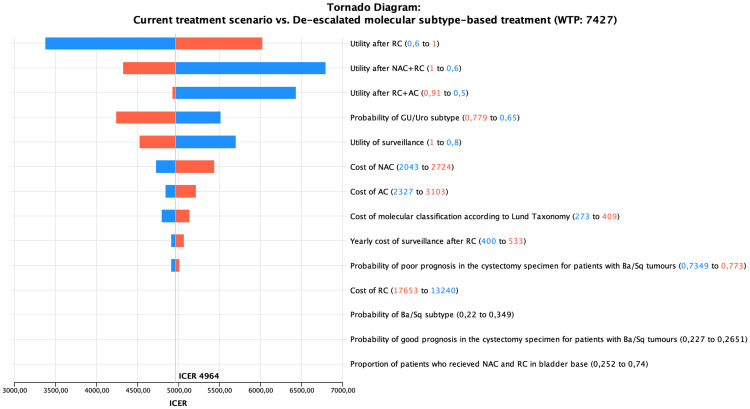 Figure 3
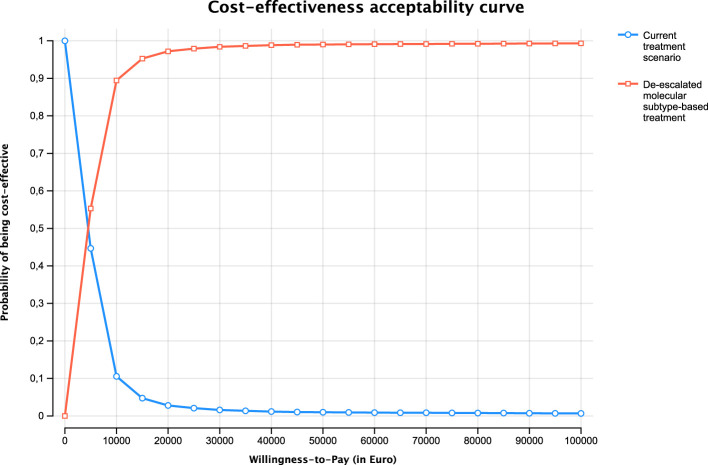 Figure 4
| T stage | N stage | |
|---|---|---|
| Good prognosis (A & B) | pT0, pTa, pTCIS, pT1, pT2, pT2a, pT2b, pTx, N/A | pN0, pNX, N/A |
| Poor prognosis (C or D) | pT3, pT3a, pT3b, pT4a, pT4b | pN1, pN2, pN3 |
| Parameter | Point estimate | Range | Source |
|---|---|---|---|
| Probabilities | |||
| Current treatment practice | |||
| NAC+RC | 0.280 | 0.252 to 0.740 | BladderBaSe 2.0, expert opinion, ( |
| Only RC | 0.720 | 0.648 to 0.811 | BladderBaSe 2.0, expert opinion, ( |
| Poor prognosis | 0.053 | 0.047 to 0.058 | BladderBaSe 2.0, expert opinion |
| Good prognosis | 0.947 | 0.853 to 0.99 | BladderBaSe 2.0, expert opinion |
| Molecular subtype | |||
| Uro/GU subtype (NAC+RC) | 0.696 | 0.650 to 0.779 | ( |
| Ba/Sq subtype (only RC) | 0.303 | 0.220 to 0.349 | ( |
| Poor prognosis | 0.753 | 0.734 to 0.773 | ( |
| Good prognosis | 0.246 | 0.227 to 0.265 | ( |
| Cost | |||
| RC | 14711 | 13240 to 17653 | Region Skane |
| NAC (3 courses) | 2270 | 2043 to 2724 | TLV, Region Skane, Region Stockholm |
| AC (4 courses) | 2586 | 2327 to 3103 | TLV, Region Skane, Region Stockholm |
| Surveillance | 444 | 400 to 533 | Joyce et al. ( |
| Identification of subtype | 341 | 273 to 409 | Region Skane |
| Utility | |||
| Surveillance | 0.914 | 0.8 to 1.0 | iROC trial ( |
| Cystectomy | 0.80 | 0.6 to 1.0 | Literature ( |
| Disutility NAC/AC | -0.36 | -0.30 to -0.40 | Literature ( |
| Time duration | Cost (Euro) (std) | Incremental cost | QALYs (std) | Incremental benefit | ICER (Euro/QALY) |
|---|---|---|---|---|---|
| 2-year | |||||
| Current treatment | 16,064 (1,175) | 2.16 (0.65) | |||
| Molecular subtype- | 17,930 (711) | 1,866 | 2.32 (0.55) | 0.17 | 11,211 |
| 3-year | |||||
| Current treatment | 16,245 (1,253) | 2.53 (0.94) | |||
| Molecular subtype- | 18,160 (785) | 1,914 | 2.80 (0.83) | 0.27 | 7,192 |
| 5-year | |||||
| Current treatment | 16,416 (1,387) | 2.88 (1.34) | |||
| Molecular subtype- | 18,396 (939) | 1,980 | 3.28 (1.29) | 0.40 | 4,964 |
Peer Reviews
No public reviews on file for this paper yet. If you reviewed it on a platform where reviews are public (OpenReview, ICLR, NeurIPS, ICML), you can paste yours below so the community can read it here.
Videos
No videos yet. Explain this paper in a talk, walkthrough, or lecture? Add one.
Taxonomy
TopicsBladder and Urothelial Cancer Treatments · Urinary and Genital Oncology Studies · Cancer Immunotherapy and Biomarkers
Introduction
1
With the advent of molecular classification based on transcriptomic profiling (1) and subsequent studies suggesting a role for molecular subtyping in predicting neoadjuvant chemotherapy (NAC) response (2–4), possibilities to individually tailor the use of NAC have emerged. By applying the Lund taxonomy (LundTax), we have shown that patients with the Basal/Squamous (Ba/Sq) subtype are less likely to benefit from three courses of cisplatin-based chemotherapy compared to those with Urothelial-like (Uro) or Genomically Unstable (GU) subtypes, both when evaluating the pathological response in the cystectomy specimen and the survival outcomes (3).
Today, the standard of care for all patients with muscle-invasive bladder cancer (MIBC) without metastases (T2-T4aN0M0) is cisplatin-based NAC followed by radical cystectomy (RC). The use of NAC gains a 5% absolute survival benefit at five years compared to RC only (5). In Sweden, 113 out of 152 (74%) patients under 76 years received such preoperative treatment in 2022 (6). For patients not receiving NAC, cisplatin-based chemotherapy can be considered in the adjuvant setting for selected patients with advanced disease (pT3/pT4 and/or N+) according to Swedish and EAU guidelines (7).
Applying a molecular subtype-based and de-escalated use of NAC to reduce overtreatment combined with offering adjuvant chemotherapy only to those with advanced disease in the cystectomy specimen may entail a better utilization of healthcare resources. It might also increase the uptake of NAC, which up to now have had a low utilization rate of only 17.2% according to a recent meta-analysis (8). This is particularly important considering that bladder cancer is one of the most expensive malignancies, with a total annual cost of around $7.93 billion in the USA (in 2015) and €5.24 billion in Europe (in 2019) (9).
To alter the current treatment practice, offering NAC to all eligible patients, and provide treatment according to molecular subtypes in line with the ideas behind precision medicine, a broad and comprehensive assessment including both effectiveness of treatment patterns as well as cost-effectiveness is needed. The objective of this study is to estimate whether molecular subtype-specific use of NAC in patients with MIBC is cost-effective compared to current practice in Sweden by applying a de-escalated use of NAC for the Ba/Sq subtype.
Materials and methods
2
In the absence of a clinical trial, this cost-effectiveness analysis utilized a Markov decision analytic simulation model following the Consolidated Health Economic Evaluation Reporting Standards (CHEERS) (10).
Study population
2.1
We used data from the Bladder Cancer Data Base Sweden (BladderBaSe 2.0), a research database including all patients in the Swedish National Register for Urinary Bladder Cancer (SNRUBC) diagnosed from the 1^st^ of January 1997 through the 31^st^ of December 2019, individually linked by using the unique Swedish personal identification number to several Swedish national data sources (11). BladderBaSe 2.0 includes information on tumor characteristics, treatments, and important confounding factors such as socioeconomic variables and comorbidity, and also with extensive follow-up. As a proxy for cisplatin-eligibility, we choose from this database all patients who were 76 years or younger at the time of RC as their main treatment for clinical stage T2-T4aN0M0 disease from 1999 to 2019. This is also in line with the Swedish national guidelines on urothelial carcinoma recommending that above 60% in this population should be offered NAC (12). We excluded patients who were treated with both NAC and adjuvant chemotherapy (AC), given that this is not recommended by EAU guidelines (7). The study population sample selection procedure is displayed in Figure 1.
Study sample selection procedure from the BladderBase 2.0 database. RC, Radical Cystectomy; NAC, Neoadjuvant Chemotherapy; AC, Adjuvant Chemotherapy.
Markov model structure
2.2
We created a Markov decision-analytic simulation model comparing current treatment practice when offering NAC to all cisplatin-eligible patients with MIBC to a de-escalated use of NAC based on molecular subtype. In the current treatment practice, patients receive either three courses of NAC, with ddMVAC (methotrexate, vinblastine, Adriamycin, and cisplatin), followed by RC (NAC+RC) or RC only. Those who received upfront RC without NAC optionally received four courses of AC (ddMVAC) in cases of non-organ-confined disease in the cystectomy specimen (i.e., pT3 or higher or pN+).
In the molecular subtype-based treatment option, patients with either Uro or GU tumors will receive NAC+RC, while those with the Ba/Sq subtype will receive upfront RC, but if the cystectomy specimen displays pT3 or higher or pN+, four courses of AC will be administered postoperatively according to guidelines. The Markov model is based on only three health states: survival after RC, death by bladder cancer, and death by other causes than bladder cancer, where patients transition into these health states are estimated in a yearly cycle. In Figure 2, the Markov model structure is described. The model is developed and analyzed using TreeAgePro Healthcare, v2023.
The Markov model structure.
Proportion and probabilities
2.3
The proportion of patients receiving NAC+RC, upfront RC only, and RC+AC was estimated by use of BladderBaSe 2.0. Since BladderBaSe 2.0 does not have information on molecular subtype, the percentage of individuals with Uro/GU and Ba/Sq subtypes, respectively, was estimated using data from Sjödahl et al. (3) and Olah et al. (13). The proportion of patients with Ba/Sq subtypes who had poor prognosis (≥pT3 or pN+) based on inclusion criteria in adjuvant trials (14, 15) and the corresponding proportion of good prognosis (≤pT2N0) according to the pathological tumor stage in the cystectomy specimen after RC was also estimated from these two studies (3, 13). Assuming cisplatin eligibility before and after RC, the poor prognosis definition was applied to determine the proportion of patients treated with upfront RC who would be recommended for AC. The criteria for poor and good prognosis are presented in Table 1, and the parameters of the model are given in Table 2.
The yearly survival probabilities, including death due to bladder cancer or other causes, were retrieved from BladderBaSe 2.0 (n=1297). Additionally, we used data from Sjödahl et al. to estimate the survival for individuals with Uro/GU subtypes who received NAC+RC (n=77) (3). Due to a small sample size, survival probabilities for patients with Ba/Sq subtype in both the good and poor prognosis categories were uncertain. Instead, we used survival estimates from those treated with RC only (n=1297) and with RC+AC (n=73) in BladderBaSe 2.0, respectively (Figure 1). The yearly transition probabilities are presented in the Supplementary Materials (Section 1: Supplementary Tables S1-S6). The statistical analyses were conducted using STATA version 17.
Costs and utilities
2.4
This cost-effectiveness analysis was performed from a healthcare provider’s perspective. Costs due to RC, chemotherapy, and identification of molecular subtypes through RNA extraction and RNA-sequencing applying LundTax single sample classifiers (20) were estimated from the Skane Regional Council healthcare registers (Table 2). All healthcare services were valued by using diagnosis-related groups (DRG), a patient cost classification system (21). All costs were collected in Swedish kronor (SEK) and converted into Euro (27-EU) using purchasing power parity in the 2022 price year. (22). Utility values for the survival health states were obtained from the literature and expert opinion (Table 2). The utility values, toll, and time within each health condition, i.e., RC with three or four courses of chemotherapy, were used to calculate quality-adjusted life years (QALYs) with the area under the curve methodology (23). Baseline QALY, i.e., at the year of diagnosis, was obtained from the iROC trial (18). The assumptions behind the QALY estimations are presented in the Supplementary Materials (Section 2). Costs and QALYs were discounted at a rate of 3% annually following the guideline of the Dental and Pharmaceutical Benefits Agency (TLV) of Sweden (24).
Base case analyses of cost-effectiveness
2.5
The results were expressed as incremental cost-effectiveness ratio (ICER), where ICER is defined as the difference in costs divided by the differences in QALYs between groups. According to the Swedish National Board of Health and Welfare, cost per QALY gained below 100,000 SEK (7,427 Euro/QALY) is considered low cost-effective (25) and used as the willingness-to-pay (WTP) threshold in this study. The analysis applied a base case time horizon of two years, three years, and five years from the time of RC (Table 3).
Sensitivity and scenario analyses
2.6
Several one-way and probabilistic sensitivity analyses, together with three scenario analyses, were performed to estimate the uncertainty around the base case result. Sensitivity analyses were performed for the estimate using a 5-year time horizon. Most of the parameters in the model were varied over plausible ranges, and the outcomes were presented as a tornado diagram. For example, the proportion of patients receiving NAC in Sweden has increased over the years; thus, we used the most recent value from 2022 (74%) (6). Furthermore, we used the data from a recent German study on the proportion of upfront RC in a context where NAC, by tradition, is less frequently applied (16). For probabilistic sensitivity, Monte Carlo simulations with 10,000 iterations were employed and portrayed as Cost-Effectiveness Acceptability Curve (CEAC), which shows the probability of the intervention being cost-effective across a spectrum of WTP thresholds. The three scenario analyses are presented in the Supplementary Materials (Section 3).
Results
3
Base case analyses
3.1
In the base case analyses, the de-escalated molecular subtype-based treatment was associated with a 0.40 QALY increase compared to the current treatment practice with an additional cost of €1,980 at the 5-year time horizon. This yielded an ICER of €4,964/QALY, which is deemed cost-effective in the Swedish setting. With a WTP of 7,427 Euro, a de-escalated use of NAC was deemed cost-effective beyond a 2-year time horizon (Table 2).
Sensitivity analyses
3.2
In the tornado diagram, while the base case result showed stability, the ICER demonstrated variability across parameters (Figure 3). The CEAC (Figure 4) showed that at €10,000 WTP, the molecular subtype-based treatment has a 90% probability of being cost-effective. The probability of being cost-effective increases with increasing WTP. The ICERs for the scenario analyses also fell below the WTP threshold except the third scenario (Supplementary Materials: Section 3 and Supplementary Tables S8-S10).
The Tornado diagram for one-way sensitivity analyses.
The cost-effectiveness acceptibility curve.
Discussion
4
We estimated the cost-effectiveness of molecular subtype-based use of NAC compared to the current treatment practice using population-based real-world data. We found that refraining from NAC in patients with Ba/Sq tumors and instead directly proceeding to upfront RC was cost-effective in base case, sensitivity, and scenario analyses.
To our knowledge, this is the first cost-effectiveness analysis using molecular subtype-based treatment for patients with MIBC. Thus, any comparisons with similar studies in bladder cancer were not possible. However, a de-escalated use of AC in breast cancer based on gene expression profiling has been reported as cost-effective (26), and so has molecular classification-based treatment in endometrial cancer (27).
The general lack of cost-effectiveness studies evaluating precision medicine in cancer was highlighted in a recent review, where the authors argued that the lack of clinical trials to estimate the effectiveness is a significant barrier to the implementation of targeted therapies (28). In the setting of de-escalating cancer treatment based on gene expression profiling, such lack of evidence is even more pronounced except for one large non-inferiority breast cancer RCT (n=10,273) (29). Due to the sample-size requirement, it is unlikely that an adequately designed non-inferiority RCT based on the 5% absolute survival benefit from NAC (5) investigating molecular subtype-dependent de-escalated use of NAC in bladder cancer will be performed in the foreseeable future. Simulation models are particularly helpful in this case to predict the long-term impact of interventions over time, account for uncertainties in real-world settings, and test various scenarios that may not be feasible to evaluate in traditional studies. By simulating different outcomes, we can provide more accurate predictions of both the health and economic benefits of interventions, offering valuable insights for decision-makers.
There is also a lack of research on the estimation of QALYs in bladder cancer. For example, the disutilities of both AC and NAC were not available from validated sources, such as RCTs. In the absence of reliable data, we used information about utilities from observational studies (9, 30, 31) and expert opinion (the information presented in Supplementary Materials). In addition to QALY at one-year follow-up, side effects emerging at even longer follow-up from cisplatin, an essential component in NAC, such as long-term renal impairment (32, 33), sensory neuropathy, tinnitus, and hearing loss (34) are well known and can also be taken into account. Thus, if a patient can be spared NAC based on molecular information, avoiding long-term side effects, there is another well-founded argument to implement this practice.
There are several limitations to be acknowledged in this study. First, our estimates of molecular subtype proportions, including the distribution of pathological outcomes in the cystectomy specimens stratifying patients into good and poor prognosis after RC, were derived from two small cohorts (3, 13). Due to the scarcity of sufficiently large cohorts with both molecular subtyping and clinical outcomes, our survival estimates for individuals with Ba/Sq tumors were retrieved in BladderBaSe 2.0, lacking subtype information (Section 1: Supplementary Tables S1-S6), although being a population-based source with real world data. The rationale for applying these data was based on similar survival outcomes reported for LundTax subtypes in patients treated with upfront RC in a Swedish population-based series (35) and in an observational multicenter study (36). Although our QALY estimates were based mainly on observational data and expert opinion, which might introduce bias, the baseline QALY estimation came from an RCT (18) and was based on Swedish tariff data. Thus, we have little reason to expect that this would introduce a bias when comparing NAC and AC. Another limitation was the use of only one classification system when assessing cost-effectiveness. Although the LundTax is well conformed with the MIBC consensus classification (37), several other molecular subtyping systems exist. Nonetheless, the Ba/Sq subtype defined by the MIBC consensus-classification system is also associated with chemoresistance in a recent RCT (4). Cross-comparison of various subtyping systems by clustering identified the Ba/Sq subtype as the only highly concordant across all systems, indicating that the choice of MIBC classifier matters less for the identification of this subtype. It is also likely that our outcomes are generalizable to gemcitabine-cisplatin as NAC regimen, as this cisplatin-based combination also was used in studies investigating the use of molecular subtypes as a measure to stratify the use of NAC (2–4). A limitation of our model is that adjuvant immune checkpoint inhibitors are not considered (38), even though a subtype dependent response to adjuvant checkpoint inhibitors has been suggested (39). This is beyond the scope of current study but highlights the need for future research when response probabilities on such therapy are available.
The reliability of a simulation model is contingent on the quality of the data and assumptions incorporated. Our cost data, sourced from Swedish registers, contributes to the internal validity of our findings. Nevertheless, external validity and cross-validity of a simulation model can be subject to scrutiny, although we conducted a range of sensitivity analyses to enhance the robustness of our results.
The low cost per QALY gained (€4,964/QALY) motivates the introduction of this strategy in Sweden and similar healthcare settings. This is also supported by the survival benefit from AC in patients with Ba/Sq tumors (40). In fact, a real-time population-based pipeline with prospective RNA-sequencing and molecular subtyping according to LundTax is already operating in several healthcare regions in Sweden (UROSCANSEQ, ISRCTN 15459149) (41), and a versatile and upgraded version of the LundTax classification algorithm applicable to different gene expression platforms and less sensitive to variations in sample purity is available (42). Furthermore, LundTax molecular subtyping can also be performed by immunohistochemistry on formalin-fixed specimens, further increasing the applicability of molecular classification in other healthcare contexts (43). A de-escalated subtype-based use of NAC might even increase the incentive to apply NAC in populations and countries where such preoperative treatment today is only used for a minority of patients, where overtreatment is the main objective against applying NAC. For example, only 21% of patients below 60 years of age received NAC in 2017 in Germany (44), and an even lower proportion in a report from the SEER data from the USA (17%) (45), despite being recommended to all eligible patients based on level 1a evidence (7).
Conclusions
5
Applying a de-escalated use of NAC in patients with MIBC with the Ba/Sq molecular subtype according to LundTax is cost-effective, and implementation in clinical practice can be considered.
The reference list from the paper itself. Each links out to its DOI / PubMed record.
- 1Sjödahl G Lauss MLövgren K Chebil G Gudjonsson S Veerla S. A molecular taxonomy for urothelial carcinoma. Clin Cancer Res. (2012) 18:3377–86. doi: 10.1158/1078-0432.CCR-12-0077-T 22553347 · doi ↗ · pubmed ↗
- 2Taber A Christensen E Lamy P Nordentoft I Prip F Lindskrog SV. Molecular correlates of cisplatin-based chemotherapy response in muscle invasive bladder cancer by integrated multi-omics analysis. Nat Commun. (2020) 11:4858. doi: 10.1038/s 41467-020-18640-0 32978382 PMC 7519650 · doi ↗ · pubmed ↗
- 3Sjödahl G Abrahamsson J Holmsten K Bernardo C Chebil G Eriksson P. Different responses to neoadjuvant chemotherapy in urothelial carcinoma molecular subtypes. Eur Urol. (2022) 81:523–32. doi: 10.1016/j.eururo.2021.10.035 34782206 · doi ↗ · pubmed ↗
- 4Groeneveld CS Pfister C Culine S Harter V Krucker C Fontugne J. Basal/squamous and Mixed subtype bladder cancers present poor outcomes after neoadjuvant chemotherapy in the VESPER trial. Ann Oncol. (2024) 36(1):89–98. doi: 10.1016/j.annonc.2024.09.008 39299443 · doi ↗ · pubmed ↗
- 5Vale JA. Neoadjuvant chemotherapy in invasive bladder cancer: update of a systematic review and meta-analysis of individual patient data advanced bladder cancer (ABC) meta-analysis collaboration. Eur Urol. (2005) 48:202–205; discussion 205-206. doi: 10.1016/j.eururo.2005.04.006 15939524 · doi ↗ · pubmed ↗
- 6SNRUBC. Svenska nationella kvalitetsregistret för Urinblåse- och urinvägscancer (SNRUBC). Umea: The Swedish National Quality Register for Bladder and Urinary Tract Cancer (2022). Available at: https://statistik.incanet.se/Urinblasecancer/ (Accessed May 7, 2024).
- 7Alfred Witjes J Max Bruins H Carrión A Cathomas R Compérat E Efstathiou JA. European association of urology guidelines on muscle-invasive and metastatic bladder cancer: summary of the 2023 guidelines. Eur Urol. (2024) 85:17–31. doi: 10.1016/j.eururo.2023.08.016 37858453 · doi ↗ · pubmed ↗
- 8Liu W Tian J Zhang S Yang E Shen H Li F. The utilization status of neoadjuvant chemotherapy in muscle-invasive bladder cancer: a systematic review and meta-analysis. Minerva Urol Nephrol. (2021) 73:144–53. doi: 10.23736/S 2724-6051.19.03648-8 31920065 · doi ↗ · pubmed ↗