Coagulation, clipping and closure method: New combined approach to prevent delayed bleeding after gastric endoscopic submucosal dissection
Satoshi Abiko, Haruhiro Inoue, Kei Ushikubo, Kazuki Yamamoto, Yohei Nishikawa, Ippei Tanaka, Naoya Sakamoto

Abstract
Genes, proteins, chemicals, diseases, species, mutations and cell lines named across the full text — each resolved to its canonical identifier and authoritative record.
Click any figure to enlarge with its caption.
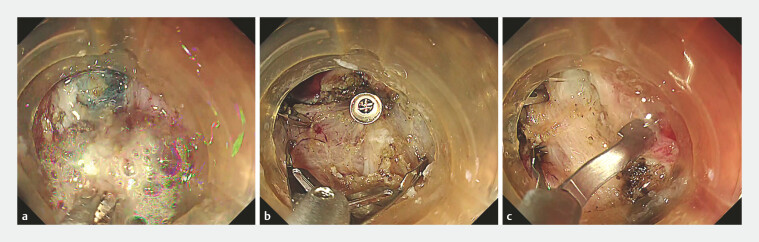 Fig. 1
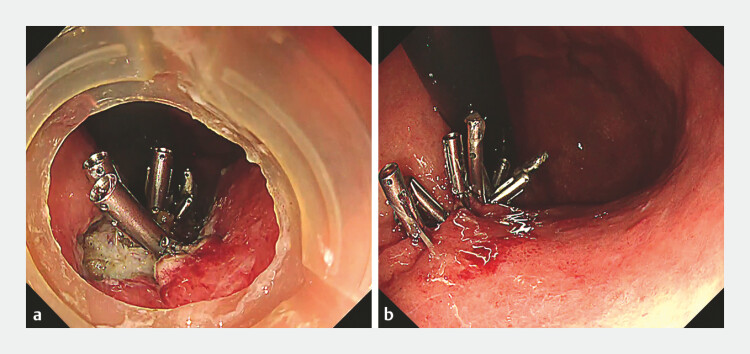 Fig. 2
Peer Reviews
No public reviews on file for this paper yet. If you reviewed it on a platform where reviews are public (OpenReview, ICLR, NeurIPS, ICML), you can paste yours below so the community can read it here.
Videos
No videos yet. Explain this paper in a talk, walkthrough, or lecture? Add one.
Taxonomy
TopicsGastric Cancer Management and Outcomes · Gastrointestinal Tumor Research and Treatment · Esophageal and GI Pathology
Introduction
Application of the coagulation, clipping and closure method.Video 1
There are several methods for preventing delayed bleeding (DB) after gastric endoscopic submucosal dissection (ESD), such as the coagulation plus clipping method and the closure method; however, they have not been able to completely prevent DB 1 2 3 . It was hypothesized that DB could be completely prevented through a combination of advanced closure with a coagulation and clipping method. Prevention of DB with this coagulation, clipping and closure (CCC) method is reported here.
Gastric ESD was performed for an 83-year-old man classified as having a high risk of DB due to oral administration of rivaroxaban and prasugrel. The ulceration followed gastric ESD (30 mm in diameter) in the lesser curvature of the upper body of the stomach. First, a coagulation procedure was performed after lesion resection, targeting vessels primarily at the margin of the ulcer base ( Fig. 1 a ). Next, perforator vessels emerging between the muscle layers and the surrounding muscle layer were clipped using 16-mm or 11-mm reopenable clips while sufficient air was suctioned ( Fig. 1 b ). As a result, the muscle layer folded. This procedure, inspired by the Origami method 4 , reduces the size of the mucosal defect ( Fig. 2 a ). Finally, complete closure of the residual mucosal defect was achieved using the dead space–eliminating technique with anchor pronged clips 5 ( Fig. 1 c , Fig. 2 b , and Video 1 ).
Coagulation, clipping and closure method for preventing delayed bleeding after gastric endoscopic submucosal dissection. a First, a coagulation procedure was performed after lesion resection, targeting vessels primarily at the margin of the ulcer base. b Next, perforator vessels emerging between the muscle layers and the surrounding muscle layer were clipped using 16-mm or 11-mm reopenable clips (SureClip; Micro-Tech Co. Ltd, Nanjing, China) while sufficient air was suctioned. c Complete closure of the residual mucosal defect was achieved using the dead space-eliminating technique with anchor pronged clips (MANTIS clip; Boston Scientific, Marlborough, Massachusetts, United States).
Condition after endoscopic submucosal dissection (ESD). a The muscle layer is folded using 16-mm or 11-mm reopenable clips. b The ulceration was completely closed using a coagulation, clipping and closure method.
Bleeding from perforator vessels may occur in areas where wound closure has dehisced; however, it is believed that this type of DB can be prevented by preemptively coagulating and clipping perforator vessels at the base of the ulcer. Preemptively folding the rigid gastric muscular layer, which is prone to dehiscence, using clips may be an effective procedure for preventing subsequent dehiscence.
The CCC method may help reduce risk of DB after gastric ESD; however, further evaluation with a larger number of cases is required to validate its effectiveness.
The reference list from the paper itself. Each links out to its DOI / PubMed record.
- 1Mukai S Cho S Nakamura S Postprocedural combined treatment using the coagulation plus artery-selective clipping (2C) method for the prevention of delayed bleeding after ESD Surg Endosc 2013271292130110.1007/s 00464-012-2600-123232998 · doi ↗ · pubmed ↗
- 2Azumi M Takeuchi M Koseki Y The search, coagulation, and clipping (SCC) method prevents delayed bleeding after gastric endoscopic submucosal dissection Gastric Cancer 20192256757510.1007/s 10120-018-0878-y 30267178 PMC 6476836 · doi ↗ · pubmed ↗
- 3Sugimoto S Nomura T Temma T Closure of gastric mucosal defects using the reopenable-clip over the line method to decrease the risk of bleeding after endoscopic submucosal dissection: a multicenter propensity score-matched case-control study (with video)Gastrointest Endosc 2024 S 0016-5107(24)03696-410.1016/j.gie.2024.11.01539542223 · doi ↗ · pubmed ↗
- 4Yamamoto K Inoue H Tanaka I Closure in antireflux mucoplasty using anchor prong clips: dead space–eliminating technique Video GIE 2024930330810.1016/j.vgie.2024.03.01039070685 PMC 11281917 · doi ↗ · pubmed ↗
- 5Masunaga T Kato M Sasaki M Modified double-layered suturing for a mucosal defect after colorectal endoscopic submucosal dissection (Origami method) (with video)Gastrointest Endosc 20239796296936642200 10.1016/j.gie.2023.01.005 · doi ↗ · pubmed ↗