Gene model for the ortholog of Sik3 in Drosophila mojavensis
Gabriella N. Bicanovsky, Karolina J. Senkow, Cassidy McColl, Jennifer Mierisch, Kellie S. Agrimson, Lindsey J. Long, Judith Leatherman, Chinmay P. Rele, Laura K Reed

TL;DR
This paper describes the gene model for the Sik3 ortholog in Drosophila mojavensis as part of a study on the evolution of the IIS pathway.
Contribution
Provides a new gene model for Sik3 in Drosophila mojavensis for IIS pathway evolution research.
Findings
Identified the Sik3 ortholog in Drosophila mojavensis genome assembly.
Used the gene model to study the evolution of the IIS pathway in Drosophila.
Contributed to a dataset for Course-based Undergraduate Research Experiences.
Abstract
Gene model for the ortholog of Salt-inducible kinase 3 ( Sik3 ) in the May 2011 (Agencourt dmoj_caf1/DmojCAF1) Genome Assembly (GenBank Accession: GCA_000005175.1 ) of Drosophila mojavensis . This ortholog was characterized as part of a developing dataset to study the evolution of the Insulin/insulin-like growth factor signaling pathway (IIS) across the genus Drosophila using the Genomics Education Partnership gene annotation protocol for Course-based Undergraduate Research Experiences.
Genes, proteins, chemicals, diseases, species, mutations and cell lines named across the full text — each resolved to its canonical identifier and authoritative record.
Click any figure to enlarge with its caption.
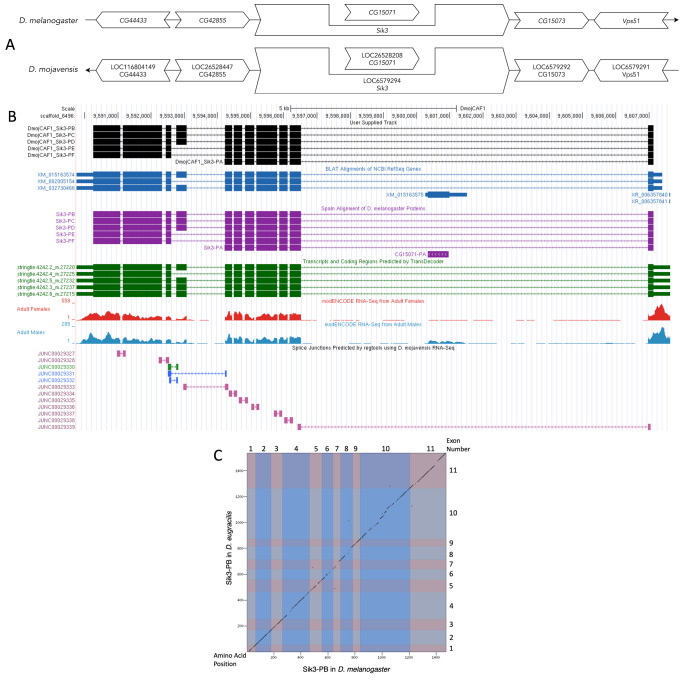 Figure 1
|
"In this GEP CURE protocol students use web-based tools to manually annotate genes in non-model
“The particular gene ortholog described here was characterized as part of a developing dataset to study the evolution of the Insulin/insulin-like growth factor signaling pathway (IIS) across the genus
“
|
- —National Institutes of Health (United States)https://ror.org/01cwqze88
- —National Science Foundation (United States)https://ror.org/021nxhr62
Peer Reviews
No public reviews on file for this paper yet. If you reviewed it on a platform where reviews are public (OpenReview, ICLR, NeurIPS, ICML), you can paste yours below so the community can read it here.
Videos
No videos yet. Explain this paper in a talk, walkthrough, or lecture? Add one.
Taxonomy
TopicsGene Regulatory Network Analysis
Description
**: **
We propose a gene model for the *D. mojavensis * ortholog of the D. melanogaster Salt-inducible kinase 3 ( * Sik3 * ) gene. The genomic region of the ortholog corresponds to the uncharacterized protein XP_015019060.1 (Locus ID LOC6579294 ) in the May 2011 (Agencourt dmoj_caf1/DmojCAF1) Genome Assembly of *D. mojavensis * ( GCA_000005175.1 ). This model is based on RNA-Seq data from *D. mojavensis * ( SRP006203
- Chen et al., 2014) and
Sik3 * in *D. melanogaster * using FlyBase release FB2023_03 ( GCA_000001215.4 ; Larkin et al., 2021; Gramates et al., 2022; Jenkins et al., 2022).
The gene * Sik3 * ( Salt-inducible kinase 3 ) is related to the AMPK Ser/Thr class of kinases and was identified using sequence homology upon comparison of the human and mouse *SIK * genes with the *Drosophila melanogaster * genome (Okamoto et al., 2004). * Sik3 * null mutants are not viable, so studies in D. melanogaster used hypomorphic alleles to characterize the role of Sik3 in the Insulin/TOR pathway (Wang et al., 2011). Under fed conditions, Sik3 is phosphorylated and activated downstream of Akt and liver kinase B1 (LKB1) where Sik3 promotes sequestration of Histone Deacetylase 4 (HDAC4) in the cytoplasm via phosphorylation (Wang et al., 2011; Choi et al., 2015). Under fasting conditions, Protein Kinase A (PKA) phosphorylates and inactivates Sik3, allowing HDAC4 to translocate to the nucleus and activate the transcription factor Forkhead Box, subgroup O (dFOXO) (Walkinshaw et al., 2013; Wang et al., 2011). Sik3 has also been shown to negatively regulate the Hippo signaling pathway in Drosophila and to be involved in circadian rhythm regulation in a range of species from flies to mice (Wehr et al., 2013; Funato et al., 2016; Liu et al., 2022).
** Synteny **
Sik3 * occurs on chromosome 2R in *D. melanogaster * and is flanked by upstream genes * CG44433 , CG42855 , * and downstream genes * CG15073 , Vacuolar protein sorting 51 * ( * Vps51 * ) * . Sik3 * holds a nested gene of * CG15071 . * It has been determined that the putative ortholog of * Sik3 * is found on scaffold CH933808.1 (scaffold_6496) in D. mojavensis with LOC6579294 ( XP_015019060.1 , via tblastn search with an e-value of 0.0 and percent identity of 67.19%), where it is surrounded by upstream genes LOC116804149 ( XP_032586360.1 ) and LOC26528447 ( XP_015019062.1 ), which correspond to * CG44433 * and * CG42855 * in *D. melanogaster * with e-values 0.48, 7e-11 and and percent identities of 65.00%, 52.63%, respectively, as determined by blastp ( Figure 1A, Altschul et al., 1990). The nested gene within the putative ortholog has a LOCID of LOC26528208 ( XP_015019061.1 ) and it corresponds to * CG15071 * in *D. melanogaster * with an e-value of 4e-56 and a percent identity of 52.15%. The putative ortholog is flanked downstream by LOC6579292 ( XP_002005188.1 ) and LOC6579291 ( XP_032586692.1 ), which correspond to * CG15073 * and * Vps51 * in D. melanogaster with e-values of 0.0, and percent identities 60.22%, 91.87%, respectively, as determined by blastp . This is likely the correct ortholog assignment for * Sik3 * in D. mojavensis for two reasons: 1) the best alignment indicated with a *blastp * search resulting in * Sik3 * with an e-value of 0.0 and a percent identity of 78.35%; and 2) the local synteny is highly conserved, consisting of the upstream and downstream genes being orthologous to *D. melanogaster * ( Figure 1A ) .
** Protein Model **
Sik3 * in
- D. mojavensis * has six protein coding isoforms (Sik3-PA, Sik3-PB, Sik3-PC, Sik3, PD, Sik3-PE, Sik3-PF) ( Figure 1B ). mRNA isoform Sik3-RA contains seven CDSs. mRNA isoforms Sik3-RC , Sik3-RD , Sik3-RB all contain eleven CDSs, and mRNA isoforms Sik3-RF and Sik3-RE contain ten CDSs. These isoforms are the same relative to the ortholog in D. melanogaster which contains six protein coding isoforms (Sik3-PA, Sik3-PB, Sik3-PC, Sik3, PD, Sik3-PE, Sik3-PF) with the same CDS structure. The dot plot that compares the protein alignment between *D. mojavensis * and *D. melanogaster * shows an indel within the 10th CDS, and the sequence alignment has a percent identity of 78.35% as determined by
- blastp * ( Figure 1C ). The coordinates of the curated gene models (Sik3-PC, Sik3-PB, Sik3-PD, Sik3-PE, Sik3-PF and Sik3-PA) can be found in NCBI at GenBank using the accessions BK064485 , BK064486 , BK064487 , BK064488 , BK064489 and BK064490 . These data are also available in Extended Data files below, which are archived in CaltechData.
Methods
Detailed methods including algorithms, database versions, and citations for the complete annotation process can be found in Rele et al. (2023). Briefly, students use the GEP instance of the UCSC Genome Browser v.435 ( https://gander.wustl.edu ; Kent WJ et al., 2002; Navarro Gonzalez et al., 2021) to examine the genomic neighborhood of their reference IIS gene in the D. melanogaster genome assembly (Aug. 2014; BDGP Release 6 + ISO1 MT/dm6). Students then retrieve the protein sequence for the D. melanogaster reference gene for a given isoform and run it using tblastn against their target *Drosophila * species genome assembly on the NCBI BLAST server ( https://blast.ncbi.nlm.nih.gov/Blast.cgi ; Altschul et al., 1990) to identify potential orthologs. To validate the potential ortholog, students compare the local genomic neighborhood of their potential ortholog with the genomic neighborhood of their reference gene in D. melanogaster . This local synteny analysis includes at minimum the two upstream and downstream genes relative to their putative ortholog. They also explore other sets of genomic evidence using multiple alignment tracks in the Genome Browser, including BLAT alignments of RefSeq Genes, Spaln alignment of
- D. melanogaster* proteins, multiple gene prediction tracks (e.g., GeMoMa, Geneid, Augustus), and modENCODE RNA-Seq from the target species. Detailed explanation of how these lines of genomic evidenced are leveraged by students in gene model development are described in Rele et al. (2023). Genomic structure information (e.g., CDSs, intron-exon number and boundaries, number of isoforms) for the D. melanogaster reference gene is retrieved through the Gene Record Finder ( https://gander.wustl.edu/~wilson/dmelgenerecord/index.html ; Rele et al *., * 2023). Approximate splice sites within the target gene are determined using tblastn using the CDSs from the D. melanogaste r reference gene. Coordinates of CDSs are then refined by examining aligned modENCODE RNA-Seq data, and by applying paradigms of molecular biology such as identifying canonical splice site sequences and ensuring the maintenance of an open reading frame across hypothesized splice sites. Students then confirm the biological validity of their target gene model using the Gene Model Checker ( https://gander.wustl.edu/~wilson/dmelgenerecord/index.html ; Rele et al., 2023), which compares the structure and translated sequence from their hypothesized target gene model against the *D. melanogaster * reference gene model. At least two independent models for a gene are generated by students under mentorship of their faculty course instructors. Those models are then reconciled by a third independent researcher mentored by the project leaders to produce the final model. Note: comparison of 5' and 3' UTR sequence information is not included in this GEP CURE protocol.
The reference list from the paper itself. Each links out to its DOI / PubMed record.
- 1Altschul SF Gish W Miller W Myers EW Lipman DJ 1990105 Basic local alignment search tool.J Mol Biol 21530022-283640341010.1016/S 0022-2836(05)80360-22231712 · doi ↗ · pubmed ↗
- 2Choi S Lim DS Chung J 2015521 Feeding and Fasting Signals Converge on the LKB 1-SIK 3 Pathway to Regulate Lipid Metabolism in Drosophila.P Lo S Genet 1151553-7390 e 1005263 e 100526310.1371/journal.pgen.100526325996931 PMC 4440640 · doi ↗ · pubmed ↗
- 3Congleton H Kiser CA Colom Diaz PA Schlichting E Walton DA Long LJ Reed LK Martinez-Cruzado JC Rele CP 20221115 Drosophila mojavensis - chico.Micro Publ Biol 202210.17912/micropub.biology.00067736468157 PMC 9709638 · doi ↗ · pubmed ↗
- 4Drosophila 12 Genomes Consortium. Clark AG Eisen MB Smith DR Bergman CM Oliver B Markow TA Kaufman TC Kellis M Gelbart W Iyer VN Pollard DA Sackton TB Larracuente AM Singh ND Abad JP Abt DN Adryan B Aguade M Akashi H Anderson WW Aquadro CF Ardell DH Arguello R Artieri CG Barbash DA Barker D Barsanti P Batterham P Batzoglou S Begun D Bhutkar A Blanco E Bosak SA Bradley RK Brand AD Brent MR Brooks AN Brown RH Butlin RK Caggese C Calvi BR Bernardo de Carvalho A Caspi A Castrezana S Celniker SE Chang JL Chapple C Chatterji S Chinwalla A Civetta A C · doi ↗ · pubmed ↗
- 5Durando CM Baker RH Etges WJ Heed WB Wasserman M De Salle R 200081 Phylogenetic analysis of the repleta species group of the genus Drosophila using multiple sources of characters.Mol Phylogenet Evol 1621055-790329630710.1006/mpev.2000.082410942616 · doi ↗ · pubmed ↗
- 6Funato H Miyoshi C Fujiyama T Kanda T Sato M Wang Z Ma J Nakane S Tomita J Ikkyu A Kakizaki M Hotta-Hirashima N Kanno S Komiya H Asano F Honda T Kim SJ Harano K Muramoto H Yonezawa T Mizuno S Miyazaki S Connor L Kumar V Miura I Suzuki T Watanabe A Abe M Sugiyama F Takahashi S Sakimura K Hayashi Y Liu Q Kume K Wakana S Takahashi JS Yanagisawa M 2016112 Forward-genetics analysis of sleep in randomly mutagenized mice.Nature 53976290028-083637838310.1038/nature 2014227806374 PMC 6076225 · doi ↗ · pubmed ↗
- 7Gramates L Sian Agapite Julie Attrill Helen Calvi Brian R Crosby Madeline A dos Santos Gilberto Goodman Joshua L Goutte-Gattat Damien Jenkins Victoria K Kaufman Thomas Larkin Aoife Matthews Beverley B Millburn Gillian Strelets Victor B Perrimon Norbert Gelbart Susan Russo Agapite Julie Broll Kris Crosby Lynn dos Santos Gil Falls Kathleen Gramates L Sian Jenkins Victoria Longden Ian Matthews Beverley Seme Jolene Tabone Christopher J Zhou Pinglei Zytkovicz Mark Brown Nick Antonazzo Giulia Attrill Helen Garapati Phani Goutte-Gatta · doi ↗ · pubmed ↗
- 8Grewal SS 20081018 Insulin/TOR signaling in growth and homeostasis: a view from the fly world.Int J Biochem Cell Biol 4151357-27251006101010.1016/j.biocel.2008.10.01018992839 · doi ↗ · pubmed ↗