Thiazides as an additional antiproteinuric treatment in young patients with Alport syndrome
Valentine Gillion, Nathalie Godefroid, Kathleen Claes, Nada Kanaan

Abstract
Genes, proteins, chemicals, diseases, species, mutations and cell lines named across the full text — each resolved to its canonical identifier and authoritative record.
Click any figure to enlarge with its caption.
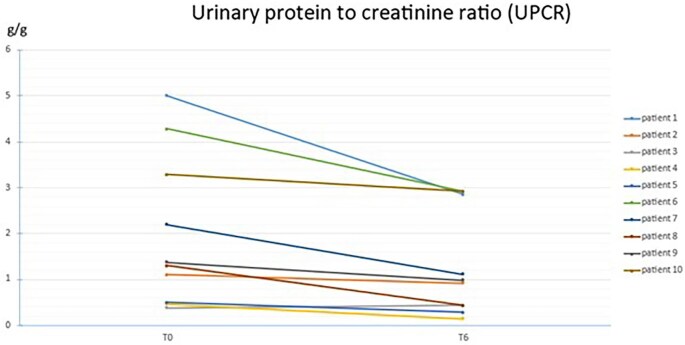 Figure 1
Peer Reviews
No public reviews on file for this paper yet. If you reviewed it on a platform where reviews are public (OpenReview, ICLR, NeurIPS, ICML), you can paste yours below so the community can read it here.
Videos
No videos yet. Explain this paper in a talk, walkthrough, or lecture? Add one.
Taxonomy
TopicsCell Adhesion Molecules Research · Neuropeptides and Animal Physiology · Blood Coagulation and Thrombosis Mechanisms
To the Editor,
Thiazides have been used for years as antihypertensive drugs with a beneficial effect on cardiovascular morbidity and mortality [1]. Additionally, thiazide diuretics may have an antiproteinuric effect. Indeed, the CLICK Trial not only recently challenged the belief that thiazides are ineffective for treating hypertension in advanced chronic kidney disease, but also demonstrated a 52% reduction from baseline in the urinary albumin to creatinine ration in the chlorthalidone group at week 12, compared to a 4% reduction in the placebo group [2].
Here we report the effect of adding hydrochlorothiazide 12.5 mg to stable doses of angiotensin-converting enzyme inhibitors or angiotensin II receptor blockers on proteinuria in patients with X-linked Alport syndrome. Ten patients from 12 to 33 years old (eight men and two women) were retrospectively studied with a median baseline urinary protein/creatinine ratio (UPCR) 1.3 g/g and a median baseline estimated glomerular filtration rate (eGFR) of 90.5 ml/min/1.73 m^2^. (Supplementary Table 1) At month 6, the mean UPCR reduction was 34.2% (Fig. 1) and eGFR was stable. No electrolyte disturbance was reported (hyponatremia or hypokalemia) and tolerance was excellent. This old, affordable, and well-known medication is widely available and should be considered to minimize proteinuria and consequently slow the progression of kidney disease in Alport syndrome. This combination therapy will probably also be effective when used with other medications such as inhibitors of SGLT2 and/or finerenone. This warrants future investigations.
Supplementary Material
sfaf008_Supplemental_File
The reference list from the paper itself. Each links out to its DOI / PubMed record.
- 1Ernst ME, Fravel MA. Thiazide and the Thiazide-like diuretics: review of hydrochlorothiazide, chlorthalidone, and indapamide. Am J Hypertens 2022;35:573–86. 10.1093/ajh/hpac 04835404993 · doi ↗ · pubmed ↗
- 2Agarwal R, Sinha AD, Cramer AE et al. Chlorthalidone for hypertension in advanced chronic kidney disease. N Engl J Med 2021;385:2507–19. 10.1056/NEJ Moa 211073034739197 PMC 9119310 · doi ↗ · pubmed ↗