Correction: Combination of betulinic acid and EGFR‑TKIs exerts synergistic anti‑tumor effects against wild‑type EGFR NSCLC by inducing autophagy‑related cell death via EGFR signaling
Han Wang, Xiaohui Du, Wenwen Liu, Congcong Zhang, Ying Li, Jingwen Hou, Yi Yu, Guiru Li, Qi Wang

Abstract
Genes, proteins, chemicals, diseases, species, mutations and cell lines named across the full text — each resolved to its canonical identifier and authoritative record.
Click any figure to enlarge with its caption.
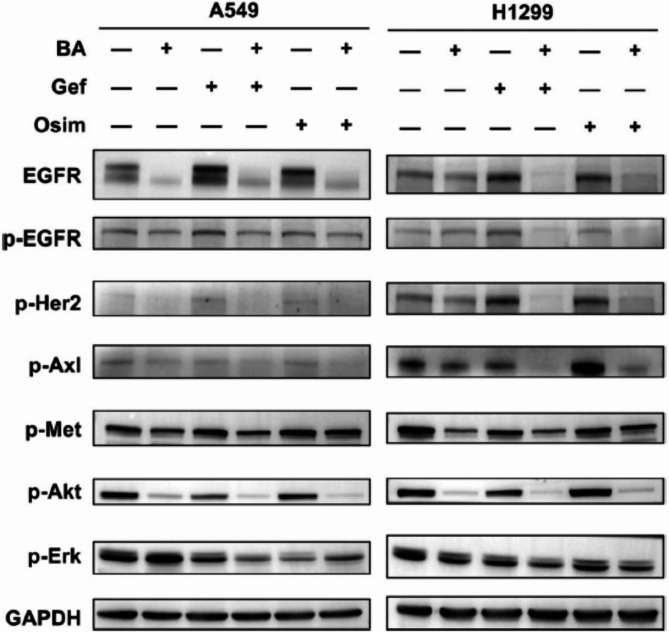 Figure 1
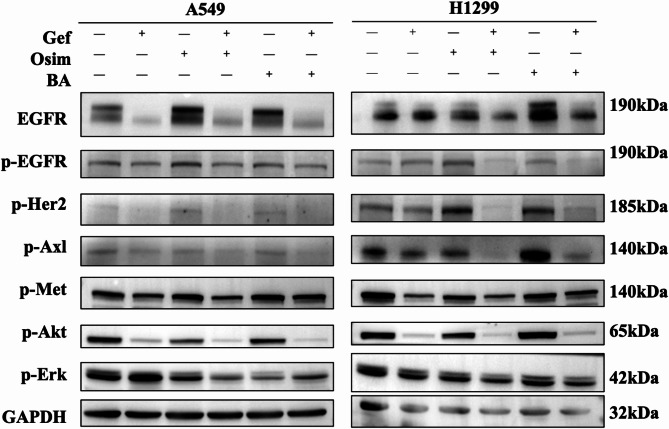 Figure 2
Peer Reviews
No public reviews on file for this paper yet. If you reviewed it on a platform where reviews are public (OpenReview, ICLR, NeurIPS, ICML), you can paste yours below so the community can read it here.
Videos
No videos yet. Explain this paper in a talk, walkthrough, or lecture? Add one.
Taxonomy
TopicsNatural product bioactivities and synthesis · RNA modifications and cancer · ATP Synthase and ATPases Research
Correction to: Respiratory Research (2024) 25:215
10.1186/s12931-024-02844-9
In the original publication of this article [1], there was an error in Fig. 5. The western blots lines reporting the EGFR and p-Her2 bands for H1299 cell lines were duplicated. The EGFR bands was mistakenly repeated in p-Her2 bands. For completeness and transparency, the old incorrect and correct Fig. 5 are displayed in this correction article.
Incorrect Fig. 5:
Fig. 5. Combination treatment enhanced the suppression of EGFR and its downstream signaling and bypass pathways in wt-EGFR NSCLC cells. A549 and H1299 cells were treated with DMSO, BA, gefitinib, osimertinib or the indicated combination and then harvested for preparation of whole-cell protein lysates and subsequent western blotting to detect the indicated proteins
Correct Fig. 5:
Fig. 5. Combination treatment enhanced the suppression of EGFR and its downstream signaling and bypass pathways in wt-EGFR NSCLC cells. A549 and H1299 cells were treated with DMSO, BA, gefitinib, osimertinib or the indicated combination and then harvested for preparation of whole-cell protein lysates and subsequent western blotting to detect the indicated proteins