Burden of laryngeal cancer in China caused by smoking from 1990 to 2021 and predictions for 2035: An age-period-cohort analysis of global burden of disease study 2021
Xue Gu, Xiaopeng Sun, Xiao Ren, Yu Li, Yingying Fang, Hui Song, Pingli Luo, Mengfan Yuan

TL;DR
This study examines how smoking has contributed to the rising burden of laryngeal cancer in China from 1990 to 2021 and predicts future trends up to 2035.
Contribution
The study provides new predictions for laryngeal cancer burden in China using age-period-cohort analysis and Bayesian modeling.
Findings
The burden of laryngeal cancer due to smoking increased in China, with more male deaths and DALYs than female.
Age-standardized rates declined, especially in females, despite rising absolute numbers.
Predictions show continued increases in deaths but decreasing age-standardized rates by 2035.
Abstract
Smoking is a major risk factor for laryngeal cancer (LC). Understanding the impact of smoking on the changing disease burden of LC is crucial for LC prevention in China and provides a scientific basis for formulating targeted LC prevention and control strategies, contributing to the achievement of the ‘Healthy China 2030’ goals. Data on LC attributable to smoking in China, stratified by sex, age, and year, were obtained from the 2021 Global Burden of Disease (GBD) study to conduct a secondary data analysis. Joinpoint regression was used to analyze trends in the burden of LC attributable to smoking in China from 1990 to 2021. Age-period-cohort (APC) analysis was employed to compare and analyze trends in the age, period, and cohort effects on the disease burden. Finally, Bayesian age-period-cohort (BAPC) analysis was used to predict trends in LC mortality and disability-adjusted life…
Genes, proteins, chemicals, diseases, species, mutations and cell lines named across the full text — each resolved to its canonical identifier and authoritative record.
Click any figure to enlarge with its caption.
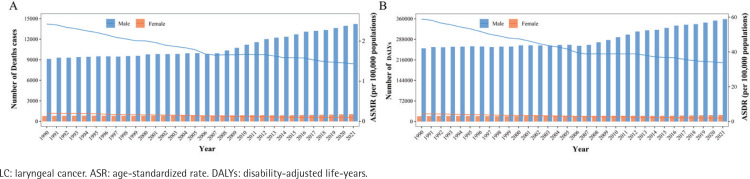 Figure 1
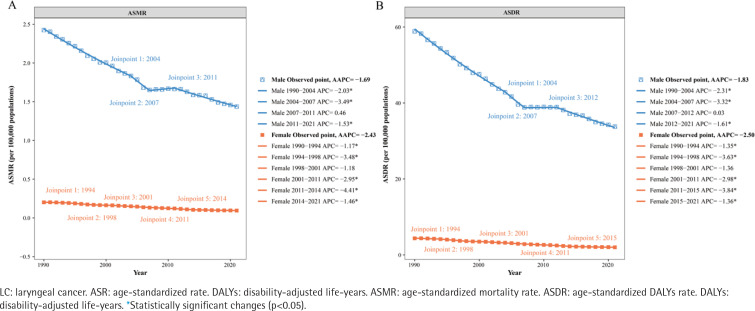 Figure 2
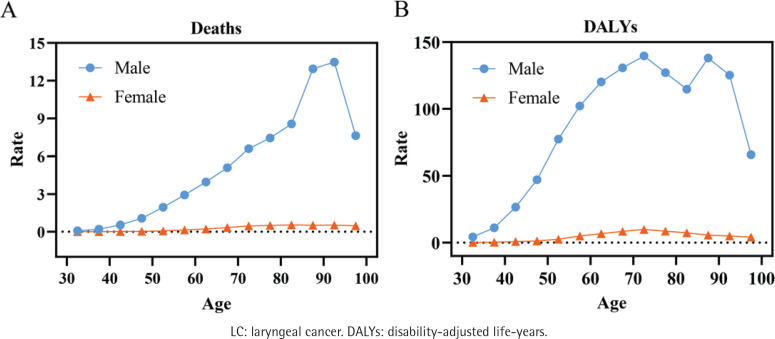 Figure 3
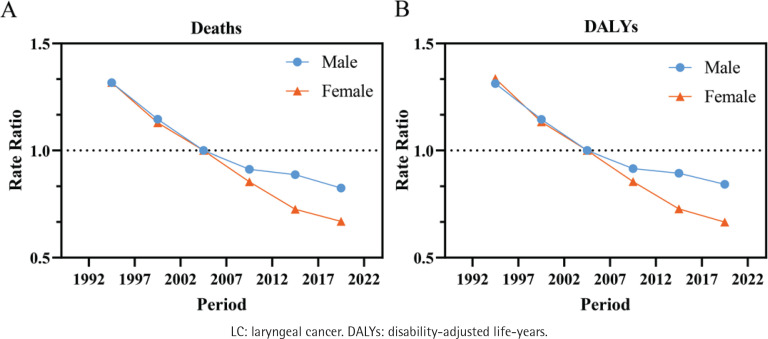 Figure 4
Peer Reviews
No public reviews on file for this paper yet. If you reviewed it on a platform where reviews are public (OpenReview, ICLR, NeurIPS, ICML), you can paste yours below so the community can read it here.
Videos
No videos yet. Explain this paper in a talk, walkthrough, or lecture? Add one.
Taxonomy
TopicsCancer-related molecular mechanisms research · Head and Neck Cancer Studies