Assessing the dose of regadenoson required to transiently alter blood-brain barrier integrity in patients with infiltrating gliomas
Stuart A Grossman, Carlos G Romo, Xiaobu Ye, Brian Kral, Roy E Strowd, Glenn Lesser, Catalina Raymond, Michaella Iacoboni, Serena Desideri, Joy Fisher, Neeraja Danda, Benjamin M Ellingson

TL;DR
This study tested regadenoson's ability to temporarily change the blood-brain barrier in glioma patients but found it did not reach the desired effect.
Contribution
The study is the first to evaluate regadenoson's dose-dependent effect on BBB permeability in human glioma patients.
Findings
Regadenoson did not achieve the target BBB permeability threshold in normal-appearing white matter.
Contrast-enhanced MRI showed a significant increase in signal intensity after regadenoson administration.
The results suggest regadenoson may still have potential to alter BBB permeability and warrant further investigation.
Abstract
The blood-brain barrier (BBB) severely limits the delivery of therapeutic agents to the brain. Regadenoson, a Food and Drug Administration-approved adenosine A2 agonist, transiently increases BBB permeability in rodents to a 70 kDa dextran. This multi-institutional, NIH-funded study examined regadenoson’s ability to transiently alter BBB permeability in patients with gliomas. Adults with supratentorial gliomas at low risk for regadenoson complications were treated with 1 of the 7 dose levels known to be safe in humans. Successful BBB disruption was defined as a 10-fold increase in vascular permeability (Ktrans) relative to historic benchmarks. This was assessed by dynamic contrast-enhanced perfusion on magnetic resonance imaging in normal-appearing white matter (NAWM) changes in NAWM and non-enhancing tumors were also quantified using contrast-enhanced T1 subtraction maps. Seven…
Genes, proteins, chemicals, diseases, species, mutations and cell lines named across the full text — each resolved to its canonical identifier and authoritative record.
Click any figure to enlarge with its caption.
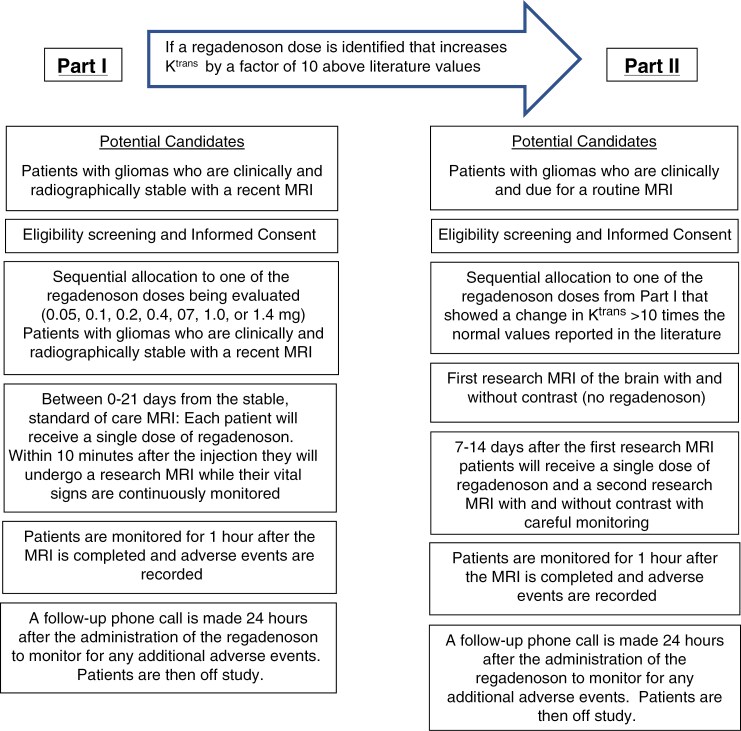 Figure 1
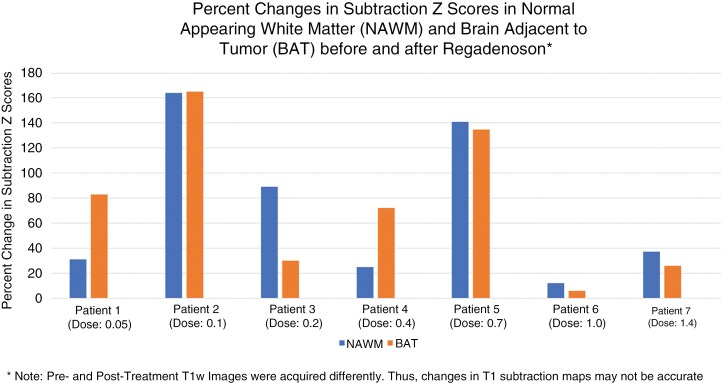 Figure 2
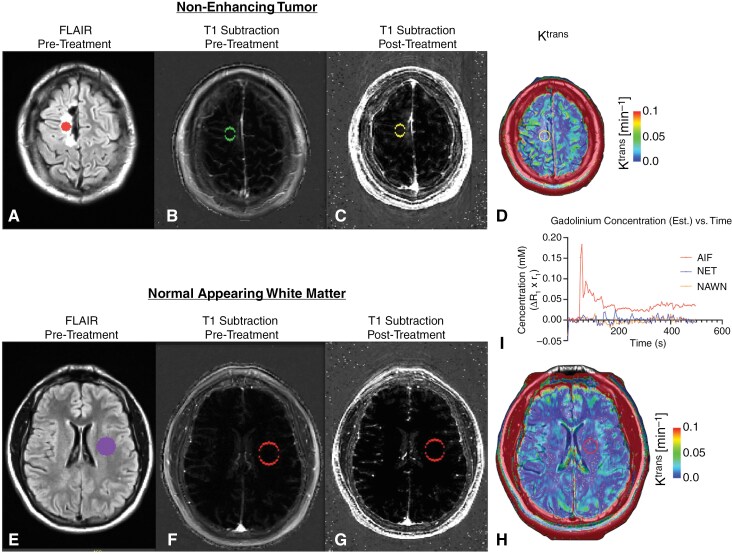 Figure 3
Peer Reviews
No public reviews on file for this paper yet. If you reviewed it on a platform where reviews are public (OpenReview, ICLR, NeurIPS, ICML), you can paste yours below so the community can read it here.
Videos
No videos yet. Explain this paper in a talk, walkthrough, or lecture? Add one.
Taxonomy
TopicsGlioma Diagnosis and Treatment · MRI in cancer diagnosis · Radiomics and Machine Learning in Medical Imaging