Radioactivity levels in the saliva of patients undergoing targeted radioligand therapy with [177Lu]Lu-PSMA-I&T and [177Lu]Lu-DOTA-TOC
Christian Schedeit, Nasir Gözlügöl, Radi Saiyed Alsheikh, Mohamed Shelan, Robert Seifert, Federico Caobelli, Urs Borner, Tateyuki Iizuka, Benoît Schaller, Axel Rominger, Paul Cumming, Ali Afshar-Oromieh, Konstantinos G. Zeimpekis

TL;DR
This study measures radioactive levels in saliva of patients undergoing radioligand therapy, finding minimal risk to healthcare workers.
Contribution
The study provides new data on salivary radioactivity levels and their decay for two types of radioligand therapies.
Findings
Salivary radioactivity peaks 2 hours post [177Lu]Lu-DOTA-TOC and 4 hours post [177Lu]Lu-PSMA-I&T.
PSMA-I&T patients show ten times higher radioactivity turnover in saliva compared to DOTA-TOC patients.
Radiation exposure to medical staff from patient saliva is considered minimal.
Abstract
The number of patients receiving radioligand therapy (RLT) has risen sharply in recent years. This raises concerns about possible risks to dental healthcare workers due to their exposure to the patients and their saliva. We therefore set about to measure the salivary radioactivity in patients undergoing 177Lu–RLT. We recruited in-house RLT patients receiving [177Lu]Lu -DOTA-TOC (n = 6) or [177Lu]Lu-PSMA-I&T (n = 14). We measured the radioactivity concentrations in 1 ml saliva samples collected before and 0.5, 2, 4, 21, 27, and 45 h post application of the radioligands, with additional samples collected at 51 and 69 h for [177Lu]Lu-PSMA-I&T patients. The biological half-life (BHL) and area under the curve (AUC) were calculated for the radioactivity of the saliva for both cohorts. Both cohorts exhibited increases in salivary radioactivity, attaining peaks at 2 h p.i. of…
Genes, proteins, chemicals, diseases, species, mutations and cell lines named across the full text — each resolved to its canonical identifier and authoritative record.
Click any figure to enlarge with its caption.
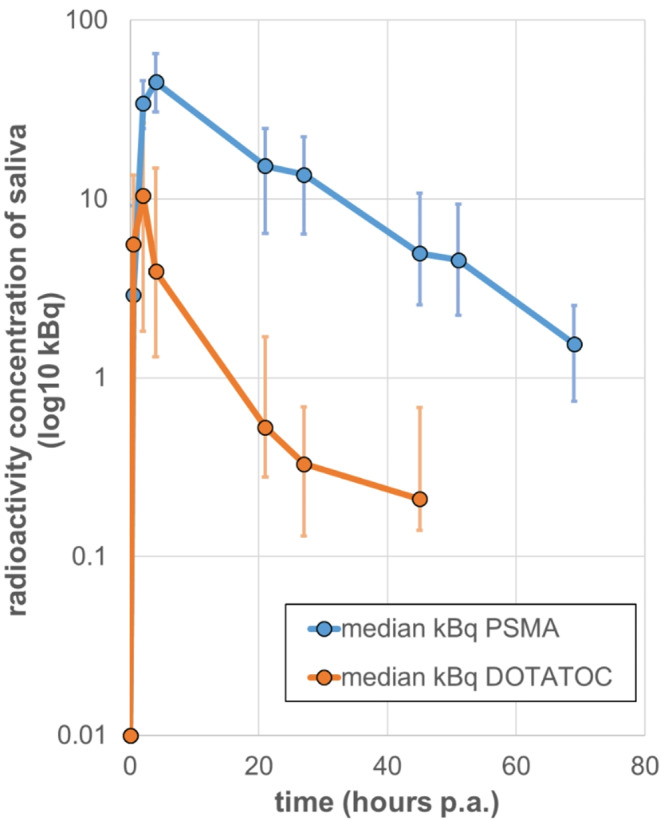 Figure 1
 Figure 2
Peer Reviews
No public reviews on file for this paper yet. If you reviewed it on a platform where reviews are public (OpenReview, ICLR, NeurIPS, ICML), you can paste yours below so the community can read it here.
Videos
No videos yet. Explain this paper in a talk, walkthrough, or lecture? Add one.
Taxonomy
TopicsRadiopharmaceutical Chemistry and Applications · Medical Imaging Techniques and Applications · Prostate Cancer Treatment and Research