Comparison of the Predictive Capacity of Oxygenation Parameters, Oxygenation Indices, and CURB-65 to Mortality, Mechanical Ventilation, and Vasopressor Support in Community-Acquired Pneumonia at Different Altitudes
Eduardo Tuta-Quintero, Alirio R. Bastidas, Angelica Mora, Luis F. Reyes, Laura E. Bello, Alejandra P. Nonzoque, Laura D. Saza, Natalia Trujillo, Jenifer C. Arias, Paola Mejía Martinez, Daniel Osorio, Paola Narváez, Laura Perdomo, Luis Vargas, María Pérez, Jesus Rubiano

TL;DR
This study compares how well different oxygenation measures and a pneumonia severity score predict outcomes in patients with pneumonia at high and low altitudes.
Contribution
The study evaluates the predictive performance of oxygenation parameters and the CURB-65 score for pneumonia outcomes at different altitudes.
Findings
The CURB-65 score showed good predictive performance for mortality at both high and low altitudes.
PaO2/FiO2 and SpO2/FiO2 were better predictors of mechanical ventilation and vasopressor needs at high altitudes.
The A-a O2 gradient was a moderate predictor of vasopressor support at low altitudes.
Abstract
Background: Populations residing at high altitudes display distinct physiological adaptations that are essential for understanding respiratory diseases. However, there is limited research on how these adaptations affect the assessment and prognosis of community-acquired pneumonia (CAP). Methods: A prognostic validation nested within a retrospective cohort was conducted on subjects with pneumonia admitted to two high-complexity institutions in Colombia at different altitudes above sea level. The receiver operating characteristic (ROC) curves were calculated for SaO2, PaO2, SpO2, A-a O2 gradient, a-A index, PaO2/FiO2, SpO2/FiO2, and the CURB-65 score to predict 30-day mortality, requirement for invasive mechanical ventilation (IMV), and need for vasopressor support. Results: 3467 were selected for analysis, with 73.7% (2557/3467) residing at high altitudes and 26.2% (910/3467) at low…
Genes, proteins, chemicals, diseases, species, mutations and cell lines named across the full text — each resolved to its canonical identifier and authoritative record.
Click any figure to enlarge with its caption.
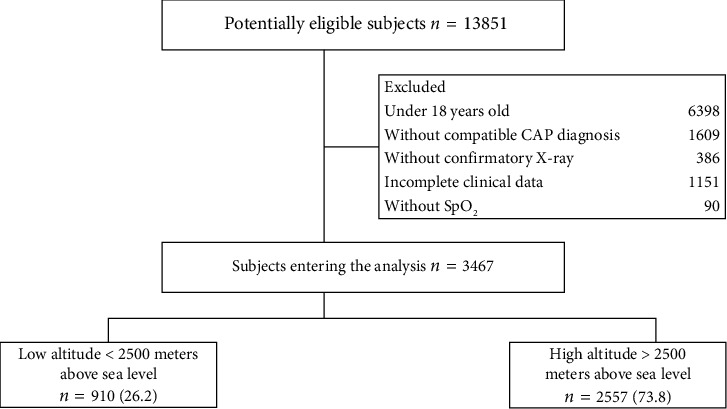 Figure 1
Peer Reviews
No public reviews on file for this paper yet. If you reviewed it on a platform where reviews are public (OpenReview, ICLR, NeurIPS, ICML), you can paste yours below so the community can read it here.
Videos
No videos yet. Explain this paper in a talk, walkthrough, or lecture? Add one.
Taxonomy
TopicsRespiratory Support and Mechanisms · Chronic Obstructive Pulmonary Disease (COPD) Research · Cardiac Arrest and Resuscitation