Digital Twins for 3D Confocal Microscopy: Near-Field, Far-Field, and Comparison with Experiments
Poul-Erik Hansen, Tobias Pahl, Liwei Fu, Ida Nielsen, Felix Rosenthal, Stephan Reichelt, Peter Lehmann, Astrid Tranum Rømer

TL;DR
This paper introduces digital twins for confocal microscopy to improve accuracy by simulating light-surface interactions using advanced models.
Contribution
The novel use of FMM for confocal microscopy and validation of three models against experimental data is presented.
Findings
Three models (FEM, FMM, BEM) produce identical accurate results for rectangular gratings when validated experimentally.
Digital twins reduce the need for repeated simulations during fine scanning in confocal microscopy.
Simulations reveal insights into experimentally observed effects like instrument transfer functions and tilted gratings.
Abstract
To push the boundaries of confocal microscopy beyond its current limitations by predicting sensor responses for complex surface geometries, we build digital twins using three rigorous models, the finite element method (FEM), Fourier modal method (FMM), and boundary element method (BEM) to model light–surface interactions. Fourier optics are then used to calculate the sensor signals at the back focal plane and at the detector. A 3D illumination model is applied to 2D periodic structures for FEM and FMM modelings and to 3D aperiodic structures for BEM modeling. The lateral and vertical scanning processes of the confocal microscope are achieved through focal-point shifts of the objective, using plane-wave illuminations with varying incident and azimuthal angles. This approach reduces the need for repeated, time-intensive rigorous simulations of the scattering process when a fine scanning…
Genes, proteins, chemicals, diseases, species, mutations and cell lines named across the full text — each resolved to its canonical identifier and authoritative record.
Click any figure to enlarge with its caption.
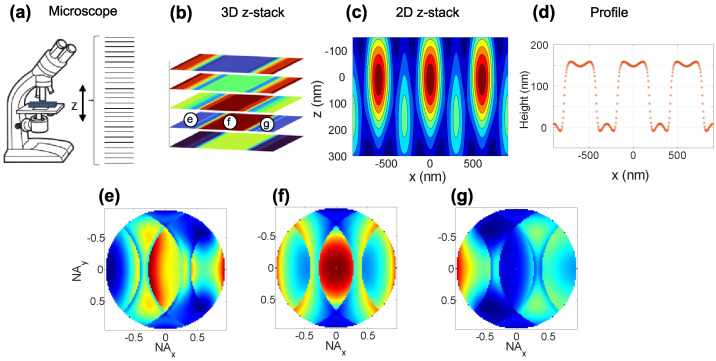 Figure 1
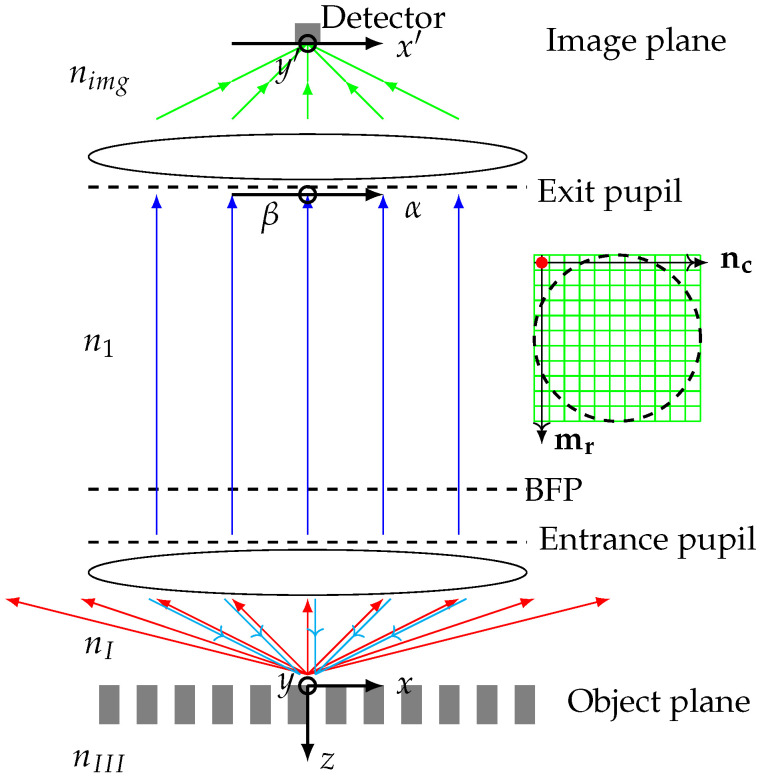 Figure 2
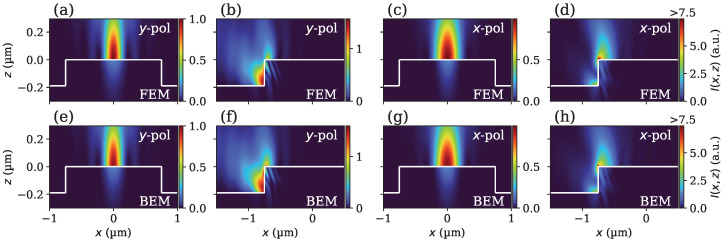 Figure 3
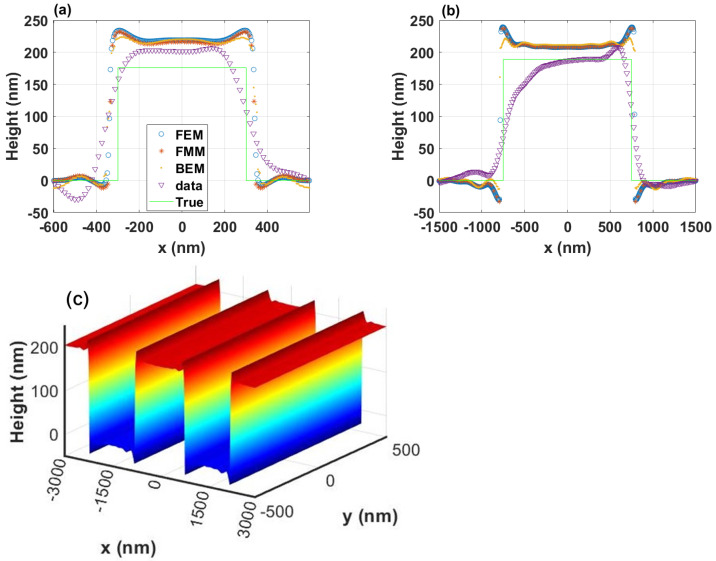 Figure 4
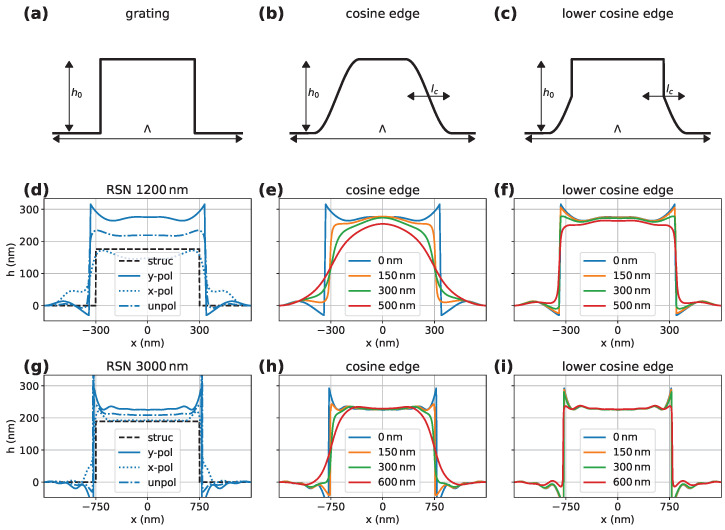 Figure 5
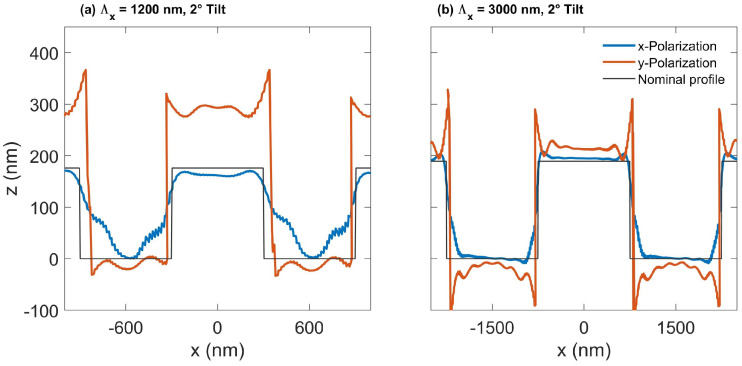 Figure 6
 Figure 7
Peer Reviews
No public reviews on file for this paper yet. If you reviewed it on a platform where reviews are public (OpenReview, ICLR, NeurIPS, ICML), you can paste yours below so the community can read it here.
Videos
No videos yet. Explain this paper in a talk, walkthrough, or lecture? Add one.
Taxonomy
TopicsNear-Field Optical Microscopy · Advanced Fluorescence Microscopy Techniques · Advanced Optical Sensing Technologies