Segmentation-Based Blood Blurring: Examining Eye-Response Differences in Gory Video Viewing
Jiwon Son, Minjeong Cha, Sangkeun Park

TL;DR
This study explores how blurring blood in gory videos affects viewer reactions, showing that partial blurring reduces perceived gore and distress.
Contribution
The paper introduces a segmentation-based blurring method to moderate graphic content while preserving narrative details.
Findings
Partial blood blurring significantly lowers perceived gore in brutal scenes.
Participants showed physiological reactions like decreased eye openness and increased blinking when viewing high-gore content.
Individuals with a stronger fear of blood blinked more frequently, indicating personal sensitivities influence responses.
Abstract
Online video platforms have enabled unprecedented access to diverse content, but minors and other vulnerable viewers can also be exposed to highly graphic or violent materials. This study addresses the need for a nuanced method of filtering gore by developing a segmentation-based approach that selectively blurs blood. We recruited 37 participants to watch both blurred and unblurred versions of five gory video clips. Eye-based physiological and gaze data, including eye openness ratio, blink frequency, and eye fixations, were recorded via a webcam and eye tracker. Our results demonstrate that partial blood blurring substantially lowers perceived gore in more brutal scenes. Additionally, participants exhibited distinctive physiological reactions when viewing clips with higher gore, such as decreased eye openness and more frequent blinking. Notably, individuals with a stronger fear of blood…
Genes, proteins, chemicals, diseases, species, mutations and cell lines named across the full text — each resolved to its canonical identifier and authoritative record.
Click any figure to enlarge with its caption.
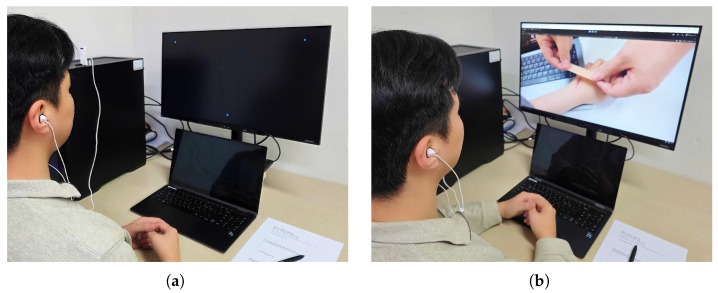 Figure 1
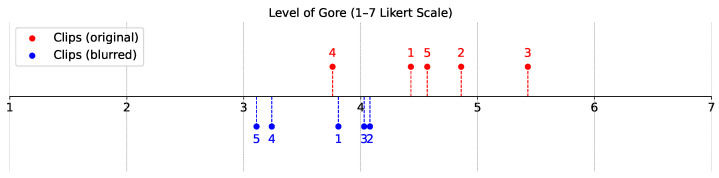 Figure 2
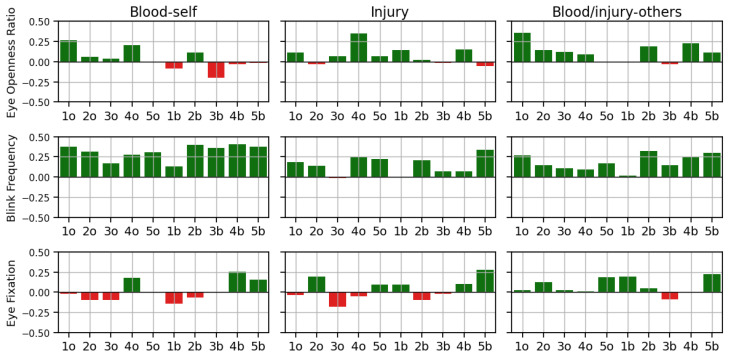 Figure 3
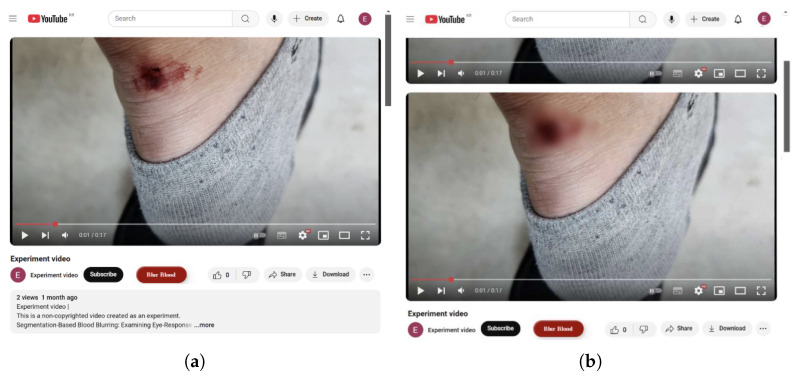 Figure 4
Peer Reviews
No public reviews on file for this paper yet. If you reviewed it on a platform where reviews are public (OpenReview, ICLR, NeurIPS, ICML), you can paste yours below so the community can read it here.
Videos
No videos yet. Explain this paper in a talk, walkthrough, or lecture? Add one.
Taxonomy
TopicsPsychology of Moral and Emotional Judgment · Media Influence and Health · Face Recognition and Perception