A Systematic Method for the Identification of Oligosaccharide Constituents in Polygonatum cyrtonema Hua Using UHPLC-Q-Exactive Orbitrap Mass Spectrometry
Suyu Yang, Bowen Gao, Qingrui Yang, Yanghui Huo, Kailin Li, Liangyin Shu, Lingxuan Fan, Yiliang Liu, Huanting Li, Wei Cai

TL;DR
This study identifies 44 new oligosaccharides in a medicinal plant using advanced mass spectrometry, providing insights for its use in health and medicine.
Contribution
A novel method combining UHPLC and Q-Exactive Orbitrap MS was developed to identify previously unknown oligosaccharides in Polygonatum cyrtonema Hua.
Findings
44 oligosaccharides, including 27 FOS and 10 AOS, were identified for the first time in Polygonatum cyrtonema Hua.
The method used high-resolution mass spectrometry and monosaccharide analysis to determine the structure of the oligosaccharides.
The findings provide a foundation for further research into the medicinal properties of the plant.
Abstract
A Polygonatum cyrtonema Hua (PCH) is a common medicinal and edible plant whose rhizomes are widely used for the treatment and prevention of various diseases. Previous studies have revealed a variety of chemical components such as polysaccharides, saponins, and flavonoids, which possess a variety of biological activities such as antimicrobial, lipid-regulating, anti-aging, hypoglycemic, and anti-inflammatory. However, to date, the structure and activity of its oligosaccharide components are still unclear. In this study, we developed a method combining ultra-high-performance liquid chromatography with Q-Exactive Orbitrap mass spectrometry (UHPLC-Q-Exactive Orbitrap MS) and monosaccharide analysis for the identification of oligosaccharides in PCH. Finally, a total of 44 oligosaccharides, including 27 fructo-oligosaccharides (FOS), 10 arabino-oligosaccharides (AOS), and 7 others, were…
Genes, proteins, chemicals, diseases, species, mutations and cell lines named across the full text — each resolved to its canonical identifier and authoritative record.
Click any figure to enlarge with its caption.
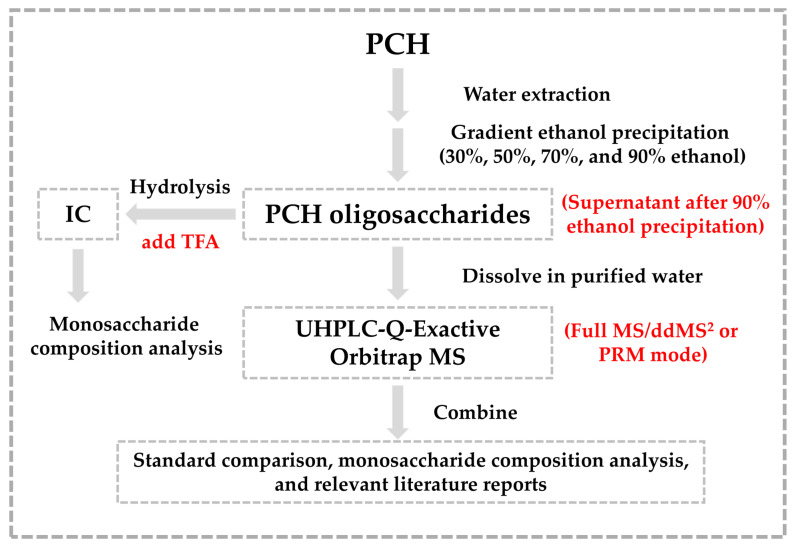 Figure 1
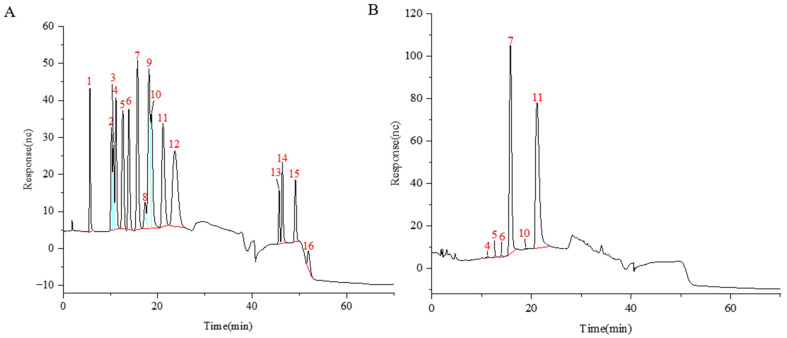 Figure 2
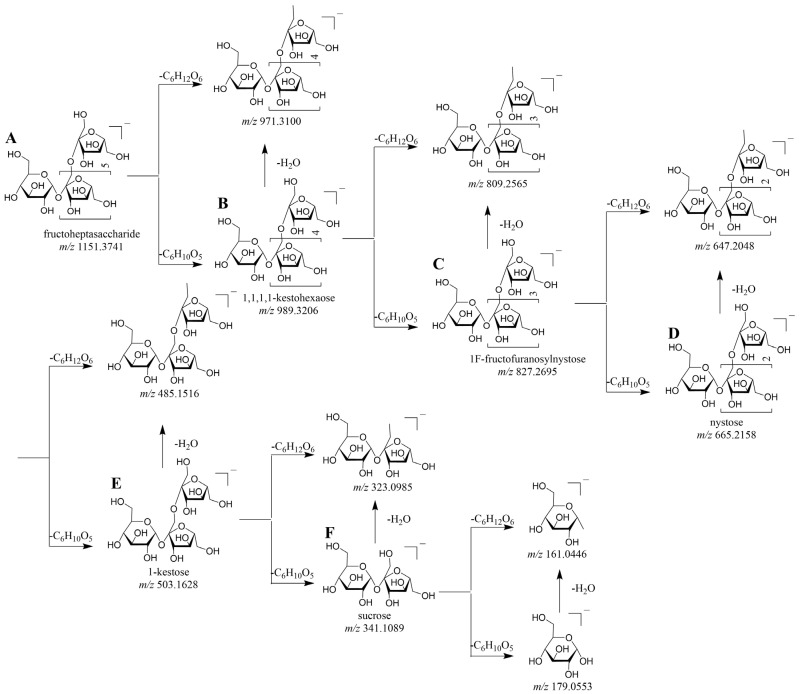 Figure 3
Peer Reviews
No public reviews on file for this paper yet. If you reviewed it on a platform where reviews are public (OpenReview, ICLR, NeurIPS, ICML), you can paste yours below so the community can read it here.
Videos
No videos yet. Explain this paper in a talk, walkthrough, or lecture? Add one.
Taxonomy
TopicsPolysaccharides and Plant Cell Walls · Phytochemical Studies and Bioactivities · Microbial Metabolites in Food Biotechnology