The Relation of Angiotensin-Converting Enzyme 2, Renin-Angiotensin-Aldosterone System Inhibitors, and Arterial Stiffness in Acute COVID-19 Emergency Department Patients—A Prospective Observational Study
Sebastian Schnaubelt, Anna Jakobljevich, Roman Brock, Julia Oppenauer, Andrea Kornfehl, Felix Eibensteiner, Christoph Veigl, Thomas Perkmann, Helmuth Haslacher, Robert Strassl, Roman Reindl-Schwaighofer, Oliver Schlager, Patrick Sulzgruber

TL;DR
This study explores the relationship between ACE2, RAAS inhibitors, and arterial stiffness in acute COVID-19 patients, suggesting RAAS inhibitors may have protective effects.
Contribution
The study provides new clinical insights into the role of sACE2 and RAAS inhibitors in acute COVID-19 patients and their vascular effects.
Findings
sACE2 levels were slightly higher in COVID-19 patients but not significantly different from non-COVID-19 patients.
RAASi use did not increase sACE2 levels in either COVID-19 or non-COVID-19 patients.
Elevated sACE2 appeared to have a beneficial effect on arterial stiffness in all patients.
Abstract
Background: Severe acute respiratory syndrome coronavirus 2 (SARS-CoV-2) causing coronavirus disease 2019 (COVID-19) can damage the endothelium and increase arterial stiffness, potentially leading to adverse cardiovascular events. In parallel, systemic inflammation in COVID-19 also impacts endothelial function. Angiotensin-converting enzyme 2 (ACE2) promotes vasodilation and anti-inflammatory effects, but also facilitates SARS-CoV-2 entry into human cells. Thus, concerns have been raised about the use of RAAS inhibitors (RAASi) in COVID-19 patients due to potential ACE2 upregulation. However, the clinical significance of increased plasma ACE2 (sACE2) in RAASi-treated COVID-19 patients remains unclear. Methods: This prospective, single-centre study evaluated RAASi, sACE2, and vascular function in acutely ill patients with COVID-19 in comparison with acutely ill patients without COVID-19.…
Genes, proteins, chemicals, diseases, species, mutations and cell lines named across the full text — each resolved to its canonical identifier and authoritative record.
Click any figure to enlarge with its caption.
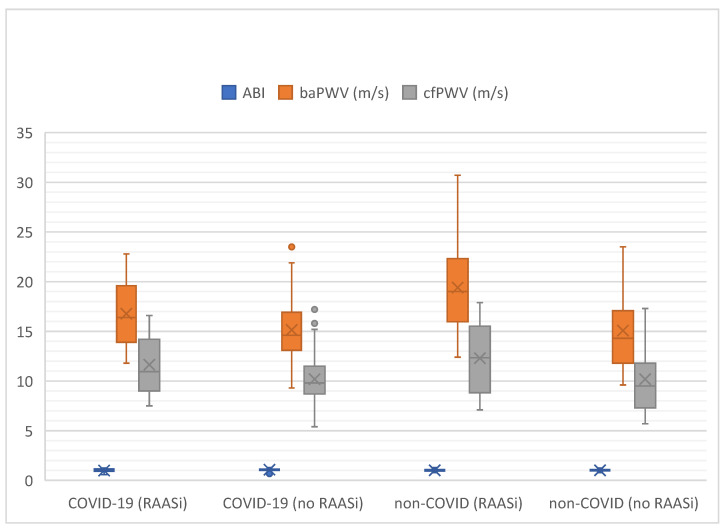 Figure 1
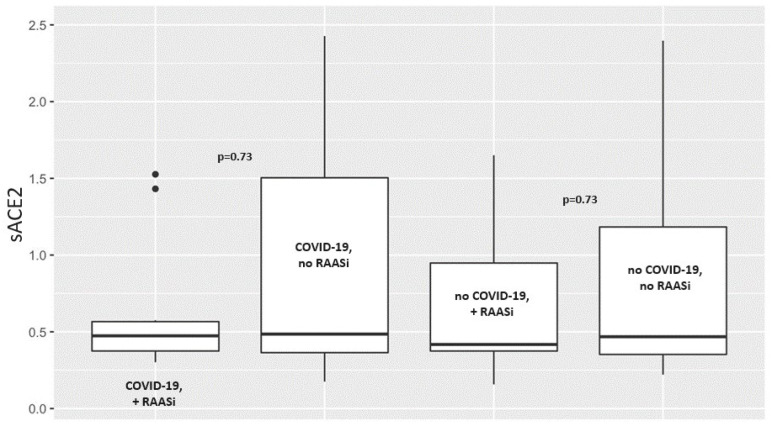 Figure 2
Peer Reviews
No public reviews on file for this paper yet. If you reviewed it on a platform where reviews are public (OpenReview, ICLR, NeurIPS, ICML), you can paste yours below so the community can read it here.
Videos
No videos yet. Explain this paper in a talk, walkthrough, or lecture? Add one.
Taxonomy
TopicsCOVID-19 Clinical Research Studies · Long-Term Effects of COVID-19 · Vitamin C and Antioxidants Research