Bi-Allelic MARVELD2 Variant Identified with Exome Sequencing in a Consanguineous Multiplex Ghanaian Family Segregating Non-Syndromic Hearing Loss
Elvis Twumasi Aboagye, Samuel Mawuli Adadey, Leonardo Alves de Souza Rios, Kevin K. Esoh, Edmond Wonkam-Tingang, Lettilia Xhakaza, Carmen De Kock, Isabelle Schrauwen, Lucas Amenga-Etego, Dirk Lang, Gordon A. Awandare, Suzanne M. Leal, Shaheen Mowla, Ambroise Wonkam

TL;DR
A harmful genetic variant in the MARVELD2 gene is linked to hearing loss in a Ghanaian family, with implications for inner ear function.
Contribution
A novel pathogenic MARVELD2 frameshift variant is identified as the cause of non-syndromic hearing loss in a consanguineous Ghanaian family.
Findings
A homozygous frameshift variant in MARVELD2 (c.1058dup) was found in all affected siblings.
The variant leads to a predicted loss of the conserved C-terminal domain and is targeted by nonsense-mediated decay.
Cell studies showed functional impacts on protein expression, localization, and actin cytoskeleton architecture.
Abstract
Genetic studies and phenotypic expansion of hearing loss (HL) for people living in Africa are greatly needed. We evaluated the clinical phenotypes of three affected siblings presenting non-syndromic (NS) HL and five unaffected members of a consanguineous Ghanaian family. Analysis of exome sequence data was performed for all affected and one unaffected family members. In-depth genetic and cellular characterization studies were performed to investigate biological significance of the implicated variant using bioinformatic tools and cell-based experimentation. Audiological examinations showed severe-to-profound, bilateral, symmetrical, and post-lingual onset. The whole-exome sequencing (WES) identified a homozygous frameshift variant: MARVEL domain containing 2 (MARVELD2):c.1058dup;p.(Val354Serfs*5) in all affected siblings. This frameshift variant leads to an early stop codon insertion and…
Genes, proteins, chemicals, diseases, species, mutations and cell lines named across the full text — each resolved to its canonical identifier and authoritative record.
Click any figure to enlarge with its caption.
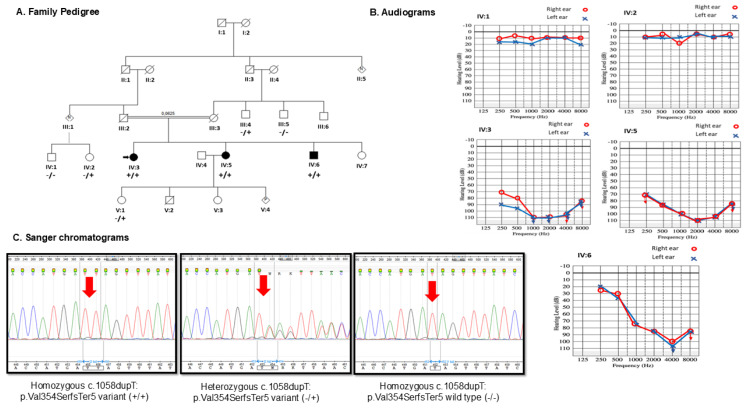 Figure 1
 Figure 2
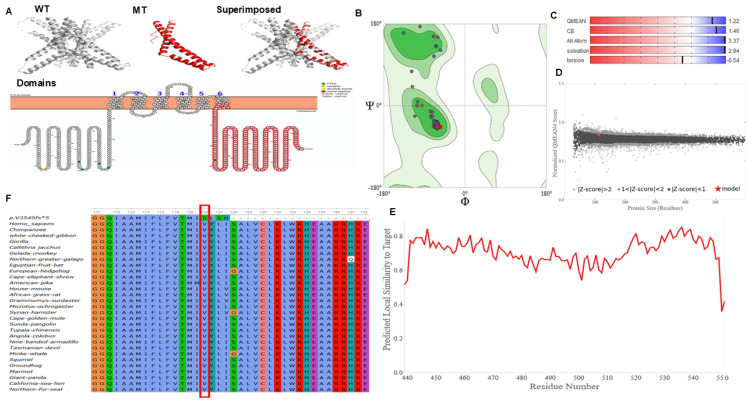 Figure 3
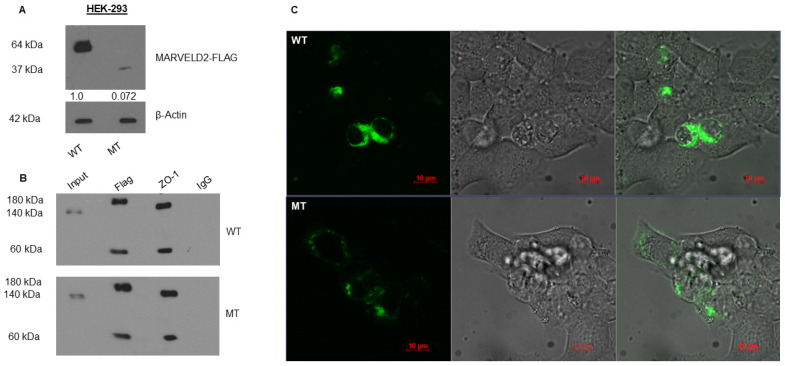 Figure 4
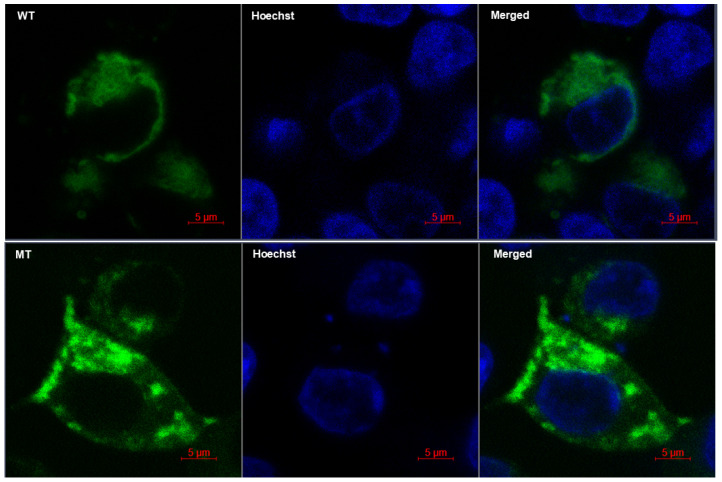 Figure 5
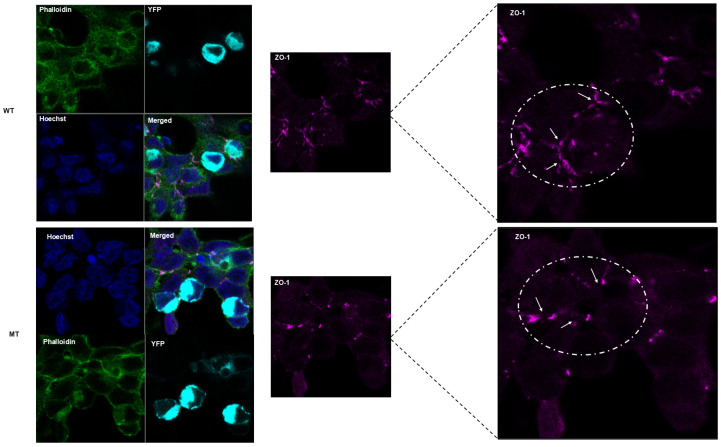 Figure 6
Peer Reviews
No public reviews on file for this paper yet. If you reviewed it on a platform where reviews are public (OpenReview, ICLR, NeurIPS, ICML), you can paste yours below so the community can read it here.
Videos
No videos yet. Explain this paper in a talk, walkthrough, or lecture? Add one.
Taxonomy
TopicsHearing, Cochlea, Tinnitus, Genetics · RNA regulation and disease · Connexins and lens biology