The Impact of Vascular Anatomic Variations in the Infra-Pyloric Area on the Surgical Outcomes of Laparoscopic Pylorus-Preserving Gastrectomy in Early Gastric Cancer: A Post Hoc Analysis of a Multicenter Prospective Trial (KLASS-04)
Sang Soo Eom, Sin Hye Park, Young Shick Rhee, Sa-Hong Kim, Hyuk-Joon Lee, Young-Woo Kim, Han-Kwang Yang, Do Joong Park, Sang Uk Han, Hyung-Ho Kim, Woo Jin Hyung, Ji-Ho Park, Yun-Suhk Suh, Oh-Kyung Kwon, Wook Kim, Young-Kyu Park, Hong Man Yoon, Sang-Hoon Ahn, Seong-Ho Kong

TL;DR
This study examines how variations in the infra-pyloric artery affect surgical outcomes in early gastric cancer patients undergoing a specific laparoscopic procedure.
Contribution
The study reveals new insights into the impact of infra-pyloric artery variations on surgical duration during pylorus-preserving gastrectomy.
Findings
The infra-pyloric artery types were more diverse than previously reported.
Surgical operating time varied significantly based on the type of infra-pyloric artery.
No significant differences were found in other surgical outcomes across artery types.
Abstract
Background/Objectives: During laparoscopic pylorus-preserving gastrectomy (LPPG), the preservation of the infra-pyloric artery (IPA) and dissection of the infra-pyloric lymph node (LN) station 6 are essential, underscoring the importance of understanding the anatomical structure of the IPA. This study aimed to investigate anatomical variations in the IPA and surgical outcomes based on data from a multicenter prospective trial. Methods: A post hoc analysis was conducted based on the Korean Laparoendoscopic Gastrointestinal Surgery Study (KLASS)-04 trial, in which patients randomly underwent LPPG or laparoscopic distal gastrectomy (LDG). The IPA variations were categorized into three groups: distal, caudal, and proximal. Clinicopathological characteristics and surgical outcomes were analyzed according to the IPA type. Results: Among the 192 patients, the distribution of IPA types was as…
Genes, proteins, chemicals, diseases, species, mutations and cell lines named across the full text — each resolved to its canonical identifier and authoritative record.
Click any figure to enlarge with its caption.
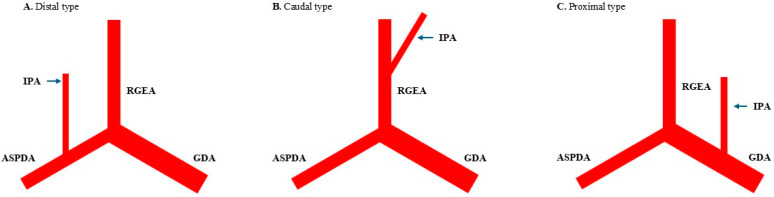 Figure 1
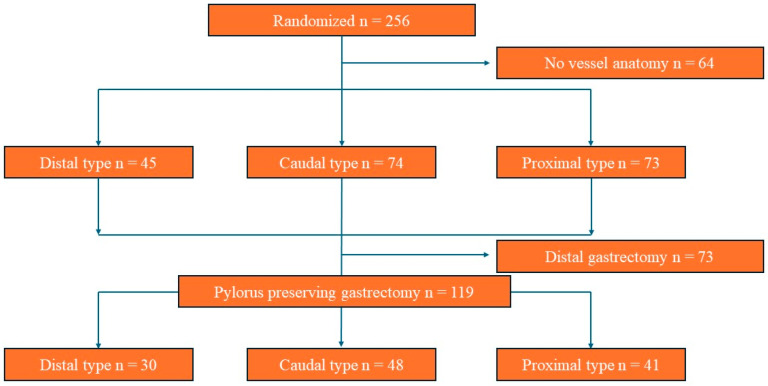 Figure 2
Peer Reviews
No public reviews on file for this paper yet. If you reviewed it on a platform where reviews are public (OpenReview, ICLR, NeurIPS, ICML), you can paste yours below so the community can read it here.
Videos
No videos yet. Explain this paper in a talk, walkthrough, or lecture? Add one.
Taxonomy
TopicsGastric Cancer Management and Outcomes · Gastrointestinal Tumor Research and Treatment · Esophageal Cancer Research and Treatment