Single-center retrospective evaluation of a polymerase chain reaction-based pneumonia panel on antibiotic therapy optimization at a community hospital
Luke Manda, Anthony Wasielewski, Nishika Patel, Timothy P. Gauthier

TL;DR
A PCR-based pneumonia test helped optimize antibiotic use in elderly patients at a community hospital by identifying specific bacteria in most cases.
Contribution
This study demonstrates how a PCR-based pneumonia panel can improve antibiotic stewardship in non-ICU elderly patients.
Findings
The PCR panel provided actionable results in 87% of 384 cases.
It enabled streamlining of antibiotic coverage for atypical bacteria, Pseudomonas aeruginosa, and MRSA.
Abstract
The implementation of a polymerase chain reaction-based pneumonia panel was associated with actionable results in 87% of 384 cases. In a population of mostly elderly non-intensive care unit patients with sputum samples, opportunities for antibiotic stewardship included streamlining for atypical bacteria, Pseudomonas aeruginosa, and methicillin-resistant Staphylococcus aureus coverage, with occasional opportunities to escalate antibiotic therapy.
Genes, proteins, chemicals, diseases, species, mutations and cell lines named across the full text — each resolved to its canonical identifier and authoritative record.
Click any figure to enlarge with its caption.
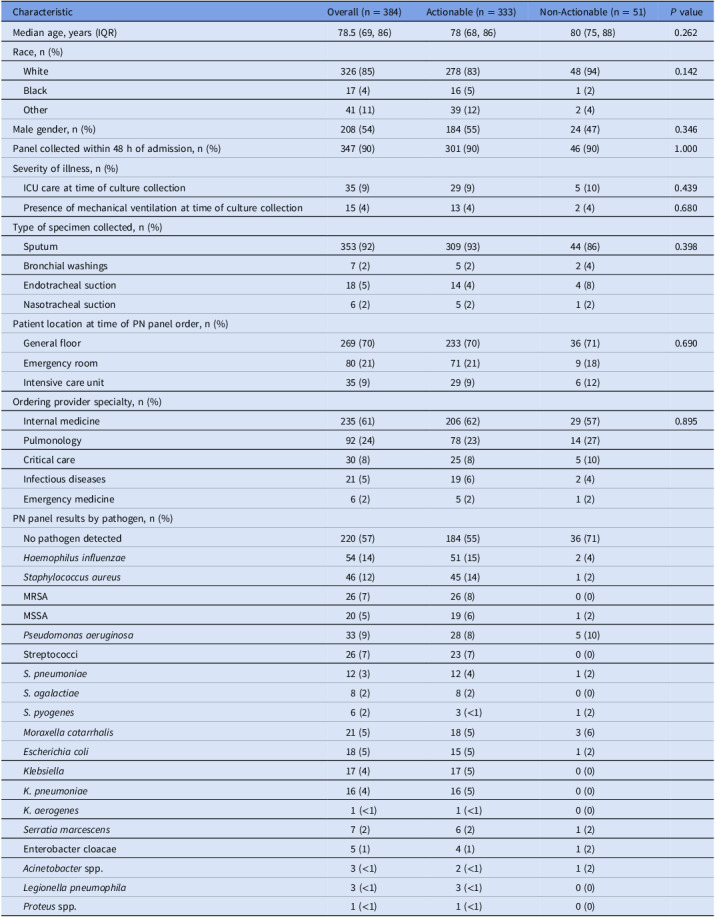 Figure 1
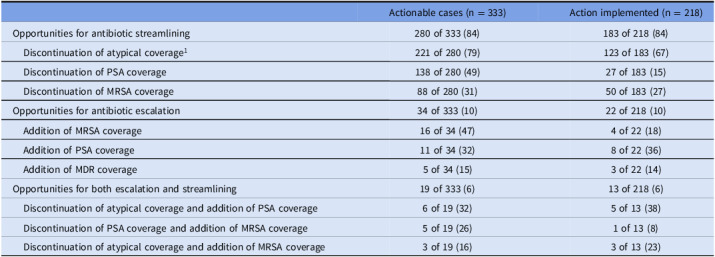 Figure 2
Peer Reviews
No public reviews on file for this paper yet. If you reviewed it on a platform where reviews are public (OpenReview, ICLR, NeurIPS, ICML), you can paste yours below so the community can read it here.
Videos
No videos yet. Explain this paper in a talk, walkthrough, or lecture? Add one.
Taxonomy
TopicsPneumonia and Respiratory Infections · Nosocomial Infections in ICU · Antibiotic Use and Resistance
Introduction
The availability of polymerase chain reaction (PCR)-based pneumonia (PN) panels in clinical practice is revolutionary to organism identification speed and has been shown to significantly reduce unnecessary empiric antibiotic use.^ 1 ^ Buchan et al reviewed patients with PN panel results, identifying opportunities for antibiotic adjustment in 71% of patients, with antibiotic discontinuation or de-escalation occurring in 48% of patients.^ 2 ^ Esplund et al examined the impact of a PN panel on an intensive care unit (ICU) population, finding opportunity for antibiotic changes in 75% of cases, an implementation rate of 54%, and shorter times to antibiotic changes by 29 hours with a 2-day reduction in median antibiotic days of therapy.^ 3 ^ Markussen et al evaluated the utilization of a PN panel within an emergency department, finding participants with PN panel results were not only 3.5 times more likely to receive pathogen-directed treatment, but they also received it 9 hours faster than patients without a PN panel.^ 4 ^
Indeed, there is a growing body of literature regarding the opportunity of a PN panel to enhance patient care; however, more data are needed to fully elucidate the best use of this emerging technology. The purpose of this study was to evaluate the impact of incorporating a PCR-based PN panel into the management of PN and to identify opportunities to optimize the interpretation and implementation of opportunities created by the panel results.
Methods
This retrospective, single-center study was conducted at a 400-bed community hospital. In December 2022, the BioFire® FilmArray® PN panel (33 targets, ∼1 hour turnaround)^ 5 ^ was introduced as an orderable diagnostic test for acute care respiratory samples. The PN panel results published between December 2022 and September 2023 were extracted from the electronic medical record by laboratory informatics. Patients were screened and excluded if pregnant, incarcerated, found to have positive extrapulmonary cultures, or received systemic antibiotics more than 72 hours prior to the PN panel collection time.
The primary outcome was the incidence of actionable PN panel results. An actionable PN panel result was defined as a result that indicated an opportunity for antibiotic escalation and/or streamlining for PN. PN panel results that failed to identify atypical bacteria, methicillin-resistant S. aureus (MRSA), Pseudomonas aeruginosa (PSA), or multi-drug resistance gene markers when antibiotics targeting those pathogens were being utilized were designated as streamlining opportunities, as were PN panel results that did not identify any pathogens when antibiotics were being utilized. Secondary outcomes included the implementation of actionable PN panel results, time to implementation, hospital length of stay, all-cause in-hospital mortality, readmission within 30 days of discharge due to any cause, and intervention by the antimicrobial stewardship program pharmacist. Implemented actionable panel results were defined as any modification of the antibiotic regimen that was concordant with the opportunity created by the actionable PN panel. Durations of targeted therapy for MRSA and PSA were evaluated for patients with the respective streamlining opportunity.
Statistical analysis was performed using the Kruskal–Wallis test for continuous variables and either the chi-squared or Fisher’s Exact test for categorical variables. Interquartile ranges from the first quarter to the third quarter were reported for time-dependent variables in addition to the median value. A prespecified two-sided P value of <.05 identified statistical significance. The study was approved by the local institutional review board.
Results
Of 507 patients screened, 384 were included in the analysis. Reasons for exclusion were positive extrapulmonary culture (n = 65) and receipt of antibiotics 72 hours or more before PN panel (n = 58). Actionable results were identified in 333 cases (87%). Baseline characteristics for the entire cohort as well as patients with actionable versus non-actionable results are displayed in Table 1. Concordant PN panel and culture results were found in 361 cases (94%). Of the 23 discordant results, 22 (96%) were PN panels that identified pathogens that did not grow on culture (including 9 related to MRSA and 4 related to PSA). One discordant result was identified for a negative PN panel, but PSA grew on culture. Pharmacist intervention was found for 24 cases (6%).
Table 1.Baseline characteristics including data on cases with actionable versus non-actionable resultsCharacteristicOverall (n = 384)Actionable (n = 333)Non-Actionable (n = 51) P valueMedian age, years (IQR)78.5 (69, 86)78 (68, 86)80 (75, 88)0.262Race, n (%) White326 (85)278 (83)48 (94)0.142 Black17 (4)16 (5)1 (2) Other41 (11)39 (12)2 (4)Male gender, n (%)208 (54)184 (55)24 (47)0.346Panel collected within 48 h of admission, n (%)347 (90)301 (90)46 (90)1.000Severity of illness, n (%) ICU care at time of culture collection35 (9)29 (9)5 (10)0.439 Presence of mechanical ventilation at time of culture collection15 (4)13 (4)2 (4)0.680Type of specimen collected, n (%) Sputum353 (92)309 (93)44 (86)0.398 Bronchial washings7 (2)5 (2)2 (4) Endotracheal suction18 (5)14 (4)4 (8) Nasotracheal suction6 (2)5 (2)1 (2)Patient location at time of PN panel order, n (%) General floor269 (70)233 (70)36 (71)0.690 Emergency room80 (21)71 (21)9 (18) Intensive care unit35 (9)29 (9)6 (12)Ordering provider specialty, n (%) Internal medicine235 (61)206 (62)29 (57)0.895 Pulmonology92 (24)78 (23)14 (27) Critical care30 (8)25 (8)5 (10) Infectious diseases21 (5)19 (6)2 (4) Emergency medicine6 (2)5 (2)1 (2)PN panel results by pathogen, n (%) No pathogen detected220 (57)184 (55)36 (71) Haemophilus influenzae 54 (14)51 (15)2 (4) Staphylococcus aureus 46 (12)45 (14)1 (2) MRSA26 (7)26 (8)0 (0) MSSA20 (5)19 (6)1 (2) Pseudomonas aeruginosa 33 (9)28 (8)5 (10) Streptococci26 (7)23 (7)0 (0) S. pneumoniae 12 (3)12 (4)1 (2) S. agalactiae 8 (2)8 (2)0 (0) S. pyogenes 6 (2)3 (<1)1 (2) Moraxella catarrhalis 21 (5)18 (5)3 (6) Escherichia coli 18 (5)15 (5)1 (2) Klebsiella 17 (4)17 (5)0 (0) K. pneumoniae 16 (4)16 (5)0 (0) K. aerogenes 1 (<1)1 (<1)0 (0) Serratia marcescens 7 (2)6 (2)1 (2) Enterobacter cloacae5 (1)4 (1)1 (2) Acinetobacter spp.3 (<1)2 (<1)1 (2) Legionella pneumophila 3 (<1)3 (<1)0 (0) Proteus spp.1 (<1)1 (<1)0 (0)Note. IQR, interquartile range; ICU, intensive care unit; PN, pneumonia; MRSA, methicillin-resistant S. aureus.
Classification of actionable results and those that were implemented is provided in Table 2. For implemented actionable results, the median time from PN result to antimicrobial regimen modification was 22 hours overall, with a median of 23 hours for streamlining opportunities and 15 hours of escalation opportunities. With respect to the time of the culture result, the opportunities identified by the PN panel results were implemented by a median time of 24 hours before culture results were finalized. Implementation of streamlining and escalation opportunities were implemented in a median time of 22 hours and 45 hours, respectively, before culture results were finalized.
Table 2.Classification of actionable pneumonia panel results and those that were implementedActionable cases (n = 333)Action implemented (n = 218)Opportunities for antibiotic streamlining280 of 333 (84)183 of 218 (84) Discontinuation of atypical coverage^ 1 ^ 221 of 280 (79)123 of 183 (67) Discontinuation of PSA coverage138 of 280 (49)27 of 183 (15) Discontinuation of MRSA coverage88 of 280 (31)50 of 183 (27)Opportunities for antibiotic escalation34 of 333 (10)22 of 218 (10) Addition of MRSA coverage16 of 34 (47)4 of 22 (18) Addition of PSA coverage11 of 34 (32)8 of 22 (36) Addition of MDR coverage5 of 34 (15)3 of 22 (14)Opportunities for both escalation and streamlining19 of 333 (6)13 of 218 (6) Discontinuation of atypical coverage and addition of PSA coverage6 of 19 (32)5 of 13 (38) Discontinuation of PSA coverage and addition of MRSA coverage5 of 19 (26)1 of 13 (8) Discontinuation of atypical coverage and addition of MRSA coverage3 of 19 (16)3 of 13 (23)Note. PSA, Pseudomonas aeruginosa; MRSA, methicillin-resistant S. aureus; MDR, multi-drug resistance. 1 Specific streamlining and escalation opportunities were counted per instance, not per patient.
Patients with actionable results that were implemented had a median hospital length of stay of 6 days versus 3 days for those with results not implemented (P < 0.01). All-cause mortality was 3% (n = 7) for patients with implemented results compared to 2% (n = 2) for those where it was not implemented (P = 0.72). Readmission within 30 days occurred in 29 patients (n = 13%) who had actionable results implemented versus 7 patients (6%) for those where it was not implemented (P = 0.19). Comparing results implemented within 24 hours (n = 118) to those implemented after 24 hours (n = 100), the median hospital length of stay was 4 days when implemented within 24 hours versus 6 days when implemented after 24 hours. Comparing patients with interventions implemented versus not implemented, no difference was found in all-cause mortality or readmission rates.
Discussion
This analysis found that a high percentage of PN panels result in actionable opportunities for antimicrobial stewardship. These actionable results mostly created opportunities for streamlining of atypical bacteria, PSA, and MRSA coverage, with occasional opportunities to escalate antibiotic therapy.
The patient population in this study was predominantly elderly and white, not requiring ICU-level care or mechanical ventilation at the time of PN panel collection. Internal medicine was the most frequent ordering provider type, and sputum specimens were the large majority of collected specimen types, often collected within 48 hours of hospital admission. Population characterization is important, as the lack of clinical benefit found within this study does not necessarily reflect a potential lack of benefit in a particular subgroup. For example, previous studies have demonstrated high sensitivity and specificity of the PN panel with bronchoalveolar lavage samples, while results from this study support the assertion that the PN panel maintains a high level of accuracy and reliability when utilized with sputum samples.^ 2 ^
This study is limited by the single-center observational design, dependence on accurate specimen collection, and lack of focused education to prescribers. A key component to introducing new tests is ensuring that actionable opportunities are implemented. Although approximately 9 in 10 tests had an actionable result, only 65% were implemented, and only about half were implemented within 24 hours. Consistent with suggestions from existing literature, incorporation of PN panel results into routine antimicrobial stewardship activities completed by pharmacists (including provider education) will be one next step, while implementing a clinical decision support system will be a second step.^ 6 ^ A clinical benefit is more likely to be observed if opportunities are acted upon more frequently and expeditiously.
Conclusion
Implementation of a PN panel can produce a large amount of actionable results, which can improve antibiotic streamlining and escalation, but implemented opportunities may not globally improve clinical outcomes.
The reference list from the paper itself. Each links out to its DOI / PubMed record.
- 1Niederman MS , Torres A . Severe community-acquired pneumonia. Eur Respir Rev 2022 ;31(166):220123 36517046 10.1183/16000617.0123-2022 PMC 9879347 · doi ↗ · pubmed ↗
- 2Buchan BW , et al. Practical comparison of the Bio Fire Film Array pneumonia panel to routine diagnostic methods and potential impact on antimicrobial stewardship in adult hospitalized patients with lower respiratory tract infections. J Clin Microbiol 2020;58(7):e 00135–20 32350045 10.1128/JCM.00135-20PMC 7315039 · doi ↗ · pubmed ↗
- 3Esplund JN et al. Clinical impact of a multiplex rapid diagnostic pneumonia panel in critically ill patients. Antimicrob Steward Healthc Epidemiol 2023;3(1):e 5 36714280 10.1017/ash.2022.358PMC 9879924 · doi ↗ · pubmed ↗
- 4Markussen DL et al. Diagnostic stewardship in community-acquired pneumonia with syndromic molecular testing: a randomized clinical trial. JAMA Netw Open 2024;7(3):e 240830 38446481 10.1001/jamanetworkopen.2024.0830 PMC 10918504 · doi ↗ · pubmed ↗
- 5Bio Fire® Diagnostics. Bio Fire® Film Array® Pneumonia Panel Instruction Booklet. The Bio Fire® Film Array® Pneumonia Panel | Bio Fire® Diagnostics (biofiredx.com). Access Date: 11.8.2023
- 6Timbrook TT et al. Current and future opportunities for rapid diagnostics in antimicrobial stewardship. Med Clin North Am 2018;102(5):899–911 30126579 10.1016/j.mcna.2018.05.004 · doi ↗ · pubmed ↗