Top 100 most-cited articles on pelvic organ prolapse: a visualization and bibliometric analysis
Lu Yang, Qin Tao, Huaye Wu, Litong Yin, Xuemei Wu, Ying Xiong, Xiaoqin Gan, Yonghong Lin, Xia Yu

TL;DR
This study analyzed the 100 most-cited papers on pelvic organ prolapse to identify key research themes and trends in the field.
Contribution
The study provides a comprehensive bibliometric analysis of the most influential research on pelvic organ prolapse, highlighting emerging trends like tissue engineering.
Findings
The top 100 articles were cited 26,894 times and mostly published between 2001 and 2010.
Epidemiological research and tissue engineering in treatment are the main focus areas.
The United States and the University of California, San Francisco, led in POP research output.
Abstract
Bibliometric analysis is a scientometric method that allows the quantitative analysis of publications. This study used the Web of Science database to perform a bibliometric analysis of the 100 most-cited articles in the field of pelvic organ prolapse (POP) to identify the key research themes and emerging topics within this area. We collected pertinent publications from the Web of Science Core Collection (WoSCC). The search was conducted using the following keywords: “pelvic organ prolapse”, “pelvic organ prolapse” or “pelvic organ prolapses”. The search included all publication dates up to June 27, 2024, without any article type restrictions, and the articles were sorted based on their citation count. The top 100 articles with the most citations were included in the subsequent analyses. Several tools, including the Bibliometrix program in R, CiteSpace software, the Online Analysis…
Genes, proteins, chemicals, diseases, species, mutations and cell lines named across the full text — each resolved to its canonical identifier and authoritative record.
Click any figure to enlarge with its caption.
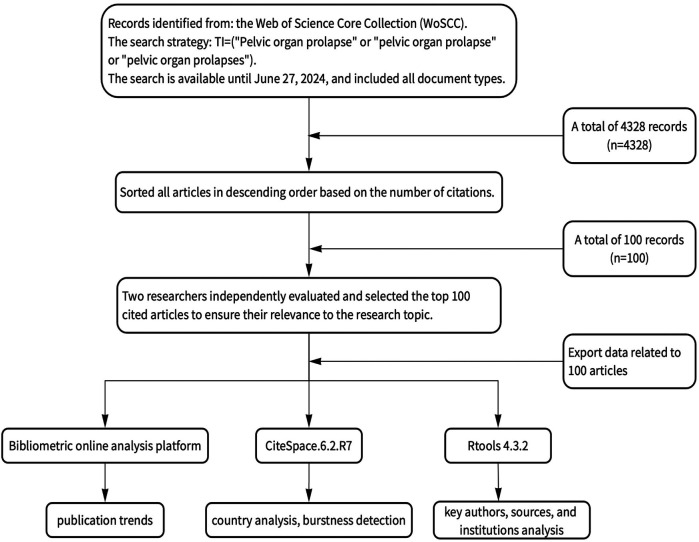 Figure 1
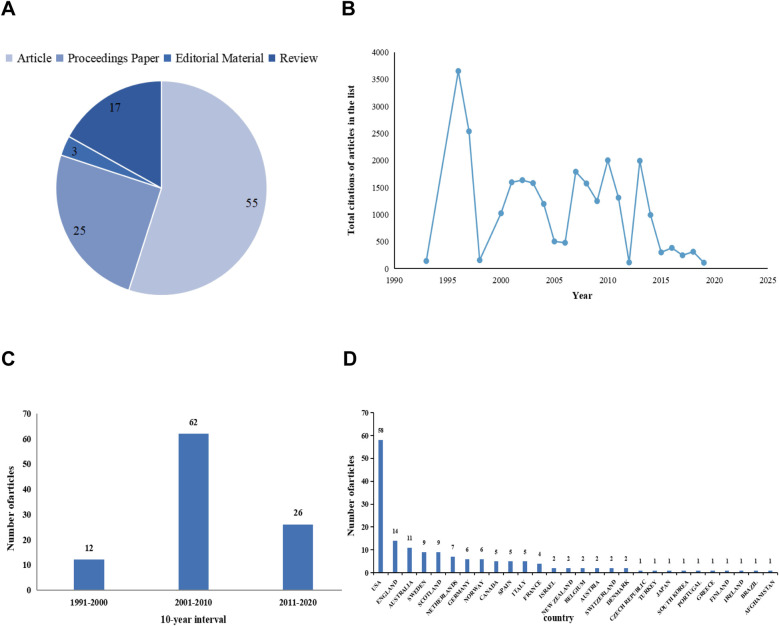 Figure 2
| Institution | Number of articles |
|---|---|
| Univ Calif San Francisco | 12 |
| Univ Aberdeen | 11 |
| Univ Michigan | 10 |
| Univ New Mexico | 9 |
| Karolinska Inst | 8 |
| Univ Pittsburgh | 8 |
| Univ Texas | 8 |
| Brown Univ | 7 |
| Cleveland Clin FDN | 7 |
| Madigan Army Med CTR | 7 |
| Obstet Gynecol and Womens Hlth Inst | 7 |
| Univ Med CTR | 7 |
| Univ Texas Sw Med CTR Dallas | 7 |
| Glasgow Caledonian Univ | 6 |
| Johns Hopkins Univ | 6 |
| Med Univ S Carolina | 6 |
| Radboud Univ Nijmegen | 6 |
| No. | Sources | Articles | Category quartile | 2023 impact factor | Total no. of citations |
|---|---|---|---|---|---|
| 1 | American Journal of Obstetrics and Gynecology | 28 | Q1 | 8.7 | 8,961 |
| 2 | Obstetrics and Gynecology | 22 | Q1 | 5.7 | 7,463 |
| 3 | International Urogynecology Journal | 17 | Q3 | 1.8 | 3,026 |
| 4 | BJOG-an International Journal of Obstetrics and Gynaecology | 4 | Q1 | 4.7 | 797 |
| 5 | Neurourology and Urodynamics | 4 | Q3 | 1.8 | 1,228 |
| 6 | Cochrane Database of Systematic Reviews | 3 | Q1 | 8.8 | 1,138 |
| 7 | European Urology | 3 | Q1 | 25.3 | 364 |
| 8 | International Urogynecology Journal and Pelvic Floor Dysfunction | 3 | Q3 | 1.8 | 805 |
| 9 | Lancet | 3 | Q1 | 98.4 | 842 |
| 10 | American Journal of Pathology | 1 | Q1 | 4.7 | 143 |
| 11 | American Journal of Roentgenology | 1 | Q1 | 4.7 | 171 |
| 12 | BJU International | 1 | Q1 | 3.7 | 110 |
| 13 | BMJ Open | 1 | Q1 | 2.4 | 111 |
| 14 | BMJ-British Medical Journal | 1 | Q1 | 93.6 | 111 |
| 15 | European Journal of Obstetrics & Gynecology and Reproductive Biology | 1 | Q2 | 2.1 | 179 |
| 16 | JAMA-Journal of the American Medical Association | 1 | Q1 | 63.1 | 381 |
| 17 | Journal of Clinical Investigation | 1 | Q1 | 13.3 | 108 |
| 18 | Journal of Sexual Medicine | 1 | Q1 | 3.3 | 102 |
| 19 | Journal of the American Association of Gynecologic Laparoscopists | 1 | Q2 | 1.843 | 120 |
| 20 | New England Journal of Medicine | 1 | Q1 | 96.2 | 432 |
| 21 | Ultrasound in Obstetrics & Gynecology | 1 | Q1 | 6.1 | 187 |
| 22 | World Journal of Urology | 1 | Q2 | 2.8 | 115 |
| Authors | Articles | h_index | PY_start | TC |
|---|---|---|---|---|
| Barber MD | 7 | 7 | 2000 | 2,110 |
| Maher C | 5 | 5 | 2007 | 2,167 |
| Nygaard I | 5 | 5 | 2002 | 2,595 |
| Weber AM | 5 | 5 | 1997 | 1,056 |
| Altman D | 4 | 4 | 2007 | 739 |
| Brubaker L | 4 | 4 | 2009 | 1,671 |
| Bump RC | 4 | 4 | 1993 | 3,820 |
| Cundiff GW | 4 | 4 | 1996 | 922 |
| Hagen S | 4 | 4 | 2010 | 746 |
| Handa VL | 4 | 4 | 1996 | 664 |
| Rogers RG | 4 | 4 | 2001 | 1,062 |
| Subak LL | 4 | 4 | 2001 | 916 |
| Word RA | 4 | 4 | 2002 | 481 |
| Types of study | No of articles |
|---|---|
| Guidelines/consensus | 7 |
| Meta-analysis | 3 |
| Reviews | 17 |
| Observational study | 56 |
| Retrospective | 21 |
| Prospective | 14 |
| Cross-sectional study | 21 |
| Experimental study | 17 |
- —National Natural Science Foundation of China
- —Natural Science Foundation of Sichuan Province
- —Sichuan Provincial Maternal and Child Medicine Science and Technology Innovation Project
- —the Yingcai Scheme, Chengdu Women's and Children's Central Hospital
- —Youth Innovation Foundation of Sichuan Provincial Medical
- —Health Commission of Chengdu
Peer Reviews
No public reviews on file for this paper yet. If you reviewed it on a platform where reviews are public (OpenReview, ICLR, NeurIPS, ICML), you can paste yours below so the community can read it here.
Videos
No videos yet. Explain this paper in a talk, walkthrough, or lecture? Add one.
Taxonomy
TopicsPelvic floor disorders treatments · Urinary Tract Infections Management · Pelvic and Acetabular Injuries
Introduction
Pelvic organ prolapse (POP) occurs when pelvic organs descend into or outside the vagina, leading to symptoms such as vaginal bulging, pelvic pressure, urinary incontinence, and pelvic or low back pain (1). The prevalence of POP varies from 1.9% to 46.50% globally (2–4), significantly impacting women's health and quality of life (5–7).
Research indicates a higher incidence of prolapse surgery among older individuals (8). With the aging population, the prevalence of prolapse in women is projected to increase to 4.9 million by 2050, which represents a 46% increase and poses a significant societal burden (9). Hence, it is important to review the relevant literature to understand current research trends and key areas of interest in POP.
Bibliometric analysis is a scientific research tool that can quantitatively analyze publications and is used extensively for processing large datasets. It enables the examination of research trends, productivity, scientific linkage patterns, and the impact of scientific literature across various fields (10–12). This tool is widely applied in the medical domain, with software such as CiteSpace to facilitate the visualization of bibliometric results (13–15). One method employed in this analysis assesses how frequently an article is cited by other researchers. The number of citations of an article is a crucial indicator of its influence, it not only reflects the research status in this field, but also provides an important reference and foundation for future research (16–18). Therefore, the articles with the highest citation rates are likely to have the most significant impact within their scientific community. In addition, we found that previous studies in different research fields conducted data analysis by including the top 100 most-cited articles, so we also included the top 100 most-cited articles in the analysis. The working flow chart of this study is shown in Figure 1.
The working flow chart.
While bibliometric analysis has been applied to study trends in female pelvic organ research (19), no bibliometric analysis has been conducted to reveal the research emphasis and trajectory on highly cited articles in POP. To fill this gap, we conducted a bibliometric analysis of the most influential studies in the field of POP.
Materials and methods
Data sources and search strategies
Relevant articles were identified by searching the Social Sciences Citation Index (SSCI) and Science Citation Index Expanded (SCI-Expanded) on the Web of Science Core Collection (WoSCC) to mitigate potential bias resulting from database updates. The following search strategy was used: TI = (“pelvic organ prolapse” or “pelvic organ prolapse” or “pelvic organ prolapse”). The search included all publication dates up to June 27, 2024 and all study types. A total of 4,328 articles were retrieved from the WoSCC database. These articles were then sorted in descending order based on the number of citations, and the top 100 most cited articles were selected for further analysis. Initially, the titles of the articles were screened, and the abstracts and full texts were reviewed as needed. Two researchers (LY and XY) independently evaluated each article to ensure its relevance to the study topic.
In the field of epidemiology, articles were sorted into specific groups according to the type of research conducted: (1) experimental study; (2) review; (3) meta-analysis; (4) guidelines/consensus; and (5) observational study (prospective analyses, retrospective analyses and cross-sectional studies). The impact factor (IF) of the journals was extracted from Journal Citation Reports (JCR), and tables and graphs were generated using Microsoft Word and Excel, respectively. The study involved the analysis of published articles, thereby obviating the requirement for ethical clearance.
Data analysis and data visualization
The data, sourced as a tab-separated text document from WoSCC, were imported into Bibliometrics' Online Analysis Platform for further analysis. The publication trends over the years were examined using the “Total volume” option.
The complete records and reference sources of the top 100 most cited articles were acquired in.TXT format from the WoSCC database. The identification of popular search terms was found based on burst points, while the countries of publication were obtained through a country analysis using specific parameters in the CiteSpace program.
Utilizing the Bibliometrix package in R (Version 4.3.2), we retrieved the top 100 articles, their associated citation counts and annual citations, and identified key authors, sources, and institutions from data stored in TXT format through the “Biblioshiny” web interface.
Quality control of bibliometric analysis
We took the following quality control measures: (1) Data cleaning: We removed redundant and erroneous data and ensured that all data were in a consistent format to improve the accuracy of the analysis. (2) Tool calibration: We used the latest version of the bibliometric tool and calibrated the output results by comparing them with existing standards and datasets. (3) Sample representativeness: When selecting literature data, we ensured that sufficient sample time periods were included to maintain the representativeness of the results. (4) Result verification: Our results have been cross-checked via multiple independent analyses to ensure reliability. In addition, we invited experts in the field to review our results to ensure validity. (5) Transparency: We have documented the methodological process in detail so that future researchers can reproduce the study.
Results
The top 100 most cited articles and the number of citations
Supplementary Material 1 provides a list of the top 100 articles with their citation counts and average citations per year. The total number of citations for these articles was 26,894, with individual citations ranging from 98 to 3,255, an average of 268.94 citations per article and a median of 162. The average was calculated to better reflect the overall average of the data. The median represents the middlemost data point. Compared with the average, the median is not affected by extreme values and better reflects the central tendency of the data.
Study types
Among the 100 articles analyzed, 55 were classified as original articles, 25 as proceedings papers, 17 as reviews, and 3 as editorial content (Figure 2A). The article with the highest number of citations, “The standardization of terminology of female pelvic organ prolapse and pelvic floor dysfunction,” was published in the American Journal of Obstetrics and Gynecology in 1996 and had 3,255 citations. This seminal work contributed significantly to the development of a standardized lexicon for characterizing POP and pelvic floor dysfunction in the female population.
(A) Document types pie chart; (B) total number of citations per year; (C) annual publication volume at 10-year intervals; (D) number of publications by country.
Total number of citations per year
Figure 2B represents the cumulative citations for the top 100 articles annually from 1993 to 2019. We refer to the method of analyzing the distribution of published papers at a 10-year interval adopted by existing studies, and conclude that the peak in article publications occurred between 2001 and 2010, as shown in Figure 2C.
Country analysis
After eliminating duplicate entries, 100 articles were analyzed using CiteSpace. The top-cited articles originated from 28 countries, predominantly the United States (n = 58), followed by England (n = 14) and Australia (n = 11). Together, these three countries accounted for 83% of the total publications. The distribution of article contributions by country is illustrated in Figure 2D.
Institution analysis
Table 1 displays a summary of institutions that authored six or more articles in the field of POP. Prominent contributors included the University of California, San Francisco (n = 12), the University of Aberdeen (n = 11), and the University of Michigan (n = 10).
Journal analysis
The search results from the WoSCC revealed that the 100 most cited articles were published across 22 journals, as shown in Table 2. We organized these journals by volume and included information on their 2023 IFs, JCR categories, and countries of publication. These data, sourced from journal citation reports, are crucial for assessing a journal's influence within the scientific community and identifying current research trends. The American Journal of Obstetrics and Gynecology was identified as the most significant contributor to research on POP, with 28 articles on the list and a total of 8,961 citations, boasting an IF of 8.7 in 2023. Following closely behind was obstetrics and gynecology. Notably, the Lancet held the highest IF for 2023 among these journals, at 98.4.
Author analysis
Overall, 454 authors were included in the 100 articles. The top 13 authors in the field of POP, each with a minimum of 4 articles, are presented in Table 3. The leading group was Barber MD, with 7 articles, followed by Maher C, Nygaard I, and Weber AM, with 5 articles each. Notably, a strong positive correlation was observed among the top 13 authors between their H-index and the number of articles on the list.
Clusters of keywords
The burstness detection by the CiteSpace can extract burst terms from a large number of subject words in the literature to identify the research frontier and development trend of a certain discipline. Through burst point detection using CiteSpace software, 62 prominent terms were identified. After redundant and vague terms were removed, the remaining citations were categorized into seven subgroups: treatment, outcomes, anatomy and symptoms, diagnosis and detection, pathogenesis and risk factors, implants, and research proceedings (Supplementary Material 2). Terms with greater strength are associated with more robust research fields. Further, the duration of the burst time directly correlates with the longevity of the epidemic in a given time.
In the treatment subcluster, there was a notable transition from conventional hysterectomy to diverse transvaginal or transabdominal repair surgeries (Supplementary Material 2a). Patient outcomes, including physical and psychological well-being and overall quality of life, showed relatively high levels of satisfaction, as indicated by the prominence of specific keywords (Supplementary Material 2b). Notable keywords in the anatomy and symptoms subclusters, such as endopelvic fascia plication and vaginal wall prolapse, along with floor disorders, demonstrated significant citation bursts, with the keyword “floor disorder” exhibiting a substantial burst factor of up to 2.57 between 2008 and 2013 (Supplementary Material 2c). Among these, the keyword “stress incontinence” had citation bursts over the past decade (Supplementary Material 2d). Within the pathogenesis and risk factors subcluster, keywords associated with citation bursts shifted from discussions on innervation to elastic fiber homeostasis, age, and childbirth (Supplementary Material 2e). Conversely, the implants subcluster was characterized by a single keyword related to the utilization of implants in pelvic repair surgery (Supplementary Material 2f). Lastly, in research proceedings, keywords such as “randomized trial” and “prospective randomized trial” have shown robust citation bursts (Supplementary Material 2g).
Article classification analysis
Table 4 shows the classification of the articles based on their study type, which includes experimental studies, observational studies, reviews and meta-analyses, and guidelines/consensuses.
Seventeen studies were experimental research conducted to identify the mechanisms underlying disease development and progression, compare treatment modalities, and monitor patient prognosis. Fifty-six articles were observational studies, employing prospective, retrospective, or cross-sectional designs. Twenty-one studies were cross-sectional, fourteen were prospective, and the remainder were retrospective studies. Experimental research aimed primarily to evaluate the efficacy and safety of treatments and explore personalized approaches. Additionally, seventeen articles were comprehensive reviews that addressed the pathogenesis of POP to treatment strategies for POP. Notably, only three articles were meta-analyses, providing evidence-based insights into nonsurgical and surgical interventions for POP. Furthermore, seven research articles outlined the fundamental principles, recommendations, and consensus reached by experts guiding clinical decision-making for healthcare professionals and caregivers.
A comprehensive examination of 33 research articles was performed to elucidate the key mechanisms underlying the onset of POP. Factors such as vaginal childbirth, forceps delivery, fetal weight, neuromuscular injury, racial disparities, obesity, changes in vaginal biomechanics, modifications in connective tissue structure and function, advancing age, increased body mass index, and other variables were investigated. The development of prolapse is influenced by multiple factors, with vaginal childbirth, advanced age, and increased body mass index emerging as the most prevalent risk factors.
Forty-six articles analyzed the treatment and prognosis of POP, assessed the safety and effectiveness of both surgical and nonsurgical interventions, as well as explored complications such as hysterectomy, abdominal sacrocolpopexy, vaginal sacrospinous colpopexy, posterior vaginal wall repair, mesh repair for anterior or posterior compartment prolapse, and pelvic floor muscle training. Moreover, reoperation rates were monitored for patients who underwent surgical treatment for POP. This condition impacts women throughout their reproductive years, prompting individuals of all ages to seek surgical intervention.
The research in three studies focused on imaging, specifically the use of ultrasonic diagnosis and dynamic MR imaging for the detection and measurement of POP. Furthermore, eighteen studies investigated symptoms and treatment, establishing standardized terminology and management strategies for patients with POP.
Discussion
In the fields of obstetrics and gynecology, POP is a significant research subject. In this study, we analyzed 100 articles to provide a thorough examination of the most frequently cited research on POP. Through bibliometric analysis, our aim was to systematically identify key research trends and advancements. Additionally, by categorizing studies based on topics and article descriptors, we highlighted critical areas within POP that are currently under investigation and may require further research attention.
Although the study of POP dates back to 1975 (19), our analysis revealed that the majority of highly cited studies were conducted after 1993. The period from 1993 to 2019 had the highest number of top 100 cited articles, with peak research activity observed between 2001 and 2010. During this timeframe, a total of 62 articles were published, with notable contributions in 2008 and 2009, adding 10 and 7 articles, respectively, to the list. Our current research trends align with bibliometric analyses in related areas, including studies on female POP, trends in pelvic floor reconstruction, and POP repair using mesh (19–21).
It is a well-established phenomenon that newer articles, despite potentially having a greater impact, may rank lower based on citations. This discrepancy arises from the lower number of citations for newer articles in their initial years and their limited time frame to accumulate citations, consequently leading to reduced representation in the top 100 article list (22). Recognizing the limitations of relying solely on citations as a metric of scientific value, we adopted citations per year as a more robust parameter for evaluating an article's enduring impact. Nevertheless, our analysis revealed that, even when ranked by citations per year, the most cited articles consistently maintained the highest total citation counts.
Topics related to POP span various disciplines, including neurology, urology, basic science, and general medicine, leading to the publication of highly cited articles in a range of journals. While a small number of articles (n = 4) were found in neurology journals, the majority were published in obstetrics and gynecology journals. This publishing pattern mirrors bibliometric trends observed in other fields, such as thyroid eye disease and regenerative endodontics, where top articles are predominantly found in specialized journals due to the focus on advancements appealing primarily to researchers and practitioners within the specialty areas (23, 24).
The preponderance of publications emanated from nations such as the U.S. (n = 58), with notable contributions from England, Australia, Sweden, and Scotland. In a bibliometric examination of POP from 2007 to 2016, Australia was not listed among the top five high-producing countries (25). Nevertheless, given the present surge in publications, numerous countries beyond the U.S. have made substantial contributions to the academic literature in POP research.
The top 10 academic institutions that contribute the most are mainly from the U.S. and the UK. None of the institutions with over six publications were linked to a developing country, and this could be ascribed to the delayed or slower advancements in research development in those regions.
The list predominantly featured original research articles, with review articles constituting less than twenty percent. Only three meta-analyses were included. Close to half of the articles addressed POP treatment, while approximately one-third explored the pathogenesis and pathophysiology of POP. This distribution underscores the importance of epidemiological research and treatment in POP, indicating the continued investigation on POP pathogenesis.
In our analysis, we observed a shift in anatomical research within the field of POP, from focusing on structural aspects to emphasizing the pelvic floor ligament. This finding is consistent with previous studies that explored the pathogenesis of POP at the microscopic level of the pelvic ligament (26). In addition, interest in the use of polypropylene mesh has increased, suggesting that tissue engineering has become a new research hotspot. This is consistent with the results of previous studies (19, 27). Furthermore, current research on POP involves the investigation of various cell types, including stem cells, primary somatic cells, and specialized cell lines (28, 29). Additionally, there is ongoing investigation of bionic scaffolds such as absorbable poly-4-hydroxybutyrate (30).
Bibliometrics, as a quantitative measure, primarily reflects an article's recognition within the scientific community rather than its quality and potential impact on research. Despite employing a rigorous analytical approach, our focus was limited to the top 100 most cited articles, potentially overlooking other valuable literature. Additionally, the “cumulative effect” of earlier published articles, influenced by varying publication times and the fact that low citations do not necessarily signify poor research quality, should be considered. Furthermore, while bibliometric analysis aids in identifying influential research, crucial factors such as research design and experimental method rigor are not factored in. In conclusion, the outcomes of our bibliometric analysis can provide insights into monitoring the latest developments and popular research areas in the field of POP.
The reference list from the paper itself. Each links out to its DOI / PubMed record.
- 1Mc Leod LJ Lee PE. Pelvic organ prolapse. CMAJ. (2023) 195(30):E 1013. 10.1503/cmaj.23008937553149 PMC 10446149 · doi ↗ · pubmed ↗
- 2Peinado-Molina RA Hernández-Martínez A Martínez-Vázquez S Rodríguez-Almagro J Martínez-Galiano JM. Pelvic floor dysfunction: prevalence and associated factors. BMC Public Health. (2023) 23(1):2005. 10.1186/s 12889-023-16901-337838661 PMC 10576367 · doi ↗ · pubmed ↗
- 3Benti Terefe A Gemeda Gudeta T Teferi Mengistu G Abebe Sori S. Determinants of pelvic floor disorders among women visiting the gynecology outpatient department in Wolkite university specialized center, Wolkite, Ethiopia. Obstet Gynecol Int. (2022) 2022:6949700. 10.1155/2022/694970035996749 PMC 9392642 · doi ↗ · pubmed ↗
- 4Malaekah H Al Medbel HS Al Mowallad S Al Asiri Z Albadrani A Abdullah H. Prevalence of pelvic floor dysfunction in women in Riyadh, Kingdom of Saudi Arabia: a cross-sectional study. Women’s Health (Lond). (2022) 18:17455065211072252. 10.1177/1745506521107225235100887 PMC 8811438 · doi ↗ · pubmed ↗
- 5Carroll L Sullivan CO Doody C Perrotta C Fullen BM. Pelvic organ prolapse: women’s experiences of accessing care & recommendations for improvement. BMC Women’s Health. (2023) 23(1):672. 10.1186/s 12905-023-02832-z 38114966 PMC 10729347 · doi ↗ · pubmed ↗
- 6Zhu Q Shu H Dai Z. Effect of pelvic floor dysfunction on sexual function and quality of life in Chinese women of different ages: an observational study. Geriatr Gerontol Int. (2019) 19(4):299–304. 10.1111/ggi.1361830811813 · doi ↗ · pubmed ↗
- 7Reis AM Brito LGO Lunardi ALB Pinto ESMP Juliato CRT. Depression, anxiety, and stress in women with urinary incontinence with or without myofascial dysfunction in the pelvic floor muscles: a cross-sectional study. Neurourol Urodyn. (2021) 40(1):334–9. 10.1002/nau.2456333150603 · doi ↗ · pubmed ↗
- 8Barber MD Maher C. Epidemiology and outcome assessment of pelvic organ prolapse. Int Urogynecol J. (2013) 24(11):1783–90. 10.1007/s 00192-013-2169-924142054 · doi ↗ · pubmed ↗