Nature's best vs. bruised: A veggie edibility evaluation database
Bidisha Samanta, Sriparna Banerjee, Ranadhir Das, Sheli Sinha Chaudhuri, Khalifa Djemal, Amir Ali Feiz

TL;DR
This paper introduces a database for evaluating the edibility of vegetables using automated methods to assess freshness and quality.
Contribution
The paper presents a new database specifically designed for training and validating automated vegetable edibility evaluation systems.
Findings
Automated methods for assessing vegetable freshness are effective but require suitable datasets.
Current techniques rely on deep learning to categorize vegetables based on morphology, texture, and color.
A lack of appropriate databases limits the effectiveness of these automated methods.
Abstract
In the realm of evaluating vegetable freshness, automated methods that assess external morphology, texture, and colour have emerged as efficient and cost-effective tools. These methods play a crucial role in sorting high-quality vegetables for both export and local consumption, significantly impacting the revenue of the food industry worldwide. Researchers have recognized the importance of this area, leading to the development of various automated techniques, particularly leveraging advanced deep learning technologies to categorize vegetables into specific classes. However, the effectiveness of these methods heavily relies on the databases used for training and validation, posing a challenge due to the lack of suitable datasets.
Genes, proteins, chemicals, diseases, species, mutations and cell lines named across the full text — each resolved to its canonical identifier and authoritative record.
Click any figure to enlarge with its caption.
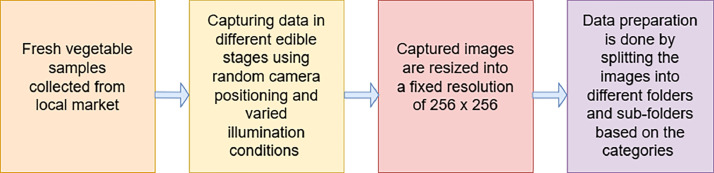 Figure 1
Peer Reviews
No public reviews on file for this paper yet. If you reviewed it on a platform where reviews are public (OpenReview, ICLR, NeurIPS, ICML), you can paste yours below so the community can read it here.
Videos
No videos yet. Explain this paper in a talk, walkthrough, or lecture? Add one.
Taxonomy
TopicsUrban Green Space and Health · Remote Sensing and LiDAR Applications · Remote Sensing in Agriculture
Specifications TableSubjectSmart Agriculture, Vegetable freshness evaluation, Deep Neural NetworksSpecific subject areaAutomated Vegetable freshness quality evaluationType of dataImages of vegetables from Fresh to Damaged to Severely DamagedData acquisitionImages of vegetables included in this dataset are acquired using varied camera angles, non-uniform illumination and consistent white background.Data formatRawDataset preparationVarious freshness stages of vegetables were captured using the high-resolution rear cameras of three different mobile phones. These images were saved in JPG format after resizing to a fixed dimension of 256 × 256 using a Python script. The resized images were organized into six folders: Cowpea, Snake Gourd, Spiny Gourd, Ivy Gourd, Taro root and Turmeric.Within these folders, the vegetable images were further categorized into six subfolders based on their freshness level: Fresh, Damaged, and Severely Damaged. All images were captured under different lighting conditions against a white background. This meticulously curated vegetable image dataset serves a vital purpose in the testing, training, and validation of automated models designed for evaluation of freshness levels of vegetables. Researchers and developers can utilize this dataset to enhance the accuracy and efficiency of their vegetable-related projects, benefiting from the diverse quality and type variations captured in the images.Data collectionImages of vegetables from Fresh to Damaged to Severely DamagedData source locationThis dataset is prepared at Jadavpur University, Kolkata, India.22.4989*°N, 88.3714°E*Data accessibilityRepository name: Nature's Best vs. Bruised: A Veggie EvaluationData identification number: 10.17632/b2mvj3kjfx.1Direct URL to data: https://data.mendeley.com/datasets/b2mvj3kjfx/1Related research articleNone
Value of the Data
1
- •This database contains a total of 4464 high-quality images of six different types of vegetables namely, Cowpea, Snake Gourd, Spiny Gourd, Ivy Gourd, Taro root and Turmeric.
- •Images included within each vegetable category are further categorized into three classes namely, Fresh, Damaged, and Severely Damaged.
- •The provided dataset offers a valuable resource for researchers working on deep learning solutions focused on classifying vegetables according to their freshness levels.
- •The dataset holds immense potential in the development of high-quality vegetable freshness evaluation applications.
Background
2
The principle objective behind the curation of this database lies in the development of an automated vegetable edibility estimation method. In order to design any automated method, apart from the architecture of the method, another crucial parameter based on which the performance efficiency of the designed method is largely dependent on lies in the varsities in characteristics of samples used to train the method. As the absence of proper database often hinders the development of proper methods mostly in computer vision domain, so this database is specifically curated to mitigate this limitation.
Data Description
3
Trading of vegetables contributes in earning a significant revenue by the agricultural industry. Exporting vegetables often takes a lot of time which significantly impact the freshness of vegetables. Hence automatic sorting of vegetable in a non-invasive manner has become essential for cost effective and time efficient processing. Due to the overwhelming performance achieved by the advanced deep neural technologies in various automated tasks, nowadays researches have come up with automated designs to efficiently classify the edibility of vegetables be leveraging the advanced deep learning techniques [[1], [2], [3], [4], [5]].
The research has pioneered the creation of a unique database named ``Nature's Best vs. Bruised: A Veggie Evaluation,'' featuring 4464 images representing six commonly consumed vegetables in India: Turmeric (Scientific name: Curcuma longa), Spiny Gourd (Scientific name: Momordica dioica), Taro root (Scientific name: Colocasia esculenta), Ivy Gourd (Scientific name: Coccinia grandis), Snake Gourd (Scientific name: Trichosanthes cucumerina) and Cowpea (Scientific name: Vigna sinensis Savi).
These specific vegetables were chosen due to their widespread consumption and affordability, particularly in rural areas, and notably, they were absent from existing databases. These particular six types of vegetables are chosen because of the diversities in their growing characteristics which portray how the degradation nature of the shoot vegetables differ from that of the root vegetables. Out of the six types of vegetables, Taro root and Turmeric are root vegetables while the other vegetables grow above the ground. The sample images of this newly curated database are shown in table format containing all the stages from Fresh to Damaged to Severely Damaged where Tables 1, 2, 3, 4, Table 5, Table 6 holds Turmeric, Spiny Gourd, Taro root, Ivy Gourd, Snake Gourd, Cowpea images, respectively.Table 1. Description of Turmeric sample images included in the nature's best vs. bruised: a veggie evaluation dataset.Table 1. Image, table 1Table 2Description of Spiny Gourd sample images included in the nature's best vs. bruised: a veggie evaluation dataset.Table 2. Image, table 2Table 3Description of Taro Root sample images included in the nature's best vs. bruised: a veggie evaluation dataset.Table 3. Image, table 3Table 4Description of Ivy Gourd sample images included in the nature's best vs. bruised: a veggie evaluation dataset.Table 4. Image, table 4Table 5Description of Snake Gourd sample images included in the nature's best vs. bruised: a veggie evaluation dataset.Table 5. Image, table 5Table 6Description of Cowpea sample images included in the nature's best vs. bruised: a veggie evaluation dataset.Table 6. Image, table 6
The sampling population of different types of vegetables considered for curating this database are:
- 1.Cowpea: 100 Samples
- 2.Ivy Gourd: 61 Samples
- 3.Snake Gourd: 99 Samples
- 4.Spiny Gourd: 104 Samples
- 5.Taro root: 48 Samples
- 6.Turmeric: 94 Samples
These are the number of samples whose images taken in different angles are included in the curated database. No additional augmentation is performed to increase the number of samples in the database. The inter-class variations in the number of samples makes the database imbalance which facilities its usage in evaluating the performances of the machine learning algorithms in handling imbalance dataset. However any user can perform augmentation and synthetically generate samples based on their requirements.
The images within our database authentically capture the natural progression of these vegetables, showcasing their transition from Fresh state to Damaged to Severely Damaged conditions, without any external manipulation. We classified these images into three distinct categories: Fresh, Damaged, and Severely Damaged. Fig. 1 displays the curation process of this database.Fig. 1. Steps adapted to curate the nature's best vs. bruised: a veggie evaluation dataset.Fig 1
This comprehensive database stands as a valuable resource for researchers in the field, addressing the crucial need for robust datasets and facilitating advancements in automated vegetable quality assessment techniques.
Examples of images included in this newly curated database are given in the following Tables:
Experimental Design, Materials and Methods
4
The high-definition rear cameras of OnePlus7T, Redmi Note 9 pro max and OnePlus Nord mobile phones were employed to capture the photographs of the vegetables. After capturing the images, they are resized to a fixed dimension of 256 × 256 using a python script and are stored in appropriate folders in .jpeg format. Table 7 contains the consolidated device camera specifications which are utilized to capture images.Table 7. Specification of image acquisition devices.Table 7. Sl.NoPropertiesCamera 1Camera 2Camera 31Device nameOnePlus7TRedmi Note 9 pro maxOnePlus Nord2Camera specificationsRear camera48 megapixel (f/1.6, 0.8 micron) +16 megapixel (f/2.2) +12 megapixel (f/2.2)Front camera16 megapixel (f/2.0, 1.0 micron)Quad camera64 megapixel (f/1.9, 0.8 micron) +8 megapixel (f/2.2) +5 megapixel (f/2.4) +2 megapixel (f/2.4)Quad camera48 megapixel (f/1.8, 0.8 micron) +5 megapixel (f/2.3) +5 megapixel (f/2.4) +2 megapixel (f/2.4)
Materials or Specification of Image Acquisition System
4.1
OnePlus7T camera specifications: 48 MP Ultra-wide Triple camera
Redmi Note 9 pro max camera specifications: AI Quad camera array 64 MP+8 MP+5MP+2MP
OnePlus Nord camera specifications: 48 OIS+8+5+2 MP Quad Camera, 32+8 MP Dual Front Camera
Method
4.2
All the vegetable species considered for designing this database are brought from local markets in fresh condition and are transformed from Fresh to Damaged to Severely Damaged stages under constant supervision in the laboratory. All of the steps adapted for the curation of this database is shown in Fig. 1 and Table 9 contains all the detailed information regarding the inter-class distribution among the various vegetable species considered while designing this database. The images included in this database are captured using varied camera angles, non-uniform illumination and consistent white background. The images captured for each class under each vegetable category are included into suitable folders after resizing them into a fixed resolution of 256 × 256 pixels and detailed information about all the image properties of this database is mentioned in Table 8. The inclusion of these diverse types of samples have enhanced the real-life effectiveness of this database enabling it to serve as a reliable one to perform training, validation and testing of methods designed to automatic freshness evaluation of vegetables.Table 8. Images details and quality.Table 8. Sl.No.Image detailsImage quality1Dimension256 × 256 pixels2Height2563Width2564Vertical resolution72 dpi5Horizontal resolution72 dpi6Bit depth247Resolution unit28Colour representationsRGBTable 9Nature's best vs. bruised: a veggie evaluation: dataset details.Table 9. ClassesVegetable SpeciesCamera angles, illumination and image background specificationsNumber of images included under each class for each vegetable speciesFreshDamagedSeverely DamagedCowpea (Scientific name: Vigna sinensis Savi), Snake Gourd (Scientific name: Trichosanthes cucumerina), Spiny Gourd (Scientific name: Momordica dioica), Ivy Gourd (Scientific name: Coccinia grandis), Taro root (Scientific name: Colocasia esculenta) and Turmeric (*Scientific name: Curcuma longa)Images are captured using varied camera angles, non-uniform illumination conditions in the presence of artificial light and using consistent white background, thereby ensuring the diversity in samples.FreshCowpea:203Snake Gourd:122Spiny Gourd:418Ivy Gourd: 246Taro root:228Turmeric:350DamagedCowpea: NILSnake Gourd:124Spiny Gourd:487Ivy Gourd:254Taro root:186Turmeric:335Severely DamagedCowpea:204Snake Gourd:123Spiny Gourd:420Ivy Gourd:254Taro root:186**Turmeric:324*
Limitations
None.
Ethics Statement
The research presented herein does not involve human or animal subjects. All images utilized in this work were self-acquired and do not include any sourced from social media platforms. Additionally, no external funding was received for the completion of this research.
Funding
This work is not funded by any sources.
CRediT authorship contribution statement
Bidisha Samanta: Methodology, Data curation, Investigation. Sriparna Banerjee: Conceptualization, Methodology, Data curation, Investigation, Writing – review & editing, Validation. Ranadhir Das: Methodology, Data curation. Sheli Sinha Chaudhuri: Supervision. Khalifa Djemal: Supervision. Amir Ali Feiz: Supervision.
The reference list from the paper itself. Each links out to its DOI / PubMed record.
- 1Suryawanshi Y.Patil K.Chumchu P.Veg Net: dataset of vegetable quality images for machine learning applications Data Brief 4520221610.1016/j.dib.2022.108657 PMC 967947436426086 · doi ↗ · pubmed ↗
- 2Firouz M.S.Sardari H.Defect detection in fruit and vegetables by using machine vision systems and image processing Food Eng. Rev.14202235337910.1007/s 12393-022-09307-1 · doi ↗
- 3Yuan Y.Chen X.Vegetable and fruit freshness detection based on deep features and principal component analysis Curr. Res. Food Sci.8202411010.1016/j.crfs.2023.100656 PMC 1076731638188650 · doi ↗ · pubmed ↗
- 4Wang W.Zhu A.Wei H.Yu L.A novel method for vegetable and fruit classification based on using diffusion maps and machine learning Curr. Res. Food Sci.8202411010.1016/j.crfs.2024.100737 PMC 1104606738681525 · doi ↗ · pubmed ↗
- 5Duth P.S.Jayasimha K.Intra class vegetable recognition system using deep learning Proceedings of the 4th International Conference on Intelligent Computing and Control Systems (ICICCS)202060360610.1109/ICICCS 48265.2020.9121164 · doi ↗