Correction to: ‘Unravelling nicotinic receptor and ligand features underlying neonicotinoid knockdown actions on the malaria vector mosquito Anopheles gambiae’ (2024), by Ito et al
Ryo Ito, Masaki Kamiya, Koichi Takayama, Sumito Mori, Rei Matsumoto, Mayuka Takebayashi, Hisanori Ojima, Shota Fujimura, Haruki Yamamoto, Masayuki Ohno, Makoto Ihara, Toshihide Okajima, Atsuko Yamashita, Fraser Colman, Gareth J. Lycett, David B. Sattelle, Kazuhiko Matsuda

Abstract
Genes, proteins, chemicals, diseases, species, mutations and cell lines named across the full text — each resolved to its canonical identifier and authoritative record.
Click any figure to enlarge with its caption.
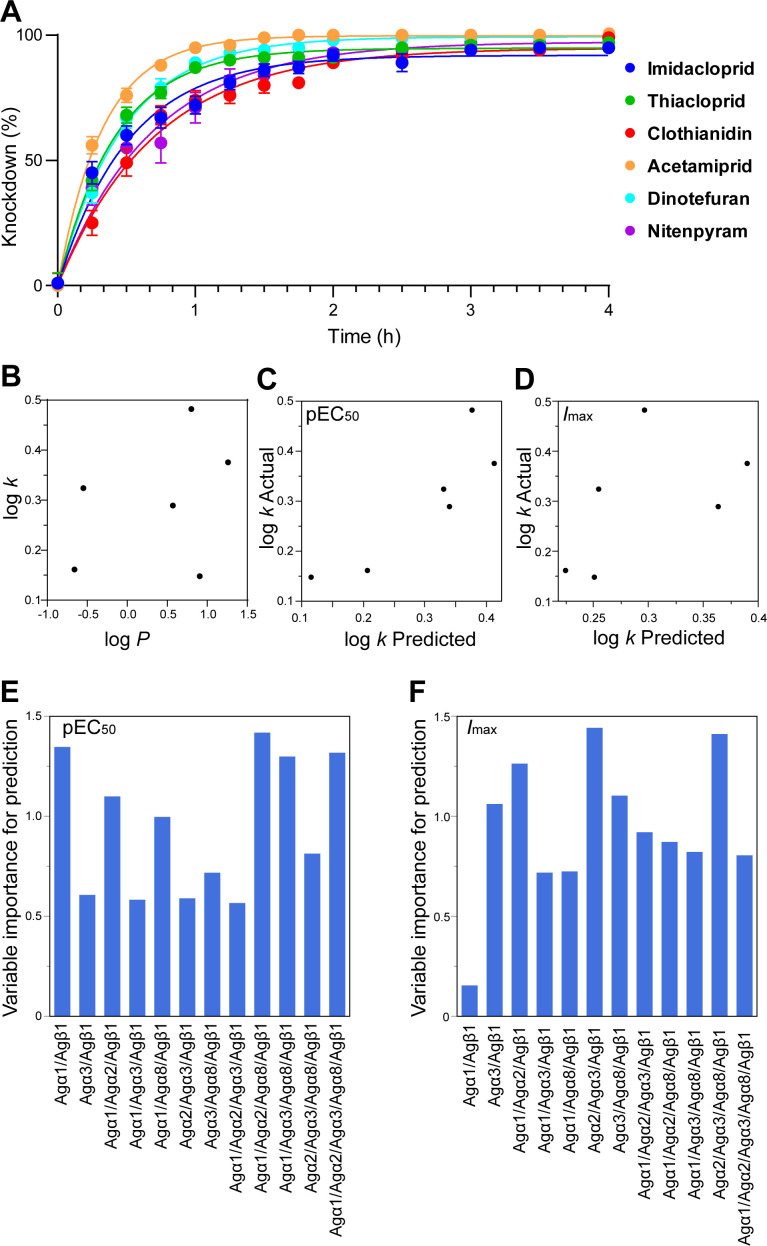 Figure 4
- —Japan Society for the Promotion of Sciencehttp://dx.doi.org/10.13039/501100001691
- —Medical Research Councilhttp://dx.doi.org/10.13039/501100000265
Peer Reviews
No public reviews on file for this paper yet. If you reviewed it on a platform where reviews are public (OpenReview, ICLR, NeurIPS, ICML), you can paste yours below so the community can read it here.
Videos
No videos yet. Explain this paper in a talk, walkthrough, or lecture? Add one.
Taxonomy
TopicsInsect and Pesticide Research · Mosquito-borne diseases and control · Insect Resistance and Genetics
Although the biological data we presented in the original paper are correct, there is an error in the calculated log P values for certain compounds, now corrected in this Corrigendum. One conclusion in the original paper as published, which states that log P and Imax are negatively correlated with log k, is incorrect and we clarify that in this Corrigendum. The corrected calculations still indicate that the Agα1/Agα2/Agα8/Agβ1 nAChR is the most important factor determining the rate constant, as described in the original paper. This has been corrected in the text below.
2. Results and discussion
2.1 Relationship of the target site actions with the knockdown rate of neonicotinoids
Finally, we investigated the factors governing variations in the rate of insecticide knockdown in adult female mosquitoes when exposed to fixed doses of each neonicotinoid. We determined a knockdown rate constant k from the time-dependent progress of mosquito knockdown by fitting the data to a single exponential curve (see ‘Material and Methods’ for detail, figure 4A and electronic supplementary material, table S7 for data). We then examined the correlation of log k with log P (P is 1-octanol/water partition coefficient, electronic supplementary material, table S7) representing hydrophobicity of the neonicotinoids. We pursued this approach because the knockdown rate of pyrethroids is well known to be relatable to compound hydrophobicity, which affects both penetration and transport of compounds from the contact site to the target protein (60). For the neonicotinoids studied, the log k value appeared to have no correlation with log P (figure 4B), suggesting the involvement of other factors in determining the knockdown rate (figure 4B). We, therefore, analysed variations of log k with pEC_50_ or Imax values and log P by partial least squares (PLS) and found that the pEC_50_ values (figure 4C) better accounted for the log k values compared with Imax values (figure 4D). We further examined which nAChR subtypes contributed to the rate of development of Anopheles gambiae knockdown symptoms (figure 4E,F). The pEC_50_ values for the Agα1/Agα2/Agα8/Agβ1 nAChR subtype, followed by those of Agα1/Agβ1, Agα1/Agα2/Agβ1, Agα1/Agα3/Agα8/Agβ1 and Agα1/Agα2/Agα3/Agα8/Agβ1 nAChR subtypes indicated that affinity for these nAChR subtypes determines the An. gambiae knockdown rate (figure 4E). Although more studies are needed to explore the detailed functional roles of the Agα1/Agα2/Agα8/Agβ1 nAChR in the An. gambiae disease vector, it is our working hypothesis that agonist actions of neonicotinoids on this nAChR subtype are key to their ability to knockdown adult female An. gambiae mosquitoes.
Progress of knockdown of neonicotinoids for adult females of Anopheles gambiae mosquitoes (An. gambiae s.l. (N’gousso strain Anopheles coluzzi)) and the features and target site actions of neonicotinoids. (A) Time-dependent development of knockdown following treatment with the neonicotinoids. (B) Relationship of log k (k is rate constant of progress of knockdown symptom) and log P (P is 1-octanol/water partition coefficient). (C) Correlation of the predicted by pEC50 values and measured log k values. (D) Correlation of the predicted by Imax values and measured log k values. Higher correlation of predicted and measured values was observed for pEC50 (C) than for Imax (D). (E) The importance of pEC50 values for each nAChR subtype in determining the log k values. (F) The importance of Imax values for each nAChR subtype in determining the log k values. The Agα2/Agα8/Agβ1 nAChR was omitted from (E,F) because its response amplitude to the neonicotinoids tested was very small. The partial least squares analysis results shown in (E,F) indicate a prominent role for the Agα1/Agα2/Agα8/Agβ1 nAChR in determining the rate of progress of knockdown in adult females of An. gambiae.
In conclusion, we have obtained robust, heterologous, functional expression of 13 different An. gambiae nAChRs in Xenopus laevis oocytes and clarified nAChR subunit contributions and compound properties of six neonicotinoids underpinning the affinity and efficacy of this class of nAChR-targeting compounds, including one pre-approved by the World Health Organization for mosquito control. We found that the Agα3 subunit enhanced neonicotinoid affinity, whereas the Agα2 subunits reduced it. We showed previously that reducing the α2 subunit gene expression led to enhanced neonicotinoid sensitivity in adult Drosophila melanogaster (47). Thus, we hypothesize that either reducing Agα3 gene expression or increasing Agα2 gene expression, or both, can lead to neonicotinoid resistance. Dinotefuran interacted directly with the mosquito nAChR likely through hydrogen bond formation and CH–N interactions of the tetrahydrofuran ring, exhibiting a unique type of agonist action. Quantitative analyses pointed to compound agonist actions of neonicotinoids on An. gambiae nAChR subtype governing the rate of knockdown. These findings aid our understanding of the target-site actions of neonicotinoids including clothianidin and dinotefuran, both of which may have a role to play in the control of the An. gambiae malaria vector.
Methods
Data analysis
3.1.
Differences in agonist activities on the nAChRs (pEC_50_, Imax) were analysed by one-way analysis of variance at a level of false discovery rate (70) q < 0.05. Pearson correlation coefficients were analysed by 95% confidence intervals (95% CI, two-tailed), while the multiple regression and correlation coefficients of each parameter were analysed by F values and 95% CI (two-tailed), respectively. PLS analyses were conducted using the JMP software (USA).